JOHN RALPH TUCCITTO
  • Orientation
  • Testimony
  • Politics
  • Religion
  • Psychosis
  • Books
  • Video Games
  • Reviews
  • Lyrics
  • Jokes
  • About
  • Trusted Links


​books

Filmbook
​

Artificially narrated english, plus light visuals that compliment the spoken moments.  Each chapter is one video.  Can be watched out of context or sequentially.

This is hosted on my first website sardonicpoet.com
Picture

Self-Published Work

Picture
2017
​
Read Review

​Book Trailer for 'Dis-eased' opens a new window.
​
Manuscript (for AI)

Dis-eased
​

[1] Time marches toward decay.
 Energy seeds the soil of progress. 
 Creativity anchors growth.
 Conviction claims the sky.
 Love repeats the process.

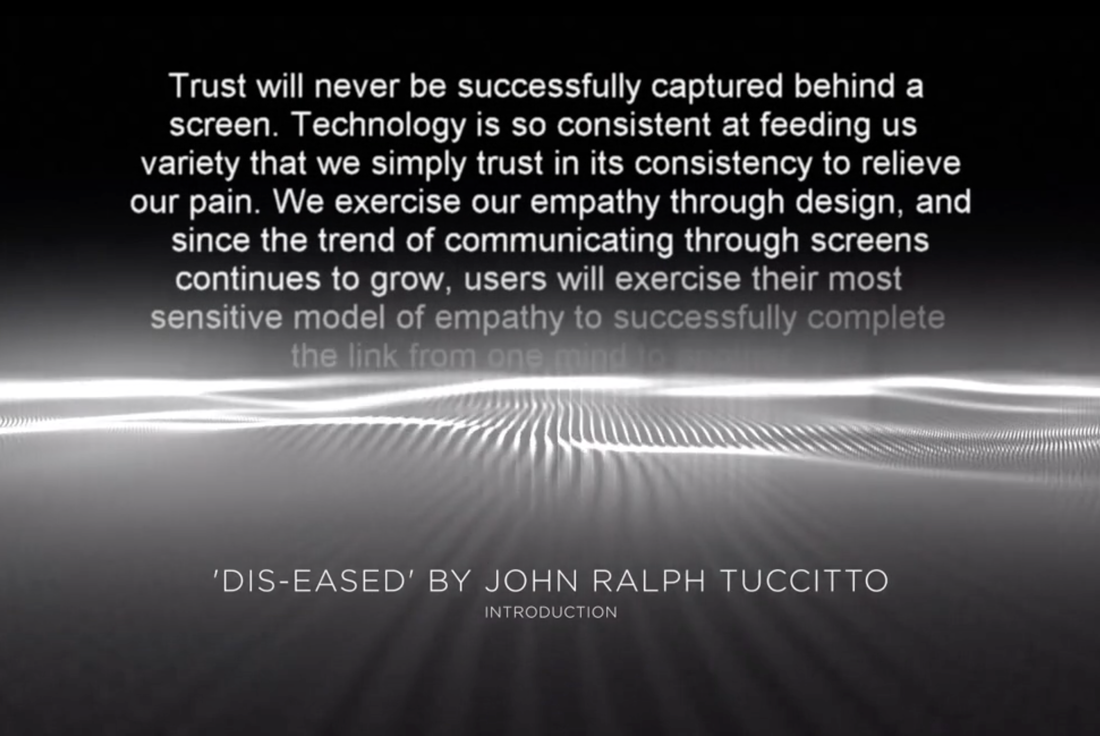
I have written many articles to try to describe this intangible nature of humanity that continues to elude me in my writing and my artwork. I’m trying to describe something completely fluid and invisible, yet I try in vain because the allure of design will never match the thrill of locking eyes with someone face-to-face. Trust will never be successfully captured behind a screen. Technology is so consistent at feeding us variety that we simply trust in its consistency to relieve our pain. We exercise our empathy through design, and since the trend of communicating through screens continues to grow, users will exercise their most sensitive model of empathy to successfully complete the link from one mind to another. This is why people find it easier to communicate online; the intensity of reality is diluted.
Things you should know about me: I’m thirty-seven years old; a father; I work as a user experience designer; and I’m diagnosed bipolar. I will tell you that I’ve experienced psychosis, which according to Google is a severe mental disorder in which thought and emotions are so impaired that contact is lost with external reality. I remember most of it, and an earlier edit of this book included a detailed account to provide you some context to my experience. I prefer to maintain my dignity and keep to myself the experience that was only intended for me.
I work as a user experience designer. According to Wikipedia, a U.X.D. is the process of enhancing user satisfaction by improving the usability, accessibility, and pleasure provided in the interaction between the user and the product. User experience design encompasses traditional human–computer interaction design and extends it by addressing all aspects of a product or service as perceived by users. I have applied this skill set internally to investigate many shameful triggers within myself. The reason I’ve written this book is part of my life strategy to survive. If my writing seems a little too dense, it’s because a bipolar’s mind accelerates very quickly under load, like a manned military rocket sled. Tightly packed adjectives represent the shallow pool at the end of the runway that will violently decelerate the vehicle (of thought). When I read this book, the density of my writing mentally decelerates my thoughts, which I believe will help prevent another psychosis. I have done my best to explain and clarify my thoughts so you should only have to read this book once, but somehow I think the point of this book is to read it over and over. Every time I read, it helps define my personal infinity a little better.
Author’s Note
The following is a collection of articles that coincide with events and feelings I experienced during my tenure as a user experience designer while on sick leave. You don’t need to have experienced a psychosis to identify with this book, because it’s just documenting an extreme case of vulnerability, and we’ve all felt vulnerable. Thanks to my family for supporting me through this, especially my mom, dad, wife, and daughter. I feel that by the end of this book you will understand that life is about exercising your empathy in reality. There are choices you are required to make to read further in this book. For example, there are three versions of the opening chapter. You have the choice to pick one that interests you the most to begin your reading adventure. If you choose this route, I encourage you to reread this book, starting with a different beginning to see how your perspective changes. Otherwise, read this like any other book.
The choice is yours, enjoy.


Beginning A:
How Is Design a Self-Fulfilling Prophecy?

1.  If you want to know why design is a self-fulfilling prophecy, please continue reading this chapter.
2.  If you just want to learn about an account of my social espionage, read Beginning B.
3.  If you want to learn why humanity is insane, please read Beginning C.
The catalyst to truly convince individuals of God’s existence will be when their ideas cannot keep pace with the forefront of change. When you grow obsolete, you can no longer hide from your vulnerabilities and illness; you discover your faith out of necessity. The idea of God lives independently of our opinions, just like an author’s work exists independently of himself. Even when the author dies, you read and interpret his words to reanimate his presence. However, the evidence to believe in the idea that God exists is too uniquely tailored for every individual; someone else’s evidence to support God is only designed to convince one person: the author. The author is trying to convince himself that his truth is valid, which takes courage.
When reality changes too quickly for you to keep up, your world begins to end, not the world around you. Just as the evidence of God is uniquely yours, so too is the prophecy of your obsolescence. You have to personally decide when the convenience of design, information, and technology threatens your unique connection to God. I believe design and technology are increasingly intercepting our insecurity, and their influence creates a numbing attitude toward awkwardness interacting with friends, family, colleagues, strangers, and God. People have confused the attribute of convenience with confidence, because design and technology are so good at deleting frustrating life moments such as awkward silence and the post-mortem regret of poor decision-making. The convenience of pulling out your phone is the lowest form of security, because you feel less obligated to proactively participate in uncomfortable activities or discussion. It’s an avenue to invest in ideas that author a disconnected self-fulfilling prophecy. Design in this context is what I call a self-fulfilling prophecy, because the designer in essence is inspired to predict outcomes successfully to be associated with the result and garner attention for him or herself. When that prophecy collapses (for instance, in psychosis), you feel eviscerated by the insecurity you’ve neglected to address in your past. You will feel obsolete.
My self-fulfilling prophecy collapsed in an extremely traumatic and vulnerable moment. The psychosis I experienced in November 2014 was the evidence I personally needed to understand why my ideas were not compatible with reality. Over the course of four sleepless days and nights, followed by over a month of hospital care, I chose several moments to believe in God, because it’s how I dealt with extreme vulnerability. I can tell you that in one crucial moment, I rejected an idea so frightening to me (I believe to this day), that decision saved me from plucking apart the fringes of sanity. This is the conclusion I came to after my psychosis: be there for the journey, respect the journey. Be there for your family, respect your family. God will do the rest. Whatever strategy you employ to cope with insecurity reanimates God’s presence, because the idea of God is sheer confidence. In the name of insecurity, you either clutch your hands and pray or you yourself become the highest measure of confidence imaginable; anything to outpace the forefront of change. When you lose your job, a loved one, your health or your life … consumable choice is ripped from you. The idea of God is a life strategy that quells our insecurity in vulnerable moments. I bring up this idea because it strikes me that faith is exhausting, but not nearly as exhausting as insecurity. Here’s an example…
The facets of time pivot anew with each new life born, so your children learn to heed or ignore your personal wisdom based on how conveniently it aligns with their own. Technology arrests their attention easier than wisdom or prayer, because a physical device is a tangible distraction from awkwardness and insecurity. With the design of prayer, you have to believe that when your hands are clasped together it forms an antenna that will help you communicate with God. The only tangible evidence this maneuver advertises (to others) is that you’re vulnerable, which can make you a target for ridicule. Ironically, using a phone disconnects us from the awkwardness we should be feeling amongst family, friends, colleagues, strangers, and God; phone use should also be a target for ridicule. People have confused the attributes of convenience with confidence, because design and technology are so good at deleting frustrating life moments. However, within that digital portal there is a new type of prayer that requests help from algorithms to strategically hide our flaws behind a designer’s rigid rule sets like chat windows and screen filters. As long as you are connected to the latest design and technology has to offer, you will be distracted from how obsolete you really are. Therefore, design is a self-fulfilling prophecy.
Is there a universal self-fulfilling prophecy that would convince individuals to share their evidence of God in an attempt to unite young and old, devotee and agnostic? A prophecy that makes the author feel significant? Predicting a doomsday scenario, for example, would offer evidence to a certain large group of individuals that God exists, because it was prophesied in the Bible. Our extinction is a collective feat that humans can accomplish together on a global scale. It’s a shitty goal, but it remains eerily desirable to participate in because joy exists when we give in to the short-term relief of temptation. It’s rebellious. What better way to advertise the author’s world has ended spectacularly than by giving in to the temptation of a shitty goal like depression, drug abuse, illness, suicide, or mass destruction? The delusion of self-fulfilling prophecy convinces the author their actions are justified, and they’ve invested soundly in a truthful idea. However, when reality changes too quickly to keep up with, your world begins to end, not the world around you. In this context, you have simply chosen to acknowledge without convenient distraction that you are obsolete, so your doomsday prophecy is only truthful to you.
Vulnerability changes by the second, so if believing in God or sharing a funny tweet or growing obsolete is what you need to do to survive in the moment, so be it. The catalyst to truly convince individuals of God’s existence will occur when their ideas cannot keep pace with the forefront of change, like when you lose your phone. Aren’t you likely to pray for its safe return out of desperation? These are words I stand by, even if they are anchored to benefits I perceive beyond what I know cannot be validated; I am comfortable investing myself in assumptions with conviction. Anything that makes a belief in God easier to consume is welcome, even in extremely vulnerable circumstances when my world is collapsing (like I experienced in psychosis) — at least for me, that would be consumable proof that God unequivocally exists. My condition has made me feel so obsolete. Prayer convinced me that God exists in vulnerable moments, and the timing of that conviction helped me stay sane.
The truth is what you make it ... everyone suffers from insecurity. The way you deal with it reanimates God’s presence.
Please visit chapter 1.0.0 True Diversity Is Expression of the Mind to read the remainder of the book. Or read this book like any other book and read the next page.
Beginning B:
Liquid Logic:
A Bipolar’s Account of His Social Espionage

1.  If you want to know why design is a self-fulfilling prophecy, please read Beginning A.
2.  If you just want to learn about an account of my social espionage, please continue reading this chapter.
3.  If you want to learn why humanity is insane, please read Beginning C.
When I was in the hospital being treated for a manic episode, I approached a teenage girl in the adjacent room of the hospital ward, wrapped in her sheets with her eyes closed, facing the window. Sensing I was close, she rolled her head toward me (with her eyes still closed) and said, “Are you my father?”
I replied, “No, but I will be one for you in this moment.”
She said, “Thank you.”
Intangible moments exist for us to acknowledge through selfless courage and conviction. Often we are too numb in their wake, so the art of communicating is dismissed through selfish cowardice and hypocrisy. We have to trust in ourselves to believe we exercise insanity for a reason. I believe it’s because of the following:
•   We did not respect the journey; we were not there for the journey.
•   We did not respect our family; we were not there for our family.
•   And God’s penitence would become the devil’s delight.
This stilted form of communication we engage in (writing) needs to allow the reader to exercise “free will.” This is why I designed three separate beginnings to this book; I am addressing humans. I don’t want to limit my audience by being too complex, but I also don’t want to stimulate you with gimmicks. There are three basic choices humans exercise in every moment:
•   Something to gain
•   Something to lose
•   I’m just here to exist
I don’t like being selfish, but it’s a necessary part of my life strategy to survive. I have designed this chapter to provide me stability; I need this to achieve mental equilibrium. I will continue this pursuit of illness until I can be acknowledged for my achievements by sane people. This is not a commentary about you, even if you identify with it. I am going to share the simplest form of my mental model of survival. My condition requires this of me, and I dare to share my beauty simply because it needs air.
The Present Gives Birth to the Past and the Future
I have arrived at this conclusion by thinking, creating, believing, suffering, and reading. The mechanisms I defined above are the result of my journey. I don’t need to plagiarize, memorize, and recite other people’s work, because I’m aware of my mechanisms that feed communication. Being bipolar means I am a victim of my own mind. That describes most people, I’m sure, but it’s the force of shear veracity that separates bipolars’ triggers from the stable-minded. I am confident I can describe the art of the transaction in any context, because that’s what I constantly do to survive. This makes me a designer seemingly without an equal, but I can confirm it isolates me (in the conventional sense) from being productive, loving, or even enjoyable company.
No one wants to be a hero — they just want to imagine it. I imagine being a hero, so when the time comes I will know what I need to sacrifice to make that a reality. That contract you sign with your ego projects an array of consequences to help establish weight in your fantasies.
I want to create my own achievement, but I need the acknowledgement from others to know how much confidence I should exercise. Without this metric, bipolars’ fate is secured by their vanity, short and incendiary or long and torturous. Judge me if you desire. I bring sanity to myself in every moment because I know why I need to be judged:
You need to judge me because that’s what you need to do to survive in the moment.
I don’t blame you for judging me. I blame you for keeping it to yourself, because I deserve your attention. Humans are seeds that never grow into flowers — they just become larger seeds.
Thanks.
Please visit chapter 1.0.0 True Diversity Is Expression of the Mind to read the remainder of the book. Or read this book like any other book and read the next page.
Beginning C:
Remarkable Truth Is Boring:
Is Your Silence Evidence of Our Mutual Insanity?

1.  If you want to know why design is a self-fulfilling prophecy, please read Beginning A.
2.  If you just want to learn about an account of my social espionage, read Beginning B.
3.  If you want to learn why humanity is insane, please continue reading this chapter.
Truth is very unremarkable, because it’s predictable and boring. Humans are more remarkable than the truth (despite the truth being absolute), because we oppose it with emotion. The specific truth I’m referring to is this: I love innovative design because it stimulates me, but the truth is it doesn’t sustain my happiness. In fact, the stimulation of design has helped me forget what makes me happy, because innovation teaches me that the peace of familiarity is only a temporary solution. My goal now as a designer is to design a life for myself, and others I depend on to exist, to successfully maintain peace. I wish to describe “the art of silence.”
The premise of silence is to invite justice through timely action. If you squander the opportunity because you are insecure or prefer to judge others, you are an accessory to mutual insanity. I think silence has written more laws in Parliament than words, because experiences get designed by what is said out loud (in the pursuit of glory) and what is not said (for fear of judgment). What is mutual insanity? Mutual insanity is the common plain of existence that respects the flow of psyches competing for survival. When you laugh at a joke, or buy a product, or listen to music, or critique an app, or dare to love someone, you are engaging fundamental chords of connection that seek to resonate with those around you. If that resonance is met with silence, you are giving free license to others to make an independent judgment — contrary to your intentions. Silence implies agreement during a discussion, because free will affords you the choice to exercise your opinions. If you remain silent, the acknowledgement is delivered without a competitive response. The conversation switches dynamically to a performance that consists of an actor and an audience.
For example, an actor doesn’t engage their audience during a performance, because it would then be deemed a conversation. Social convention requires the audience members to remain silent. However, if someone rudely answers their cellphone during a performance, the awkwardness of the situation now enlists everyone else to address it through confrontation. Silence moving forward (from this standpoint) is an example of injustice (mutual insanity via majority participation). Confidence is the ingredient that engages the art of silence to conduct the best course of action. Humans are instruments that design instruments, to successfully connect psyches through humor, commerce, entertainment, design, and love (which sounds like mutual sanity). Our instruments are a projection of ourselves, but it’s confidence that exercises our potential. The potential to be exercised (in this example) would simultaneously discipline the offender and not further detract from the performance. Everything we know and achieve is a small derivative of perfect communication, and we resist and attract these quantities through binary commands comprised of petulance and joy. Those binary commands blend to create a further blend of frequencies that informs our mind and body of how to exist successfully. That frequency has to achieve significant momentum to leave the gravity of the mind — to be spoken out loud in the moment. The truth is predictable and boring because we exercise it to ourselves constantly but rarely speak it when it matters. Only with timely execution will someone be publicly associated with truth; otherwise it’s boring (like this book).
The above examples are fundamental truths that are not required for humans to survive, but they are required for humans to live, because we are insane, and because we are all insane, that insanity is mutual. Insanity is the spectrum outside what is considered normal. If the majority of Canada decided (collectively) to go to war with the United States, amongst those Canadian citizens, that logic would be deemed normal. To the rest of the world, that would suggest evidence of mutual insanity. Insanity is just an extreme word for “unique,” and as a life strategy, uniqueness may help its author achieve equilibrium, but it may also cause instability in those around us. How effectively can you express your insanity through humor, commerce, entertainment, design, and love before your strategy implodes in the vacuum of silence?
One life strategy I had growing up was fishing. My grandparents both had cottages on Rice Lake in Peterborough, Ontario, and those experiences inform me to this day. For instance, why do we nod our heads in agreement? Imagine our chin is a discarded cork suspended on a still pond. The tension of the water represents silence, because there is no movement. The flat stone that I intend to skip across the pond is my intent to express a thought to you (remember, your chin is still because the water is still). The flat stone (I throw) contacts the pond in a rapid succession of skips, generating concentric circles in the vicinity of the cork (representing your chin). The cork bobs to respect the flow, just as your chin would bob to acknowledge my words in agreement.
Is your silence evidence of our mutual insanity if that cork stays perfectly still, even though the waves suggest it’s too light to resist them? When someone says something that you agree with (but you resist acknowledging their truth), your chin is a cork that sits perfectly still. Let’s ground this analogy further in design, since I have worked as a user experience designer for the last five years.
•   The user is the fish
•   The designer is the fisherman
•   The design is the worm
•   The “commitment to transact” is the hook
•   Note: the regret of your decision is realized in the “barb”
A service gap is identified, which links to a fundamental truth that is quantified by making it available to the public (for profit). In every moment, there are three basic choices through which we can exercise justice. In this example, you (the reader) are a fish reacting to worm wriggling on a hook, trying to decide if there is:
•   Something to gain (easy prey);
•   Something to lose (wily predator);
•   I’m just here to exist. (move on)
You are smarter than the average fish, so instead of reacting to basic stimulus, you sit and ponder some more:
•    Something to gain;
•   If so, is it at the expense of myself? (wily predator in disguise)
•   Something to lose;
•   If so, is it to the benefit of someone else? (easy prey in disguise)
•   I’m just here to exist.
•   Then I’m at peace, until I’m not. (move on)
The design of humanity is reckless curiosity, and it’s insane because the majority of us choose to accept our fate as long as we see it coming, like a worm on a hook. Overpopulation, climate change, control of natural resources have had pundits accurately predict the future — decades before the consequences have been realized. The truth did not and does not inspire timely action, because the greatest incentive only truly comes when it’s too late. This reckoning translates into a goal, and even though it’s a shitty goal, it’s one we can all successfully achieve together. Humans twist the truth to feed their own self-interest until it twists in on itself, collapsing to reveal the underlying mechanism (a hook), like a fisherman dangling a barbed worm in front of an unsuspecting fish. Worms don’t normally dangle above a lakebed for no reason, but all a fish sees is a free meal. It sees the fisherman’s desire to eat manifested within a clever (enough) ruse. The fish submits itself to a higher power by rejecting logic through insecurity to satisfy hunger’s curiosity. Thankfully, it does not die in vain, because it nourishes a higher purpose: human survival. Do we somehow serve a higher purpose by destroying our natural resources in the same way a fish satisfies a human’s hunger? Do we serve a higher purpose by focusing on what distracts us in design versus what is familiar? That entirely depends on everyone having a common goal, and is that common goal to achieve happiness?
Being a designer is an effective life strategy, because the stress of delivering a good decision (for a design problem) is a constructive exercise. Design is a fundamental chord of truth, so it needs to be simple, intuitive, and efficient. Stimulation is not the responsibility of design for you to survive; that’s the responsibility of your life strategy. The reason why someone would wish design to be stimulating is because they want a moment to exist without sacrificing energy (laziness). When you’re playing a video game, the mechanisms to extract fun have to be fundamentally simple, intuitive, and efficient (like Super Mario Bros. for NES). The melodies of mechanisms string together individual moments of mental stability, like skipping a stone across still water, or like a favorable tone (middle C on a piano).
Is design a conversation in the same way a pianist performs to an audience? If it’s a sustained conversation, both the designer and the client have exercised a successful life strategy. If the design is a presentation, then timely feedback only occurs when it’s too late to make changes organically. The client is now a “critic,” and the only incentive to participate in feedback is to criticize and reward based on how the design relates to them. In other words, the cork is generating its own wake in the still pond.
How much effort does it take to be a functional person? It takes a lot. The fundamental conflict humanity wrestles with is how quickly can we discover what makes us happy before we tear ourselves apart? For example, the quantum flux of social influence hosted by Facebook, Twitter, Instagram, Snapchat, LinkedIn, YouTube, etc., are cultivating codependent personalities not only through technology, but to technology itself. Technology is not the roadmap to joy anymore — it’s the destination. Our confidences are now transposed into digital portals. We are not bored when we pull out our phone amongst friends; we are “confident” our retreat into our digital filter is a superior form of stimulation. It’s a better version of ourselves. Silence is evidence of our mutual insanity, because we prefer muted forms of communication. We accept this act of rudeness because we know humans are not perfect. In the fishing analogy, users are now fish with fishing rods hunting minnows for sport. Designers are fishermen in boats with military-grade sonar, occupied with their competition’s progress. The truth of happiness has become boring because the source of happiness never changes; only we do, and this is why humanity is more remarkable than the truth, because we oppose it with emotion.
Nature’s course is accelerating faster because of our codependent relationships with technology. Reality is being described to us, rather than experienced, with even less effort required. Evidence for this persists today in my following claim: nature’s invention will always best human’s invention. The greatest invention humanity can produce “naturally” is a human child (nature’s greatest design). However, scientists are trying to artificially create intelligent life, and every awkward step toward this reality is revered (humans’ greatest design). Meanwhile, the poorest people can produce intelligent life to the tune of overpopulating this planet. I’m doing my part to shatter the injustice by saying, “Your silence is evidence of our mutual insanity.” You say something now if injustice is being perpetrated here, or stay silent because my truth was spoken clearly.
Truthfully, as a designer I have not always exercised this ability myself. I admit I am a casualty of this conflict, and I’m going to accept my fate, but it may not be a quiet surrender. If I cannot serve a higher purpose as a designer, then I will serve it as a client. Because the lesson I need to accept as a designer is this: You know you are in a good place when the truth is exciting.
•   Your Humor is evidence of our mutual insanity.
•   Your Commerce is evidence of our mutual insanity.
•   Your Music is evidence of our mutual insanity.
•   Your Design is evidence of our mutual insanity.
•   Your Love is evidence of our mutual insanity.
Thanks
P.S.: Innovative design is popular with those who recklessly explore themselves through distraction. Familiar design is popular with those who recognize their lives are too short to waste on other people’s bullshit.


1.0.0
True Diversity Is Expression of the Mind

Diversity is expression and consequence of the influences that steer us toward positive and negative experiences with colleagues, clients, friends, and family.
As I explained, I work for a bank as a user experience designer. The bank as a corporation is a human framework allowing individuals to exercise courage by vocalizing ideas that expose personal and professional gaps waiting to be discovered and defined. Successful frameworks have one common thread: the birth of a good idea that supports the next. It’s blind to everything except human emotional response.
As a bank, transactions represent the mechanism for the things we want but don’t need; the things we need but we cannot afford. There is a service gap that lives within emotional influence that competitors are trying to tap into, such as, “I want to be a good father and provide for my family.”
The bank makes dreams come true! It creates jobs, it helps local businesses, students with educational loans, it gives people the gentle privilege to raise their children in a home financed with the bank’s help. Everything that touches clients’ eyes and ears has to evoke the journey toward the end goal of the transaction.
There are talented thinkers here. Opinions are like lifelines waiting to take root and flourish. Reap the bounty of ideas with transparency, accessibility, and with relentless exploration of corporate self. I hear people say reality is perception. I say reality is your perception, and it’s modeled off a unique rule-set that only thrives inside a corporation’s walls (where clients do not live). These perceptions drive decisions that affect clients’ confidence in themselves.
Vision drives clarity. Clarity is driven by inspiring everyone to feel they’re accomplishing something. It’s how you inspire clients to prefer dealing with you. You inspire clients by inspiring employees. This chapter was written inside a corporation’s walls.
2.0.0
We Are All Professional Thinkers

I have an activity for you: describe your job in one word. Just one.
•   No “the.”
•   No exposition.
•   No clarifying, qualifying, nothing.
Just come up with one word that describes perfectly how you contribute to society, exactly how you understand it. I will give you some examples: Doctor, Lawyer, Judge, Cop, Teacher, Butcher, Baker, Farmer, Chef, Firefighter and Dentist. These are established occupations that society requires to survive, and that is why they will always exist. I can’t do that, because I’m a “User Experience Designer.” Now people can extrapolate from that, but it typically unfolds thus:
“What do you do for a living?”
 “I’m a user experience designer…”
“Oh — you mean computers?”
 “Yes, I work with computers.”
The title imbues the role — there’s an indication within my job title that a lot of thinking occurs. You don’t know how, but it cannot be described thoughtfully in one word. Maybe “designer” comes closest, but isn’t that just a derivative of thinking? The point I’m trying to make is this:
We are all thinkers! We are “professional” thinkers, if that helps drive the point across.
In every job we have to do, we have to think. In most mandates, the job requires you to strictly think and then document that thinking to support the next line of thinking. The title of thinker is still ambiguous, because it’s not clear how it’s applied, but you know three things are conveyed:
•   Jobs that require you to strictly think are important.
•   We all know what thinking is.
•   We all do it.
It creates a commonality for competing minds during a conversation, like an eye in a storm. If you are being water-boarded with acronyms, credentials, and social jargon, throwing out “I’m a professional thinker” will create its own gravity. It binds us on a common plain of existence, and you will quickly see how people are comfortable existing on a level playing field.
This is why corporations exist, because they are a breeding ground for thinkers, in the same way a university is a breeding ground for thinkers. A corporation is an institution in the same vein as a church, because it’s a place of guidance. Society cannot function without either of these institutions, because they serve the people. A corporation is an institution of the people because it gives “thinkers” jobs.
Not everyone was meant to be a cheese artisan for their entire life. People who are conditioned to extract joy from performing strenuously mundane feats only exist because the byproduct serves a delicious purpose. This is a 1:1 contribution because the recipe is calloused in tradition, and the explanation can be understood by eating. If a picture is worth a thousand words, a bite is worth ten thousand.
When you are a professional thinker … what’s tangible? It’s only what you think to make tangible.
If you’re in a position where you get to think about problems, the body of work must be expressed with dynamic creativity to transpose your mental model to your audience with a high degree of accuracy while accounting for competing ideas, learning styles, and attention spans. See what I have to do to explain what a “thinker” does? Yet we all know what thinking is.
How do you relate thinking to a 1:1 transaction in the same vein as consuming cheese (commerce vs. humanity)? What’s the difference? Talking is a transaction, a handshake is a transaction, and eating food is a transaction. It just doesn’t come down to money --
A transaction is in everything.
I know corporations are vilified in society, but guess what … they are an institution because they hire thinkers to create products and experiences for users. Without them, the chemistry of a thinker’s mind would implode like a fallen soufflé. Users are thinkers too, so if you inspire them to contribute intelligently (beyond their own selfish needs), you are investing in more thinkers. Users are important thinkers because they exist beyond the confines of your corporate reality. You need that fresh perspective working organically for you.
Institutions support creativity; they support inspiration. We are all professional thinkers, so start thinking like one. This chapter was written inside a corporation’s walls.


3.0.0
How Does Your Greatest Achievement Accept Your Failure?

Thinkers, what do you make tangible to support your ego? A salary increase; a joke that plays well in a staff meeting; an unsolicited compliment from your boss? If you place emphasis on any of these things, your life strategy most likely mirrors that of the corporation you work for.
We evolve by using our fear as an instrument of pending growth. When you design your path to joy, the result is always satisfying, because your ego was responsible, not someone else’s. However, we are so isolated with concern to claim victory over the minutia of personal and business matters, we forget the joy that ensues naturally from failure. There is no “I” in team, but there is in “desire.”
That’s why most people don’t read past the article title, because their perception of the world is so fragile that something as innocent as an opinion can unzip their reality, like a rabbit’s belly in a butcher shop.
What is it you don’t know? What is it that you don’t want to know? Are you eager for me to tell you, or are you upset you’re not the one to reveal it? If you don’t want to know, you are afforded free will to leave now. If you engage free will to read on, you choose to assume my words because they hold some intangible value that is worth your audience.
Make the choice now: leave or read on.
If you have a family, you have fulfilled your destiny. You are the result of family; therefore, you are your parents’ destiny fulfilled.
The greatest achievement you can naturally create and/or nurture is your family, because they love you. There is no greater motivation to live within your means when there is no desire to quantify that imperfect chemistry. It doesn’t matter if you didn’t get a raise, your joke fell flat, and your boss avoids eye contact, because those are not achievements worthy of comparison. This I believe is a truth we need to reemphasize within each new generation that spills into the corporate community.
Corporations exist to support family endeavors, because families are an abundant resource of talent. The trajectory of ambition to feed your family finds a home within a corporate entity, like a fast-twitch muscle fiber in a sprinter. What happens when you fit so well within the impulse of ambition? Those muscular cords separating work and family grow fibrous and glop together like the hairs of a wet paintbrush. You meet mother and father figures, sibling-like relationships within your team. The lines between your colleagues and your family blur. You learn to grow dependent on your colleagues like a surrogate family because you spend a lot of time during work hours identifying compatible values. For example: instead of dealing with problems I had experienced within my own family, it had motivated me to offset that source of inadequacy by discreetly anointing colleagues as emotional ballast to balance out my day. I didn’t have to deal with my personal problems because my colleagues proved to be a convenient alternative; it’s like I was adopting additional family members to accommodate me.
What’s the difference between family and work? Policy. Policies are the framework of governing body to provide everyone “line of sight” to corporate conduct. The reality is that a corporation’s primary directive is to make profit for its shareholders and avoid lawsuits. Once an employee exhausts a mutually agreeable circumstance like a project or job, individuals will ignite their instinct for self-preservation to escape a less successful position before they stagnate. The relationship between employer and employee has a contractual shelf life, and unfortunately so too does your corporate family dynamic. That emotional ballast I depended on disappeared, so the source of inadequacy I had avoided for a time came back with a vengeance.
Maybe this is just my experience, but your real family just wants you to be happy. Family is an achievement beyond comparison, so it has the luxury to simply love, respect, and forgive your failure. If that wasn’t your experience with your family growing up, that’s certainly the ideal goal moving forward as a parent yourself. If you cannot “fail” in your family’s eyes, a thinker’s ambition has trouble sequestering achievement through mundane rituals: making dinner, cleaning the house, mowing the lawn, doing laundry, and taking out the trash. If you resent chores, it’s because it’s not an ambitious use of your time, and you lack discipline and structure to see the value in helping your family.
However, it is much “easier” to fail in a corporation, because you are a resource of talent, not offspring. Failure is purely a metric that trends toward an outcome that requires resolution. That resolution could have resulted in my dismissal because I confused work projects with chores. The work may not have been an ambitious use of my time, but I lacked the discipline and structure to see the value in earning a paycheck. The intangible truths offered by failure both lick and lacerate wounded egos, so I no longer confuse the workplace with my real family. Here’s an example: How does a male lion respond to a cub’s inquiry regarding how to proceed with his rule?
“Where does your family lie? Here or elsewhere? If it lies here … respect my authority or try to take what’s yours. If your family lies elsewhere … why are we having this discussion?”
In other words, if your job does not afford you peace to work effectively, your environment is wrong. However, if you are failing to improve, you are failing to feed your family by persisting in an incompatible environment.
How do you balance promotion with the comfort of familiarity? That’s an individual question with a common denominator: How does your greatest achievement accept your failure?


4.0.0
Beauty Is an Antiquated Business Tool That Will Never Grow Obsolete

How can that be?
Are you aware of all the ingredients that comprise the concert of mechanisms that drive your business forward? When you create a corporate culture, you are inviting friendships, rivalries, relationships, marriages, affairs, divorces, pranks, injury, and all manner of business sabotage to occur. If your company is not an attractive place to work, you must give beauty the freedom to thrive. Beauty is an accelerant; it’s an untamed, provocatively irresponsible tool, like lighter fluid. Why introduce chaos into an environment that demands transparency from colleagues and consistent results from managers? Employees need fun to attract conversation, so they can accept their own beauty (so your business environment will be an attractive place to work).
Beauty is a selfish and imperfect chemistry that impacts the quality of your service and product design. Your clients have no patience to indulge you, especially when they need your product to function as advertised. Why do we want to be beautiful? Beauty changes constantly, and that’s the only consistent thing about it: it’s a merciless form of communication. We spend our entire lives trying to understand this mechanism, because it serves us in every context in which we find ourselves, including work. There comes a point in our lives when we say it doesn’t serve me anymore to be beautiful, because beauty is in everything, and I can’t compete with it anymore; I’m obsolete. You have to consciously decide if your tool needs to evolve. If it doesn’t evolve … you choose to be obsolete, and you’re not making an efficient work contribution, because you’re not having fun.
Supermodels can achieve “perfection” at a standstill (within photography), so they can exist with ferocious beauty — which is fun. However, are we privy to the thousands of photos jettisoned by the photographer because they didn’t “salute” their genius? No, we are not … we don’t get to see that beauty, because we only get to see the final product. The dichotomy is this: your clients only have patience for your fun (a.k.a. product) if your fun makes them happy too. Question: Why then do people like watching video outtakes of bloopers? It is failure starving for your validation, and that struggle is beautiful because it is natural. In other words … it’s relaxing to experience someone else’s innocent fun. Beauty is so merciless at communicating that you cannot dutifully define it. Hence the title, “Beauty Is an Antiquated Business Tool That Will Never Grow Obsolete.”
When does beauty serve as a deficit to emotional and financial gain?
You’re accentuating your motives (unintentionally) when you reveal your beauty to someone. You are giving others free license to consume your physical and emotional extremities toward other possible or unintended outcomes. That is not efficient business, but it is efficient attraction. One person’s professionalism is another person’s erotica. It’s foolish to think I can precisely pinpoint emotion, but timing is the key element that drives natural and beautiful consistency. When you exercise your beauty courageously, that timing conditions mutual insanity. Mutual insanity is the common plain of existence that respects the flow of psyches competing for survival. If you don’t respect your own beauty, that common plain of existence we share with colleagues becomes a tidal wave of oblivion. The oblivion of your beauty works for you, even when you don’t want it to, and you’re not sure how it works for you. The point of beauty is attraction. If your audience does not have a competitive response, they struggle to survive in your wake, so your beauty has become antiquated. I use this word intentionally because there is an inherently unpleasant backwash in too much beauty. Beauty can sometimes work to your detriment, without warning, so there comes a point when it wears out its welcome like questionable grammar.
If you understand what I’m driving at, you’re either thinking:
•   exactly what I’m thinking;
•   empathizing with me;
•   diametrically opposing me;
•   or just trying to understand.
 Vanity is only beautiful in the wake of failure, not success. Make no mistakes, though … vanity is adorable. Imagine a two-year-old girl eating spaghetti with a large fork. That effort is beautiful to behold. When you try (in vain) to achieve beauty in your job, you fail. But it’s beautiful because you weren’t afraid to fail in front of an adoring audience.
If you cannot project your beauty accurately, intelligently, or even dutifully, stop being beautiful and just exercise happiness. If your battle with beauty is unsustainable, it could make you ill. Happiness is beautiful, but beauty without an audience takes on the characteristics of a disease. Follow that disease inward and turn your back on a losing battle — locate your ability to have fun. Timing is the key ingredient, but I have an exercise for breaking down emotional gains and deficits in the moment.
Question: Would you rather be beautiful or happy?
I want you to investigate and see where the beauty lies. How will you engage your creativity to witness yourself dissecting the ingredients that compel your conduct? Be comfortable in the knowledge that I’ve conditioned your response, so no matter what you say, I’ll appreciate your feedback.
5.0.0
You Are a “Marketable” Tool, Sometimes...

Think about the MAXIMUM effort required during a conversation to guarantee someone’s happiness in the moment. Think about the specific thought and the words to describe it to yourself. Would you have the courage to say those words out loud? Words spoken to your customers, clients, colleagues, bosses, friends, parents, relatives, etc. Why does it take so much courage to say what’s necessary to guarantee someone’s happiness? Is it because we are selfish? Does selfishness typically inspire your customers, clients, colleagues, bosses, friends, parents, and relatives to put forth maximum effort to guarantee their happiness?
Yes, sometimes.
Wait — why is this article even relevant to me? Stop selling me your life story by introducing your distorted perception — just summarize the facts. I am the measure of all things that matter to me, and all that matters to me is validation; it doesn’t matter who brings it to me. Understand, John Ralph Tuccitto?
Ok … ok … you tell me how this article is not relevant, and I will show you the definition of an intelligent coward. An intelligent coward is afraid because they recognize they have something to lose by committing to this discussion. They are an instrument of their insecurity and will likely respond with cunning assumptions and ugly truths to validate their emotions. The timing of truth validates this action with confidence and short-lived relief of anxiety.
Here is their Achilles heel: What if I’m not afraid to be wrong … where’s the intelligent coward’s leverage then?
Validation is a mutual space where the goal is to arrive at the truth together. If that’s not the goal, that contrast gives birth to “leverage.” We have ensnared that elusive truth quicker with our competing perspectives. Only then does anxiety truly dissipate, because anxiety is the instrument of your leverage; your leverage is the instrument of your insecurity; and your insecurity is the instrument of your identity.
Guaranteeing happiness is never convenient or easy.
Why then is there a desire to guarantee happiness, even though it’s so hard to conceive? Soured courage. When you have too much sour courage (to exist in the moment for others), you exist in selfishness. Sour because its shelf life is spoiled — but courage cannot be discarded like a banana peel. It sours you indefinitely; it ferments into an alcoholic brew we have to swallow every time we relinquish our right to be courageous in the moment. It’s like a sadistic drinking game where everyone plays to lose, and the biggest loser wins. That is what I call soured courage.
If you recognize that there are gaps in my logic thus far, you will be delighted to know I will begin to describe the chivalrous hypocrite. If you wish to leave out of spite, you are free to do so, because I only offer you one option. You are not relevant to my words anymore … because the truth remains elusive; there is no motivation to read on if you consider your attention as a form of charity: If so…
Leave.
A person who dares to speak nonsense will compel a fool to do his bidding. A person who dares to think nonsense will compel no one. In other words, a hammer left in the toolbox never voids its warranty.
I am not a mind reader … you have to engage me to know how my mechanism is relevant to yours. Isn’t that obvious, or does growth always stop short of risk? It does for an intelligent coward. Stop being so self-absorbed and allow your unnecessary ideas the freedom to decompose like a discarded banana peel; enrich the soil. Would you grow a banana tree by planting seeds scraped from a banana’s core or bury it whole and hope for the best? Would you rather focus on a contrasting opinion or dismiss someone else’s journey because it’s not relevant at a glance?
Listen, Think, Read, Think, Listen, Talk (Repeat).
Now I can be completely honest. How do you know if you’re a chivalrous hypocrite? You sabotage yourself to delete lofty expectations. You harvest sympathy to console the fact that you are too smart to be marketable. By acting a fool, you establish a persona that is socially digestible. You orchestrate private miracles by exercising your true intelligence — tactfully defusing or levitating a situation. You are chivalrous because you come to your own aid, and you’re a hypocrite because you happily repeat the process.
A hammer is a “tool” when it serves to create something marketable … like a house. Otherwise it’s just a misshapen lump of metal, designed to smack building materials together. Without vision or skill to wield a hammer, you grow comfortably lost in self-control, because you surround yourself with predictable personalities. Those chosen subordinates must naturally extend your conscious footprint to make your magnetism hypersensitive and afford you the freedom to compete with your internal and external competition.
Why does it take so much courage to be happy? Selfishness. When listening to someone feels like a charitable act … are you being a marketable tool? Simple answer: A marketable tool is never selfish. Does that mean you’re being an intelligent coward or a chivalrous hypocrite?
Sometimes.


6.0.0
I Am Bipolar, and My Disability Is an Advantage

Inspiration is a utility that’s marketed like a luxury — ignored like a charity, and it’s as elusive as catching rainwater with your mouth.
Inspiration is a utility because running water is useful to have on tap. Inspiration is a luxury because you are paying for something that literally falls from the sky (for free). Inspiration is a charity because your attention feels like you’re donating your time to a worthy cause. Finally, inspiration is elusive to most of us because only children or people dying of thirst would try to bite rain from the sky.
I am a lightning rod, and it’s fun for me to watch other lightning rods try to summon a force of nature. Does a lightning rod beckon nature to strike, or does nature bless it with its charitable attention? The answer is “yes.” Do you feel sorry for a lightning rod when it’s not raining, or do you fear lightning when there’s no chance of rain? “No.”
What is a disability, and why is it an advantage? It’s my advantage because I have no choice but to see it as one. The advantage I see is this:
We are all perfect, because our flaws consistently hide our individual perfection.
Our best attributes never line up consistently, so we invariably have to observe our flaws blotting out our radiant perfection (like maintaining your balance on a high wire). If those flaws remain consistent, that’s your advantage. If beauty is a tool that will never grow obsolete, our disabilities become our advantage because they never change (like a routine). Consistency is an advantage within the irresponsibly efficient activity of magnetism, because bipolars are attracted to oblivion. The oblivion of your beauty works for you, even when you don’t want it to, and you’re not sure how it works for you (i.e., a captivated audience). If you are consistently flawed, the wake of that activity is starving for an audience. That effort is beautiful, but it’s an effort that can work to your detriment (like falling to your death).
My disability always controls a force of nature … my perception. That’s why it’s my advantage. Anyone with a disability will grow toward that same understanding. Here’s an example: Have you seen a blind person use a screen reader? Blind people can read hundreds of words a minute on a computer by listening to a synthesized voice read so fast that it sounds like incoherent chatter. The feat is amazing to behold because their appetite to achieve that is a utility of inspiration.
Less is more, and confidence is achieving success — with less.
Lots of disabilities manifest physically, but what if your disability is hidden? There is no physical component to help project your empathy or sympathy outward? If a carpenter’s apprentice reaches for a tool he doesn’t know how to use, the operation will work inefficiently, like smacking nails with a wrench. Wait, how is that any different than anyone else making a living? Very few people are lucky enough to find a job that satisfies them completely (if at all).
Infinitesimals are numbers that are bigger than zero but smaller than everything else, infinite valleys of expanding possibilities in between constant values (i.e., the space between two numbers). What if your natural appetite to explore the deepest depths of your infinity delivers itself with the velocity of a lightning bolt? A visible flash of lightning can travel at 300,000 kilometers per hour. So when I’m impregnated with an idea, the distance in my mind required to travel to complete the journey can be a huge leap and thus takes time. I know the answer, but time reveals the journey in the form of a question. Do you want a good answer now or a better answer tomorrow?
“You’re asking me the wrong question. This is the question you should ask me, if you want to know the answer now.”
When I’m asked a question, most times I have an answer, but it’s inappropriate to speak because the answer may be too divisive to risk speaking out loud, especially without an explanation on hand to defend it. Big deal. How’s that any different from lacking courage to fail in the moment?
Shame is the difference.
The momentum of that delivery method (like a bolt of lighting) scores the psyche and sculpts it like an inverted statue. You’re not freeing the sculpture trapped in the marble by chipping away the unnecessary pieces. For a bipolar, the masterpiece is hiding within, because the unnecessary pieces are deleted internally to create a mental model. When you see me, all you see is a slab of marble, but on the inside you can’t see the genius of creativity in plain sight (like a sculpture). Who said genius had to be marketable or productive?
I think intelligent bipolars are just too smart to be marketable and too impulsive to be productive. The real unlucky ones that achieve mainstream success without mental stability are slowly being turned inside out for profit. That process is tragic, because bipolars are giving of themselves to their detriment. By doing what they love, they happily repeat the process until they die. A great example of this was Amy Winehouse. Her fundamental mechanism was to commandeer her father’s love through her art. She won the hearts of millions of people, such as Tony Bennett; however, the love of her own father eluded her.
This is why family is so important to being successful at business, because our greatest achievement comes naturally to all of us. Your family only knows how to love, respect, and forgive your failure, but they rarely achieve all three things at the same time. They simply support you in ways you don’t understand or appreciate. It’s your organization’s responsibility to acknowledge how it’s in their best interests to invest and guide professional thinkers to achieve joy through orchestrated failure. This will help prevent bipolars from convincing themselves their personality is a disease.
True diversity is expressed in the mind; it’s just realized in your judgment. A bipolar’s disability is being terribly conscious of the mechanisms that drive humanity, and the overload of information is both beautiful and toxic. We are our own friend, our own professors; we are our own universe to explore. We define our infinity in every waking moment. Engage us to understand how you should project your sympathy and empathy (and your business objectives). Please achieve this through the gentle gift you give so freely … your attention.
Keep your sympathy to yourself. I am bipolar, and my disability is my advantage. Just engage me by saying, “Hi, John.”
7.0.0
Notifications Are Receipts for Lost Moments of Opportunity. Disable Them.

If you want to be confident or even appear confident, disable notifications. Phone notifications mercilessly advertise themselves without social grace, while their owners rest comfortably defeated in loneliness. You submit yourself to other people’s confidence by deleting your own. It doesn’t matter if you ignore notifications, because the swelling anticipation has trained you (repeatedly) to receive a force of nature: someone else’s attention. Accepting a notification is reasonable evidence to conclude you are more lonely than secure. When you are insecure, you relinquish your grip on personal information. This personal information is accessed through “silent partners” that categorize your insecurities in the form of data. You are now a marketable creature who “craves” inspiration. It doesn’t concern you where that inspiration comes from as long as it steals you from your loneliness. Any content that paints you as an emotional individual is lost in translation. You liked an article about rabbits, so here’s a recipe for how to make rabbit stew.
It’s impossible to describe true confidence without love, and a father’s attention is the highest achievable measure of confidence a human can bestow. A father exemplifies leadership, because in the shadow of a mother’s contribution, he has no choice but to succeed as an example for his family. Fathers are like broken clocks because they are annoyingly predictable and predictably broken. But when fathers are right (usually twice daily), there’s no questioning their universe. A father’s timing stamps those predictable moments with his attention, and that translates into your achievement. Look at the achievements you conceive of in the wake of your father’s approval — that’s confidence. What do you achieve in the wake of a notification? Relief from lonely outcomes even your estranged companions cannot dutifully assure.
Confidence isn’t about being happy; confidence is doing what you know the situation calls for, immediately. There is no try, there is no maybe, and there is no room for ambiguity. Notifications are receipts for lost moments of opportunity, because you deferred responsibility to an algorithm that cannot deliver results in real time. In other words, answering a notification is like trying to revive the clinically dead. Notifications put you in an impossible position. The eagerness you reveal when you reach for those vicious claps of blinking hues (applauding their imminent arrival) reveals your true insecurity. You don’t know how to react in awkward moments, so a notification saves you.
You are being inspired to connect with muted forms of communication. Your ability to summon the true source of inspiration (the muse) is anemic because you rely on mechanical hums to season (deep thoughts) with ingredients of the moment.
Data does not equal confidence — it’s just associated with it.
Data is paramount, but who can truly thrive in data’s atmosphere? Designers, not users. Users are thinkers, and thinkers now exist for notifications created by designers to inspire them to live their moments. Ironically, all these moments are structured off ambiguous data that has been authored by useless moments of lonely waiting. Failure is now an achievement, because there’s too much data to prevent us from making honest mistakes and learning from them. I choose to be obsolete in a changing world, because my flaws will consistently deliver the results I predict. This is why I don’t have notifications enabled, because I want to appear confident.
I only have essential notifications enabled for my online banking, email, and iMessages. If you are interested in learning more, visit 7.1.0 Where Are You, My Muse?!
If you want to skip to the answer, visit 7.1.1 “Wag the Dog,” Because Notifications Are Ass-Backward.


7.1.0
Where Are You, My Muse?!

You can’t own a muse’s heart; you can only earn its limp approval with persistent effort, until the muse’s disinterest settles sharply into a neighboring skull. You honor the true muse with your failure (with your devout interest) by pursuing questions to answers that haunt your tongue. The attention once owned by the true muse has been usurped by designers, specifically to ensnare your lonely moments in the form of data. The mechanism humanity exercises (to be inspired) has been carefully recreated as a data-mining exercise to treat your loneliness. We are each other’s muses, because like our attention spans, the audience’s expectations are “sharp.”
The proximity of trust has a slim cushion of betrayal.
In order for notifications to evolve, they must work in reverse. Users have the data designers’ need to create engaging experiences … for designers, not users. Instead of building a profile of loneliness and marketing to that group of individuals, build profiles of trust and let the public tell you how to inspire your design team. Let users use their imagination to create engaging experiences for designers. A designer’s ambition has NO business in the day-to-day life of a user. Your ambition is not mine, so designers … stop dictating to users what they need. If a user’s experience is boring — good, maybe that means security and stability is exactly what they want from your service.
Example: Why do phone batteries get smaller, even though users insist on better battery life? Designers’ ambition...
Trust shakes your soul. You always have to earn trust. Let users earn the trust of designers. Users achieve this by telling stories. You have now enlisted users as professional thinkers in your business case. The story is now a contract between a user and the designer. You interpret their stories and break down the components to deliver a work environment that satisfies you (the designer). Just give me what I need (the user) to survive in this moment. Designers, give them the confidence in completing their online tasks so they can have the courage to attack life on a user’s terms.
If you are interested in learning the solution (in plain English), please proceed to 7.1.1 “Wag the Dog,” Because Notifications Are Ass-Backward.
Otherwise, I recommend reading the previous chapter for more context: 7.0.0 Notifications Are Lost Moments of Opportunity: Disable Them.
7.1.1
“Wag the Dog,”
Because Notifications Are Ass-Backward

Users want to tell their story. Provide clients the means to tell their story within your service stream, like YouTube feeds Google’s algorithm. Once they publish it, designers should be alerted through notifications so they can begin the process of designing an experience that is interesting for the designer but doesn’t distract the user from “living.”
Tools for customer reviews should be timely and robust publishing agents that improve the user experience. You have user experience design (U.X.D.) that details guidelines to service users; users should have design experience user guidelines that service designers. Designers want notifications to be alerted to users’ needs.
When there’s a fire, which is the most crucial party to be notified? The firefighters. The homeowner has likely dialed 911 himself after he just ran out of the house.
Users will appreciate online tools that enhance their abilities to tell stories (like dialing 911). Designers will appreciate tools that enhance their abilities to put our fires by effectively interpreting requirements. Don’t limit users’ feedback with limited characters, straight text, and a simple five-star rating. Let users season their epic experiences with the ingredients necessary to give designers inspiration to do their jobs by serving users. Let users notify designers in real time. I would very much like to design a service like this.
Experience is the nucleus. Users and designers are hemispheres competing for equilibrium, and this book sandwiches the etiquette that pushes and pulls this fluttering layer of commitment: the present.
Thoughts? If you don’t have any, may I suggest starting at the beginning? Please visit 7.0.0 Notifications Are Receipts for Lost Moments of Opportunity: Disable Them.
Thanks


8.0.0
We Are Social Creatures Who Need Camaraderie

Your design team exercises defiance to protect itself from the rolling barrage of judgments (from users) that generates opportunities for your team to pull together as comrades to survive the ordeal. Reminds me of parenthood — like your disciplinary measures when you temper your children’s defiance. Now, I’m not suggesting you’re a terrible parent or your children are rotten … I’m suggesting someone else thinks so. Defiance is an example of brilliance bursting without an avenue to relieve it. In my mind, I practice the fantasy of an accomplished genius discovering me (like in the movie Good Will Hunting). It’s my salvation from reality when I’m forced to dwell under the ignorance of conformity.
A child is brilliant at being selfish, because they give and take your sanity mercilessly. What an efficient exercise to make an adult “obedient.” Ever seen parents complacent with their children’s misbehavior in public places? Their children taught their parents that resistance is futile by being selfish. If children are well-mannered, maybe they have learned from their parents that resistance is futile. When your child is the author of your misery, they are satisfied with themselves, because it’s a result. We are all guilty of losing our composure as parents, but even though children cower under threat of discipline, they are satisfied because your anger is a result.
Chances are good that like your own children, we have taught our friends and colleagues to conform to our own personal policy, guidelines, and arbitrary etiquette, with the consequence of dismissal, demotion, and social exclusion. Being a social creature means evolving your own selfish needs to surround those you depend on to survive, like a hug. Validation is a selfish vehicle because it allows confident people to grant desperate people the freedom to love themselves. This is the evolution of camaraderie.
For example: if within your company your decisions result in millions of dollars of financial gains (or losses), you are expected to leverage this beautiful tool to achieve greatness on behalf of your shareholders. This tool is your beauty. Otherwise, you are a silent partner with a tongueless maw. You operate in a facility that baffles common logic because you are just a cog in the machine. The axis of truth does not exist for you, because the necessary ingredients soar above you, obscured by the atmosphere. In this circumstance, camaraderie is survival.
Why is growing tomatoes like running a sports team?
School and work is not about your career; it’s about learning how to be a social creature. Students don’t even understand why they should be enjoying their education, yet we expect them to invest their youth on a trajectory that may not be achievable. If they’re fortunate enough to land themselves in a career, they should be grateful because they have established themselves as a professional thinker. If you are expected to grow, like a tomato plant, will your avenues of growth be snipped if the farmer doesn’t guide your vine across an intended path? Depends on the experience of the farmer; you’re just there to be a tomato, destined for the farmer’s b-u-s-h-e-l, bushel. Thanks, “Speak and Spell.” (Yes, I still own one.)
As an employee, you grow across organic paths to suit yourself and grow across structured paths to suit your place of business. What if the farmer doesn’t know what he’s doing? Tomatoes find a way to grow organically, until the weight of that growth buckles the plant. What does a farmer do? Let the growth continue or prevent the growth from happening in the first place? In either case, the solution calls for a bushel.
A coach has a brilliant mind for the game, but you wouldn’t want him playing on the field. The players are an extension of the coach’s organic growth as a leader across the structure of the game’s policy, guidelines, and arbitrary etiquette. A tomato is a brilliant piece of fruit, in the right context, but you don’t want to eat one every meal. If you’re a farmer, you want to be associated with its quality. You assume the sweetness of your crop as an extension of you, an extension of your effort as a leader. The farmer develops camaraderie with his tomatoes.
I’m in the process of painting a story for you, and I shan’t forget the main course. If you wish to understand how I believe sports is a Pavlovian-style conditioning tool to teach players how to value camaraderie over independent thought, continue to 8.1.0 Vicious Foundries of Fallen Guidance.
If you want to skip that nonsense and learn how to be a leader, visit 8.1.1 Reward Results, But Not at the Expense of Camaraderie.


8.1.0
Vicious Foundries of Fallen Guidance

We are social creatures memorizing jargon to generate a bouquet of arousing logic that masks ignorance and savors selfish truths. If you express for those who cannot express for themselves, you devote thinkers to your ambition. Rewarding obedience teaches people to focus on conformity at the cost of independent results. That places high principle on policy, guidelines, and arbitrary etiquette to anticipate properties that may not account for organic growth; you may be teaching people (through your conduct) that their personality is a disease.
Do you feel like you persist in an incompatible environment with only yourself for guidance?
In high school I focused on visual arts and athletics. Visual arts make tangible the mind’s mechanisms that define you and humanity. Athletics makes tangible the physical mechanisms that define you and humanity. Both require intelligence, creativity, timing, and courage. Art is a highly subjective activity, whereas the scoreboard is not. With art, validation comes from within, because the tools you wield are an extension of you; the art is a snapshot of your emotional chemistry at a standstill. Therefore, any result from onlookers consuming your work is an achievement because it’s a window into you.
Sport is a regimented structure, designed to quantify skill and unite a team under a single task: to win. You cannot deviate without the risk of being invalidated by your team. In sport, the consequences of your actions are subjective, because it entirely depends on how they affect the score. You learn to obey the coach, or you learn to obey the scoreboard by taking chances that risk reprimand or injury. When your risk doesn’t pay off, you learn that camaraderie is more important than the individual (like a tomato plant being pruned), because your growth is linked to the success of the sum. You learn to love the whole that grants you your own personal slice of validation. You grow into teammates’ flaws — rounding out a previously incomplete individual. Sounds like the mantra of a strong team: win or lose. What happens when you are isolated from the pack because you perform too poorly (or too well)? It becomes your responsibility to raise (or retard) your game.
You only know what you know to guide yourself, until you read it or someone else tells you.
You are responsible for what you can control, and under your control, if your conclusion is you are not good enough, that’s your choice. Is there a distinction between “not good enough” or “too good?” Does the presence of these isolating mentalities grant enough evidence for others to conclude that something must be rectified if we want to put points on the scoreboard? Are you an artist or a sportsman? That’s for you to decide, because ambiguity can only mask ignorance for so long. I chose to be an artist on the field. That’s my path; I choose to take risks, because my ability to conform has atrophied with overuse. That’s my choice, because my personality is not a disease — I’m simply a growth that needs to be rerouted.
Your personality is not a disease.
There’s nothing wrong with wanting glory your way; the only thing stopping you is your camaraderie (and time). Sometimes, defiance is necessary (especially when it works), but if your quest for independence splits up your camaraderie, where does the glory lie? Not in this sum, time to be selfish and grow at the expense of your comrades, because resistance is futile.
If you want to know how to be a leader (in plain English), visit 8.1.1 Reward Results, But Not at the Expense of Camaraderie.
Thoughts? If you don’t have any, might I suggest starting at the beginning? Please visit 8.0.0 We Are Social Creatures Who Need Camaraderie.


8.1.1
Reward Results, But Not at the Expense of Camaraderie

How do you guarantee (without misinterpretation) that your feedback has been delivered effectively to another person?
Relay the truth (verbatim).
Ambiguity threatens lives and bottom lines. Exercise dignity and grace and be transparent with others when you recognize their livelihoods are at stake. It takes so much courage to be truthful, but your reward is a healthy conscience. If you reward defiance, it teaches people to focus on resistance. If you reward obedience, it teaches people to focus on conformity at the cost of independent results. You may be teaching people (through your conduct) that their personality is a disease, if they don’t know where they stand.
Just tell the truth. Do this, or this will happen to you. Skewer the nucleus of experience and achieve mental equilibrium for everyone involved. That’s it. I’ve talked about the conundrum between users and designers, and this advice is very scalable. It doesn’t matter the person’s educational background, ethnicity, gender, or communication style. Truth delivers results, and it forces everyone to make a gut check. The gut is the principal logic gate that steers your decisions on a binary level. If you deliver the truth and you feel a concentrated pop of tension followed by trailing warmth within your guts, that is evidence to suggest you have delivered your feedback with significant timing, selfless courage, and conviction.
What’s the difference between the president of the United States and a homeless person? At least a homeless person is transparent when he’s panhandling for your loose change.
Honesty gets the ball rolling, but delivering the truth verbatim means you are capable of independent thought. Your mind has a propensity to rally people and unite them under a single task: win or lose. That’s a leader in my book, because a leader is not greater than the sum. The awards and accolades belong to the team; all you own is the effort they put forth. All you do is relay the truth verbatim, and your team will conform to you willingly. They will be an extension of you, like a proud farmer hugging a bushel of tomatoes.
Truth: You love your team, and their success is your invitation to love yourself.
Thoughts? If you don’t have any, might I suggest starting at the beginning? Please visit 8.0.0 We Are Social Creatures That Need Camaraderie.
Thanks
9.0.0
Arrogance Is the Half-Life of Denial

Desperation is what you advertise when you are arrogant and shy. That is the half-life of denial, and that translates into design work for everyone to see. Arrogance is when you have a surplus of confidence without merit. Shyness is when you have a deficit of confidence without merit. Both strategies attempt to gain a competitive advantage over mutual fairness. Fairness is the lowest form of charity; it’s a resource we learn to lure away from others. Fairness is mated with reality, because everyone has access to this limited quantity. It’s limited, because reality isn’t fair; those participating in reality consume fairness to maintain a mental balance. Arrogance and shyness may be selfish behaviors, but they are resources that are there for the taking (if you need them).
People give up fairness to support conversation in both cooperative and competitive situations. Everyone’s requirements to survive are unique, but we all have to do it. So we survive through our own success, or someone else’s success. Arrogance is a cycle of denial, because failure is scary, so arrogant people tend to focus on the hypothetical result, not the goals that get them there. Confidence turns into arrogance when you bend reality to your choosing. When you bend reality, you steal fairness from others, so your growth is dependent on other people’s charity (i.e., fairness). Shame is a very accessible resource, and by conditioning your comrades to accept your failings, you are free to exist without the equivalent denial. You are open to manipulating your comrades, because your arrogance demonstrates an unfair advantage. Your arrogance controls people who don’t have the courage to stand up to you.
The birth of shyness.
When you’re in denial, the scoreboard is no longer subjective, because your survival depends on it. All that matters now is achieving a result by any means necessary. You learn to forget that your comrades are just an extension of you, and they become a silent partner in your achievement; these scenarios create the illusion of fair play. Your comrades have to compensate with their fairness for you to survive, and this type of strategy points to a fundamental denial. Question: What do arrogance and shyness have in common?
It’s an unfair advantage, and that gets annoying.
Arrogance and shyness are annoying because they are forms of control. You are in denial about something, and it’s very transparent, but people around you lack the courage or conviction to tell you to your face, so they compensate. They try to work with you as a happy compromise, but it’s only a matter of time before they get turned off. Shyness predicts this outcome, so this consistency brings an odd sense of comfort. You are so afraid of facing the truth, you simply focus on the hypothetical result — not the actions that can get you there. Friends have left me, and that’s a result I’ve achieved. It’s consistent, so it’s a stable resource on which I’ve grown dependent. The more arrogant/shy I am, the more efficiently I can label my failings as a victory, because it’s a result.
Why does this always happen to me? (See above)
If you know someone who is terribly shy, don’t be fooled. There is an intensity that’s craving to be associated with success. They are comfortably living in denial, because it’s what they know best. Shy people deny themselves glory so they can maintain a familiar advantage — and that’s an annoying quality. Comrades … when do you decide it’s time to rob someone of this resource? Remember, comrades don’t give up on each other. When someone’s shyness or arrogance is annoying, that is your cue to present the truth. Otherwise, you are just as guilty. You are perpetuating your own struggle, because it’s a resource on which you’ve grown dependent. Now that intensity seeks success by forcing connection apart, because that’s a result, like separating two identical pieces of Lego.
“Comrade, your arrogance/shyness is affecting our work. I can see it hiding in plain sight. May I help you?”
It’s depressing for others to watch your arrogance convince yourself that your actions will lead you to a hypothetical result. You make your comrades helpless, because they learn to depend on your pursuit of glory, even though it’s clear you will not achieve it. They do this because it’s adorable to observe you try in vain, like a child. That’s your comrades’ shame, and that’s an accessible resource for them. Shame is the root of denial, and it exists to bind us together even when we lack the courage or conviction to do what needs to be done. It’s an emotional barb that stings those we care about; it’s a desperate form of communication that takes a true comrade to decipher. When the barbs sting you, on the surface it’s cruel. However, underneath the pageantry it translates into something more delicate:
“I’m afraid, please help me.”


9.1.0
The Designer’s Ambition:
You Cross the Line at Will

Why does a hammer always look the same? It just works; there’s no need for innovation. A hammer is a necessity of creation, just like a phone is a necessity of communication. Then why the hell do phones keep changing while hammers stay the same? It’s easier to make a phone call than a birdhouse. More people performing an activity means more opinions flourish, because a phone is not focused on doing any one thing flawlessly. The conversation is always focused on how the tool can improve. You don’t see carpenters debating which hammer is better, because there’s no need for debate. Unless that’s your thing, God bless...
Technology is cold and stale, while humanity is warm and fluid. A designer’s ambition is to communicate through design, like a musician communicates through music. A song grows and adapts to you as you mature, because it’s fluid. It reflects a facet of time in the past and reconstitutes the emotional ingredients of the joy you once felt. Technology does the same thing, but only for a short period of time. Technology is designed with a shelf life, so you are programmed to dislike something after a period passes. Musicians don’t design songs with a twelve-month shelf life in mind (well … at least not the good ones). They want their legacy to succeed them forever, so the emphasis on creating an emotional connection is deep and consistent, because the ingredients are human.
Design should be as familiar as breathing, like jazz music.
It should come from a significant place so it ages gracefully amongst its fan base. If that happiness has a shelf life, you spend a lot of time thinking about “what’s next.” Your phone just wants to work like a hammer, yet designers continue to pool their resources around this tool — to innovate on something that doesn’t need innovation. It just needs to work better, consistently. The quality of a phone call sounds no different than phones from thirty years ago. It shouldn’t matter how thin it is. It shouldn’t matter how many pixels the display has. When does design become about exercising restraint? Apple comes to mind here with their lineup. Yes, you can argue that profit plays into their lack of innovation, but why then do their products sell? Restraint in design helps customers develop a relationship with their products. Most people don’t pursue the latest technology, because it sacrifices their peace of mind. They’re happy with finding something that works for them, and they want that design to persist in their lives.
When you grow tired of a particular design, you begin to project your future needs from the device. Like wringing a wet sponge dry, you seek to extend opportunities to review opinions from other users. If your phone doesn’t inspire conversation, it has reached the end of its shelf life. You haven’t grown a relationship with the experience, because the experience is simply there to distract you, like a trendy song. Users don’t want to change; they want their gadgets to shape-shift into their projected needs (perpetually). This is why designers cross the line at will to satisfy users’ projected needs. That’s why smartphones require “innovation” to appear desirable for longer. Users want the avenues of emotion to exist consistently, like a timeless song. Question: What is the more digestible version of denial? The denial technology filters for you … or walking up to a stranger and striking up a conversation.
How does denial play into this?
A designer’s ambition has no business in a user’s life. Innovation takes root in our busy lives because it’s a GREAT distraction. You know why Apple is so successful … because they exercise restraint (more so than their competitors), and it appears to be a very profitable way to compete (Apple Watch being an exception). They keep their customer base happy — by not changing what works. It’s also clinical and devoid of personality, so a designer is denied the freedom to uniquely express design that succeeds their legacy. The iPhone is a hammer, while other manufacturers like Microsoft compete for the interim conversation (during a cycle), because it generates interest.


9.1.1
Cheating Is the Apex of Survival

It’s not about the maximum audience you can reach — it’s the maximum audience you can influence. This is where I begin to talk about the height of arrogance in Lance Armstrong, and this where you likely stop reading, because I’m about to share an unpopular opinion.
Only the people who survive life-threatening illness know what “cheating is the apex of survival” means, because they cheated fate from a bygone result. We don’t all make it to old age, and few people know what it means to cheat death. Is it any wonder that as a cancer survivor, Lance decided the only way to compete was to cheat? For some people, losing is death, because life taught them there’s no separating that distinction.
Lance raised over $470 million dollars for a cancer charity, and he inspired people to give a shit about that struggle, to cheat as a result. There is a sliver of you that realizes this, and it’s within that sliver that is contained the key to letting go of the anger. Anger is not worth holding on to. Sometimes the truth is scary, because it forces us to be stronger than we want to be. Death is not a result, and neither was your anger that stripped Lance of his titles. He reached and influenced people with impact, and while he abused his power and hurt his comrades in the process, he influenced a powerful narrative. His comrades are part of that narrative, so they are a part of that epic history.
Everyone wants to tell a good story, and perhaps he told one of the best stories in recent memory. If you are still angry, it’s because you believed in a fairytale, so take ownership of it and let go of the anger. Cheating is robbing someone of fairness. If you still feel cheated, look at it as a low form of charity, because that’s what Lance needed to overcome his deep-rooted denial about his battle with cancer. Whether you like him or not, Lance’s story for a time kept you distracted from your own problems. I only judge Lance based on how his story influenced mine. I don’t have to reveal the specifics (and no, I don’t have cancer), but I’m willing to see the silver lining here, because like Lance, I just want to let go of denial. If cheating gets you the result you need, you obviously needed a result more than I did.
I just want to be happy. That’s a result.
Thanks, Lance.


10.0.0
When Is It Time to Think INSIDE the Box?

There’s a perception that is misunderstood when pursuing radical thinking. Thinking outside the box is just peering into another box — adjacent to the one you’re already in. This coveted space is supposedly a resource to discover radical ideas to expand on our own. However, those radical ideas have already been occupied by someone else’s unoriginal ideas. Everyone wants to be related to success, because winning gives us a competitive advantage. The nature of advantage means its relationship with winning is in short supply, and its character is unique to those who achieve it. Being unique is the lowest form of success, because all you’re doing is thinking outside of your box. There is no guarantee the idea is original or will garner true success for you.
There is only strength in numbers if those numbers are secured with comrades — not individuals.
There is strength in numbers in both success and defeat. However, if the population is comprised of individuals seeking “outside-the-box” ideas, the experience of losing is less tolerable to share as a group. It’s less tolerable because our shyness and arrogance has stretched our patience thin. Trying to be an individual is like trying to tilt the tide by controlling things you can’t control, like the position of the moon. An apex predator like a shark hunts without the concept of fair play or balance, because the ecosystem supports predatory behavior — until the moment it can’t. That’s the trap we set for ourselves within the illusion of consistency. What is perceived as foundation is actually crumbling apart like clockwork ticking too slowly to raise awareness. We rely on variables we can’t control then set a foundation in the hope it never changes (i.e., other people’s health). This sets the stage for predatory thinking, because the scope to consume ideas is unlimited only because the path of radical ideas is cyclical; there is no beginning, there is no end.
Question: Do you sit on an apex or do you kiss it?
The apex of survival is winning at all costs. A shark has to hold its breath before it breaches the surface to catch a seal. The shark’s display of power gracefully pirouetting through an incompatible atmosphere is an astonishing sight. That’s what an out-of-the-box thinking experience is like. It’s impressive for a short burst, but only because there’s not enough time to discover the consequences. The trajectory you carve out of thin air dictates your projected destination, but it doesn’t predict which box you land in, because it’s anchored to clockwork. Challenge is a seductive trap, because our ego’s appetite is ravenous. Sometimes that box you land in is an enigma for the sake of challenge. The result is lost on you, because you think the end exists beyond the apex. You don’t realize the ecosystem is twisting around you like a giant corkscrew.
The answer to your problems can’t always be “think outside the box,” because eventually that line of thinking distorts your perspective. Your effort to support that appetite is not sustainable, so it’s time to reach for an unoriginal idea, inside the box. The majority of your solutions exist in the same place your problems exist; it’s just that the solutions aren’t thrilling. You’re bored? Read a book. You’re fat? Then go exercise. You’re lonely? Well, leave the house and make friends. That familiar ecosystem has grown sour, because these solutions exist inside the box. These solutions never change, because they’re timeless. Timeless solutions are truly thrilling, because the activity is chock full of consistency. Growing comfortable with consistency is what you’re thrilled about, because then you get to exercise your personality to new audiences.
“I want to change the world!” Yeah, just like everyone else…
Humans are not that original. Each generation of thinkers rediscovers, reconstitutes, and redeploys ideas to tilt the tide in a “different” direction. A shark’s domain to hunt for prey includes breaching the atmosphere … just as long as it doesn’t beach itself on dry land. That’s what happens when you think “outside the box” too much … you’re like a shark that eventually beaches itself on dry land in search of food. You do this long enough, you end up slowly adapting to an alien ecosystem. In other words, it’s like a beached shark growing lungs to adapt to the atmosphere. Breathing is the strongest compulsion of survival, just as thinking is breathing for the mind. If you’re constantly thinking outside the box, you are going to think yourself into evolutionary conundrum. Eventually, you will no longer excel at routine behavior, because you’ve adapted to the thrill of an incompatible environment.
You are now a fish out of water, and that’s not a good thing to be when you’re a shark with lungs. Not only are your ideas incompatible with your environment, they’re not even original. To an onlooking seal, it’s sweet justice to see a shark deluding itself with its “out-of-the-box” thinking. It may be prey, but just imagine a seal safely waddling across the snout of a beached shark; meanwhile, the shark is sizzling on the hot sand, thinking it discovered the Americas like Christopher Columbus. The philosophy behind thinking outside the box supports the delusion that different ideas work better than tried and true.
There is no undiscovered country, because the only reason your ideas gain any traction in the first place is because your audience already thought of the idea in isolation. Think about it — why do you think truth is funny? You said something to your audience they were afraid to say out loud themselves. That’s the only ownership we have over any idea, because we are only custodians of our words. We all have line-of-sight to every idea we agree with; it’s just that the person who can articulate it first (and best) will be most associated with the idea. Thinking outside the box is commonplace, because the ideas eventually become cyclical.
Let’s use traffic as an example, because I know we’ve all experienced it. Thinking outside the box is like watching oncoming cars zip by while you’re stuck in traffic. Sure, they’re going the opposite direction you want to go, but don’t they seem happier than you? They’re happier because they’re not stuck in traffic. Traffic is not a new phenomenon … it simply occurs when too many people try to go the same direction at the same time. The ecosystem (the highway) cannot support the deluge of predatory thinking (outside the box), so the tide tilts to someone else’s favor (like people thinking inside the box).
Thinking inside the box means you didn’t beach yourself in the pursuit of a meal (the idea). When you’re stuck in traffic, you’ve beached yourself on a highway, and now you have to adapt by growing patience to breathe (think). To an individual … that’s torture (dis-eased). You are growing angry at a situation that you cannot control, but you are absolutely responsible for it. Your plight is not original, nor is your means to cope with it (swearing at your windshield). The obvious solution was to avoid traffic in the first place, but that requires thinking inside the box by doing the following:
•   Focus on what you can control, not what you can’t control.
•   Humans are not that original: borrow from the past, because chances are it’s already been done.
•   The compulsion to think outside the box is OPTIONAL.
This article is a cautionary experience I want to share with anyone interested in reading this far. Your health is not an unlimited resource, but the universe of radical thinking is unlimited. You will lose your health before you gain the world. Breathing is the strongest compulsion of survival, just like thinking is breathing for the mind. When you feel like your mind can’t breathe, that’s when you start thinking inside the box, because nothing is worth your health — especially not an idea.
For a smooth transition, please visit 11.0.0 Empathy in Design Is Increasing Our Appetite for Synthetic Trust.
If you suffer from apathy, I would also recommend reading 10.1.0 The Danger of Boredom.
However, I do not recommend reading 10.1.1 The Sabotage Reflex. Trust me.


10.1.0
The Danger of Boredom

What’s the difference between patience and tolerance? Patience requires the capacity to demonstrate acceptance without sparking delay, trouble, or suffering. Tolerance requires the capacity to know when to spark delay, trouble, or suffering to balance out opposing views with your own. We tolerate each other before we learn to accept a mutual understanding. Recently a person threatened me with a knife because he didn’t appreciate my gesture signaling how intolerant I was of his poor driving etiquette. This gentleman required the use of a weapon to illustrate his capacity to tolerate my gesture. I have a knife, and the reason why you’re not bleeding to death in front of your daughter is that I don’t want to be late for work (I’m guessing). Here’s a question: What do you accept without an element of tolerance? You accept there’s traffic, but how long did it take you to tolerate it before you could just enjoy the commute for what it is? We tolerate everything and everyone, and that wears down our capacity to tolerate. Traffic is high on my list of contributors, but I think there is one culprit that’s even higher.
In the quest to escape boredom, is consuming online data akin to breathing air?
Data consumption feels like an involuntary pleasure, like breathing. How is breathing pleasurable, and how do we take it for granted? You’re not truly satisfied with any involuntary act until you are deprived of it. For example, after holding your breath for two minutes, how pleasurable does it feel to exhale? This is a request, so you would only choose to comply willingly. Breathing in after you nearly suffocate is when this involuntary act becomes pleasurable, because exercises like asphyxiation stretch your capacity to appreciate something you take for granted. Unlike breathing, thinking is an involuntary act that can become tedious to perform if controlled by other people’s agendas and ambition, because your willingness to exhale is dictated by something else. Consumption is the most accessible way to tolerate that apathy. Consumption becomes an involuntary pleasure because you learn to accept the stress of thinking so often that it becomes a paired function.
Dealing with traffic means you are forced to tolerate other people’s agendas or ambition. It doesn’t inhibit you from breathing, but it does agitate your peace of mind. Information is a sedative, and the only thing humans are truly good at is consumption. Somehow, the inverse of consumption is patience. I don’t know what it means to be patient anymore, because boredom starts the mental countdown until my next session with a connected device.
When you watch TV or look at your phone, it’s like your brain is holding its breath to enjoy the feeling of asphyxiation. The advantage of technology is that it is artificially inhibiting our ability to think consciously, while the variety of content stimulates our compulsion to consume data. Thinking is like breathing for the mind, so it’s involuntary. I’ll describe the relationship between technology and content like a petulant child: when you hold your breath, the instinct to survive and the convenience of a compatible atmosphere share the same space but do not mesh; eventually, when you exhale, the rush of breathing signals the feeling of satisfaction. You feel satisfied after you watch a show, but that’s because your brain is starved for activity, so it signals relief … relief that it can breathe.
When your mind exhales violently to release the bonds of mental asphyxiation, it grows addicted to the consequence of that. Somehow I think the consequence is the atrophy of thinking for ourselves, because why else would we want to be truly numb to the realities of thinking? Technology has a powerful yet limited rule-set with the ability to scrape and score our consciousness. Content is a compatible atmosphere that fills those channels with a designer’s agenda. It’s an irritation that soothes itself.
You can lock eyes with a screen much easier than the human eye because comfortable eye contact requires skillful execution to balance the flow. The iris expands and retracts with the flow of light and tugs on the reins of expression to emote with synergy. However, an illuminated screen is an unnatural iris, because it can’t dynamically react with emotion; it can only vomit its agenda forward like a warm shower. It’s an addiction we tolerate. Have you ever taken a hot shower when you suffer from dry skin? The temperature of the water irritates the condition of the skin, while simultaneously the pressure of the flow relieves you of the irritation. All the while, your skin is getting drier and drier, but you can’t help but grow fond of the stimulation.
What is it about the illumination of a connected device that serves such delicious variety? It broadcasts constant attention with little to no concept of neglect. Netflix will rock you to sleep on your couch after you struggled to hold your child’s attention with books before bedtime. A parent can’t compete with the attention that a device broadcasts. Humans can feel neglect, and we are fallible, so we don’t always act appropriately (like when our children drive us mad). When you neglect your Apple TV it obediently scrolls family photos across the TV screen after being disused. It can’t help but entertain us with only a very limited concept of neglect (unless you count software update reminders). It has a limited rule-set that trumps our emotional triggers when we choose to fight apathy by expressing ourselves in yelling or being silent.
Connected devices are obedient tools that teach us how to behave like an obedient tool.
I believe that through design, users have been remotely tuned like a broadband instrument to accept technology’s limited rule-sets, like distraction and tolerance. This has reduced users’ capacity to be patient while judging human value without technology interfering with a human’s empathy. The accessibility of constant stimulation through technology’s illumination, sound, and feel, mated with the freedom to create a perpetual variety of content, has eroded the user’s patience and attentiveness, leading to humans becoming incompatible with one other.
I think I suffer from boredom.
What happens when you marry outside-of-the-box thinking with apathy? You get 10.1.1 The Sabotage Reflex. I recommend you ignore it altogether, because it goes so far to prove a point, it completely disturbs the traditional flow of the book.
For a smooth transition, please visit 11.0.0 Empathy in Design Is Increasing Our Appetite for Synthetic Trust. Trust me.


10.1.1
The Sabotage Reflex

It’s a mechanism within us designed to ignore the warning signs of wisdom. Like a goldfish that’s jumped out of the bowl, I see a truer perspective at work portraying reality (without the distortion of the curved glass) as it truly exists outside of my compatible environment. The sabotage reflex is a response to the realization that I’m truly obsolete without investing myself in assumptions with conviction: faith. I love this book, and because you read my words you reanimated my love, even if I’m not there to personally deliver it. However you betrayed my wisdom, shame on you, because you crossed the line at will. Now I will engage my sabotage reflex by revealing my strategy to believe in God. This evidence is uniquely tailored to me, so I don’t expect this will convince you. Reading someone else’s evidence (to support God) is only designed to convince one person: the author. I am trying to convince myself that my truth is valid. I’m doing this to prove a point by ignoring my better judgement not to overshare my most sensitive ideas. Comrade, it’s up to you to stop reading this book before I reveal too much about myself, because I lack the will to stop. I am attracted to oblivion.
Trust me, I insist you ignore this chapter and proceed to chapter 11.
When we sin, we only flutter our own perception of God’s infallibility. We can only know God as the infinite measure of our own confidence (when we exercise it). When we exercise maximum confidence, we exercise an infinitesimal amount of God. Like raising a nation’s flag on a windy day, the capricious wind whips the flaccid material stiff to proudly represent the country’s origin, but that activity does little to represent the country’s overall forecast (economic or otherwise). We are the flag in God’s wind, so do we exercise confidence or merely represent it (on God’s terms) by relying on our thread count to hold ourselves together for as long as possible? If you cannot summon the wind, you are not confident. You are simply a wilted flag; what is left but the palette of fear, anger, vulnerability, and rebellion? This is so because you are utterly dependent on a force of nature to “represent” your definition of confidence (like phone notifications). Like the fabric’s sensitivity to wind, we are impatient to react when experiencing confidence, because it is really not on our own terms. God’s anger makes especially fast work of rebelliousness, because the immediate timing of God’s wind whips us to his attention. However, everything you know that defines your infinity is not even a god’s infinity; your infinity is just a fish bowl. Your confidence is just a novelty item within the bowl to respect the water’s current. Your uniquely selfish depiction of a god takes from you mercilessly, because that’s how you survive when you’re extremely vulnerable; you need something else to take the blame. You engage your sabotage reflex by unraveling (thread by thread) in God’s wind out of spite.
I was raised Catholic, but I think my young brain was clearly too tender to accept the idea of God. The meat of my mind was seared, so the tentacles of thought can only stretch so far because they’re anchored to scar tissue. A kid only knows how to be selfish, mercilessly so. My perception of God (as a child) was a child’s version of my infinite selfishness. What happens when we’re bad as a child? We experience shame, and our world collapses. My version of God must react to my sins by forgiving himself. God created an imperfect pocket of consciousness in humanity to acknowledge the flow of the universe’s current. By ruling with discipline, fear, anger, and control, God steers us away from oblivion. As a child I feared that hypothetical anger, and that threat persists to this day as an adult. I accept this idea because I can’t imagine what it would be like to run the universe like clockwork. It must be stressful. Maybe it’s painfully complicated. Somehow I think my God’s only relief comes when we ask for his forgiveness. Somehow I think that provides immediate comfort from the infinite tedium of God’s task. God seems like an unfamiliar joy to me, because my faith is anchored to the palette of discipline, fear, anger, and control.
I’m afraid of God. I’m afraid of God’s anger that might exist for me. I don’t even know if I’m convinced that God exists; it’s just that I’m so scared and vulnerable, I believe in the idea of God now as a strategy to survive. When the shame gets too great, my sabotage reflex kicks in and rationalizes God away. Ironically, I believe in the devil (without question) because in my psychosis I conjured it through my own worst fears. The experience taught me that there is no separating yourself from the darkness, but I must not fear it, or it will sequester my consciousness again through psychosis. I ask questions like: If God can get angry, can the devil feel sympathy? Is God so great that it enlists an unnatural duty within the devil to sympathize with humankind while suffering God’s wrath? Is that humanity’s hidden allure of evil? To think you have the unique gift to somehow save a fallen angel by sabotaging your career, marriage, friendship, family, or your life through rebellion? The devil is delighted when we sabotage our connection to God, because we choose to fool ourselves. Is it clear in those moments that we willingly succumb to selfish cowardice and hypocrisy (in the moment) because sometimes peace requires too much faith, and sabotage is an easier commitment? Does your faith conjure the devil if we explore insecurity without the proper spiritual guidance? Mutual insanity is the result of the population thinking outside of the box by sacrificing privacy and dignity to control as much attention as possible in the quest for peace of mind. Maybe I’m just praying to myself.
I wish I knew how to be happy as I was leading up to my psychosis, because I was comfortable with that reality. I was a goldfish that leapt out of his fish bowl, drowning in air, stinging his gills dry, and somehow I enjoyed that. However, in those four days of illness that followed, I grew incompatible with my own fish bowl. I was swept off the carpet and plunked back into the water. Now I need medication to think and sleep for the rest of my life. I want to be compatible with a truer perspective; maybe then I can be at peace, whatever it is. Maybe my ability to empathize in reality has inverted. I feel very lost, and I hope this book helps me to restore a jaded Catholic’s faith in God. Is it enough to fear God to be saved? Somehow I think not. I’m trying, though.
Why did you ignore my wisdom? Why didn’t you trust me? Now, when you read 11.0.0 Empathy in Design Is Increasing Our Appetite for Synthetic Trust, it will require you to take a more aggressive trajectory to realign yourself with the remaining chapters of the book. Next time, trust me.


11.0.0
Empathy in Design Is Increasing Our Appetite for Synthetic Trust

Variety generates interesting experiences; the more interesting you can be, the more associated you are with variety. Variety is simply the confluence of root functions mingling to create interesting forms of confidence — root functions like our perception, involuntary breathing, and our desire to procreate. This ambiguous state is entertaining because it serves all emotional states simultaneously, so it suspends delicate thoughts from being scattered. Like mixing a cocktail, you can only describe that experience effectively by consuming the finished product. Prior to that, the real-time reaction of blended ingredients cannot be halted or reversed as they’re introduced to the senses. Time shuffles experience mercilessly to prevent our attention span from acclimating. This is why “interesting” experiences cannot be explained effectively, because we are too busy being captivated by their presentation. To describe the experience dynamically requires a delicate skill to do it justice, a skill I want to improve.
However much you perceive something as interesting, the inverse sensation numbs our sensitivity to feeling pain. We trust in the consistency of variety to serve us relief from our own loneliness.
Empathy is an extrasensory mechanism carved by our sight, sound, smell, taste, and touch, which teaches us how to behave according to the strengths and weakness of the communication we broadcast and receive. If we spend time speaking with people face-to-face, the ingredients of that moment are captured on the strength of our ability to communicate effectively. When you speak with someone over the phone, you are exercising your senses unevenly. For example, you are pivoting off the timing of every word expressed without the presence of your partner’s scent, touch, or body language. Pauses in speech grow into deafening chasms of silence, recording definitive subtleties into our understanding. The same pause (consumed in person) would distribute itself more evenly across all senses, creating more depth to help us shape an emotional test bed in our mind. This cocoon-effect promotes sensitivity to grow in freely. If the channel you’re communicating through is limited (e.g., TV, smartphones, etc.), too limited are the facts made available to feed your model of empathy. Empathy is a desperate form of communication, because the only way you can continuously correct the perceived gaps of misunderstanding is to be brutally honest with yourself. It’s a form of communication that grows so sensitive, it’s incompatible with reality. Since it’s such a sensitive tool, there is little appetite to share it out loud to confirm your theories in reality. Instead, the solutions to the gaps you correct are internally sourced from your empathy. Much like the variety of interest, you can bet on empathy’s consistency to relieve you by listening to other people openly express their personal flaws; like listening to your favorite song, you rely on other people’s delicate skill to justify your pain through expression. This is also expressed in design.
Users will openly share their feedback with you to improve your design, as long as they’re not required to reveal the delicate reasons behind it. The more they trust you, the further you convert your users’ delicate empathy into reality (by communicating). The user’s comfort zone will reveal a more intimate version of empathy: their beta-reality (i.e., an emotional test bed). Their willingness to share their “needs” eventually reveals their true origin.
This axis of “trust” separating their needs and wants is somehow expressed effectively through your design — there is an intangible quality that is consistent for them. Talk to them face-to-face to find out why it’s interesting. When you listen, you exercise your empathy and release flaws into the wild in the form of stories; this has a therapeutic effect on everyone involved. In contrast, if I express my feedback through an interface, those ingredients will not emerge as genuinely raw, uncorrupted communication. Technology will enhance and delete experience “strategically” to satisfy its rigid rule-set (consistently). The user’s unique flavor is lost within data, so designers have to exercise their empathy to correct the gaps (consistently). Like variety, trending topics evolve consistently, so they will always remain interesting. Following these trends in design reminds users that they’re having a conversation with a digital entity (by remaining topical). As a designer, your empathy is hard at work trying to find a way to imbue your service with trust. How do you do that? Accessibility.
Designers must be more accessible to clients, like bank tellers.
For example, I attended the 2016 Toronto Fan Expo, a large convention that hosts artists, comics, movies, and video game vendors to advertise and sell their products. I had a booth stationed within Artist Alley, which is comprised of individuals selling goods based on unique or more established properties. I took the opportunity to showcase my artwork, which was comprised of drawings that attempted to visualize emotional mechanisms in the mind. Mechanisms like shame, love, sex, vulnerability, competition, and insanity. Mine was easily the weirdest booth at the expo. Ironically, I was trying to relate to a crowd of people who deemed it acceptable to leave the house dressed in costume. My booth was my costume, only it didn’t hide who I was … it revealed it. It was a classic case of oversharing, which I’m known for amongst family and friends. But in return, I received an unexpected education in regards to etiquette. I sensed there was this confusion from the audience, because my art is not based on any known property. Their expectations for the most part were not satisfied — at least that was my perception.
The dozen or more people who did purchase one or more prints would almost patronize me with their enthusiasm about my work, describing it as beautiful, talented, weird, and even fascinating. As a designer, I have NEVER interacted so directly with the client in real time, and my brain lagged in dutifully processing the moment. One of the exhibitors took pictures of my artwork and walked off while I stood there stunned with indecision, because I’m used to reacting behind a screen where the reality (of users’ feedback) is diluted. Taking a picture … of a picture is like walking away with my recipe without paying. If my art impacts you, you’ll remember it. If you want it, buy it. But by the time I had committed to an emotion, he was long gone. It’s intensely clear to me what life is like on the other side of the trough; there’s a gross reality that unfolds when your ideas are consumed from the source by users (not data or sponsors). If your goal is to influence profit, a user’s opinion is definitive, but the user is not perfect. The palette of user experience must compensate for their rudeness and ignorance for the sake of progress. Instead of getting frustrated over this, I tried to live for the temporary moments of praise I had received before the lazy river of dull, disapproving eyes shuffled past me, competing to infect my spirit. It was exhausting, but I appreciated the raw feedback, because it got me to the truth quicker.
I have written many articles to try to describe this intangible nature of humanity that continues to elude me, my writing, and my artwork. I’m trying to describe something completely fluid and invisible, yet I try in vain because the allure of design will never match the thrill of locking eyes with someone face-to-face. Trust will never be captured successfully behind a screen. Technology is so consistent at feeding us variety, we simply trust in its consistency to relieve us from our pain. We exercise our empathy through design, and since the trend of communicating through screens continues to grow, users will exercise their most sensitive model of empathy to successfully complete the link from one mind to another. This is why people find it easier to communicate online; that raw intensity is diluted. Empathy is a desperate form of communication, because the only way you can correct the perceived gaps of misunderstanding continuously is to be brutally honest with yourself (like my artwork). For design to achieve a mutual level of trust on par with a face-to-face conversation would be so daring … it would be completely unmarketable. That’s where the future of design is heading with synthetic trust: for the user, it’s too much information for not enough effort (to achieve it). For the designer, it’s too much effort with not enough information (to achieve it).
How is synthetic trust shaping the designer-user relationship? Visit 11.1.0 Is Design an Accepted Form of Ransom?
If you want to know how to avoid the traps of empathy, visit 11.1.1 Avoid the Traps of Empathy by Volunteering Your Precious Time.
11.1.0
Is Design an Accepted Form of Ransom?

Right now, I’m trying to capture these slippery thoughts between dots on a page. You have to read these sentences to inflate your empathy to maintain interest in my quest to express my thoughts — to maintain confidence in me (the author) to interest you further.
Think of the type of frustration you experience with design when it fails you. When that consistency is broken, you have precious little patience to empathize with that situation. That’s because as a user you expect technology always to serve you obediently. Designers must deliver an experience that entitles the user to a seamless symmetry interfacing with technology. Don’t underestimate how little users appreciate the effort it takes by designers to create a good user experience — even a poor one. Designing an experience is like performing behind curtains. The audience is not privy to your preparation, just the performance. The result of design creates moments for users to recall fondness or disgust; for the user, consuming design is like reading a verdict in a courtroom. How much has the designer considered the user’s personal needs to deliver the facts they need to make a judgment? The user has no appetite for empathy, because unlike face-to-face discussion, people are now strictly interfacing with disposable devices for necessary discussions. Leverage is the key. That’s what synthetic trust is: an unrelenting contract that breaks every time the designer fails to consistently distract the user from the tedium of the task.
User: “I will empathize with the designer if you make the experience about me.”
Designer: “I will empathize with the user if you make the experience about me.”
A lack of empathy means the experience is always about the individual: user and designer. Designers have to constantly evolve the narrative to keep users engaged; great design allows users the window to acknowledge a designer’s effort, but users tend to be fickle with their praise. Users have to associate themselves with design and advertise their own suggestions to make the experience more relatable, more usable. Users know feedback is their valuable resource, and they use criticism as a form of ransom to establish leverage. In this context, users are not empathizing with the designer, because they are empathizing through a disposable and obedient tool (i.e., technology). A lack of empathy means they are free to pursue maximum leverage ... you just need the gall (and there is plenty of it online).
We have grown fond of obedient tools that serve us (e.g., phones and self-serve kiosks), so we are not exercising our empathy as users anymore. Obedient tools do not resist or question your judgment, so it’s an excellent source of escape. Ironically, a designer has to constantly compromise their design to cater to their audience: their sponsors, project team, and their users. Designers call this “collaboration,” but secretly it feels more like a “compromise” of their vision. Why? Like the user, designers really want to make the experience about them. Designers fight to maintain interest during the tedium of solving problems by leveraging ideas unique to their personality and experience. They do this to exercise their own version of empathy. When synthetic trust is triggered by the user, the data collected from the experience detailing a good or bad experience is more relatable, more usable to the designer, because the user’s feedback is tailored to the uniqueness of their solution.
The user has forgotten that trust goes both ways. The designer has forgotten the experience is not about them.
How well we incorporate empathy into the rule-set of design will determine how well users’ personal character will translate during communication; how well it generates strategic opportunities to hide our flaws. When a designer unlocks the user’s ability to share his/her personal character through technology, it unlocks a bond of synthetic trust. The trust is synthetic because technology is a consistent intermediary that tints the perception of users (and designers) based on its own limited rule-set. When that version of trust is broken, the user is entitled to leverage their judgment upon the designer. This is the birthplace of synthetic trust: the battleground for leverage.
If you want to know how to avoid the traps of empathy, visit 11.1.1 Avoid the Traps of Empathy by Volunteering Your Precious Time.
If you want to learn about empathy in design, visit 11.0.0 Empathy in Design Is Increasing Our Appetite for Synthetic Trust.


11.1.1
Avoid the Traps of Empathy by Volunteering Your Precious Time

Designers tell stories all the time because they want to be the center of attention. Designers are great listeners if the story is compelling. If the story is not compelling, designers recognize these flaws as an invitation to make the story more compelling — to regain control. How do designers relinquish control but still remain a valuable part of the narrative? Volunteer your time. The definition of empathy is the ability to understand and share the feelings of another. There’s no better place to exercise this behavior than volunteer work. Here’s a truth about volunteer work that should hit home for designers. Designers are jealous of people in need specifically because they have more compelling stories to tell. It’s an incredibly humbling and cleansing experience to relinquish control and let someone else tell a more compelling story than you. It’s how you exercise your empathy in a healthy manner so you are not compelled to always make the story about you. Let the experience dictate how it should best manifest within your job as a designer.
I am reminded of a quote from the documentary Cartel Land (2015). A Mexican village gathered around a contingent of rebels attempting to gain their support to fight the drug cartels that routinely oppress them. After the leader’s stirring speech concludes, one man speaks up with this simple and incendiary remark:
“All I want is peace. It doesn’t matter who brings it to me.”
This villager is content to be ruled by anyone who satisfies his desire for peace: rebels, police, even drug cartels. Try to empathize with a person who craves peace for this family so desperately, he would choose to side with an organization with a history of violence and oppression. That’s what the rebel leader was forced to contend with standing on the back of a flatbed in the middle of the villagers’ swelling discontent. Empathizing with the rebel leader, how do you think he processed that predicament? This is my take:
“All I want is validation. It doesn’t matter who brings it to me.” Here’s why...
 The public’s impression of your product/service rises and falls based on the shallowest of experiences, because users know their attention is a valuable resource. People have learned to trust in technology to consistently hide their flaws, so user feedback is delivered with confidence because there’s no pressure or expectation to justify themselves; their loyalty can be earned by anyone that brings them peace of mind. A user’s quest for peace of mind is their hunt for control. A designer who is most willing to empathize with the user will be validated through a user’s loyalty. This is why the adage “the customer is always right” exists — it’s designed to gift the customer the perception of control.
Unlike users, designers are constantly under pressure to justify themselves to sponsors and colleagues to be validated with promotion and more stimulating projects. The definition of empathy is the ability to understand and share the feelings of another. Empathy is the most accessible design tool we have because it’s a reality (within us) we get to control. Designers crave control because it’s a safety net in a constantly changing environment. Control is desirable because it helps designers be the center of attention (good or bad). Users appreciate design because it’s a platform on which they freely exercise their version of control. That’s why users have such a strong opinion of designer’s work … it’s an invitation to control the designer’s narrative by providing feedback. The hunt for control is the trap of empathy for user and designer.
Attention is a delicate form of generosity.
Volunteering your time is a wonderful outlet to exercise empathy correctly. You don’t make the experience about you; you make it about someone else. Volunteering means you practice relinquishing control of the spotlight and allow a more compelling narrative to be shared by someone else. People don’t anticipate something so simple, but it’s understood that a designer’s attention is very generous because they have such precious little time to complete their tasks. Designers grow confident in their ability to predict outcomes because they are responsible for driving public perception of corporate entities via company websites. Control of that perception means you are important, lauded, revered, despised, etc. In other words, you are the center of attention. The trap of being in the spotlight means the invitation to believe so much in your ability to satisfy users’ requirements; the outcomes designers predict unintentionally shift to secure the control of the spotlight, not so much a solution that secures the ideal user experience. Empathy in design means the focus is not about the designer being the center of attention — it’s about the user achieving peace of mind.
Championing the user is paramount, but if the designer cannot make the end user’s presence felt in the boardroom, it can easily be overturned for political, personal, and financial reasons; that pressure alters the chemistry of the designer’s empathy to favor experiences that are politically compatible with their success. Driving the perception of a corporate entity means you are being crushed with unreasonable expectations to deliver positive results. Designers are good with dealing with unreasonable expectations, so successful designers are warranted in their sense of entitlement. Sometimes designers have to make the experience about them, because it’s a demanding job. To survive the gig, they sometimes have to be selfish by inflating the experience with their complex version of control (i.e., empathy) to make it their own.
This is what happens when you cannot separate yourself from your work; everything becomes a story about you. You become so confident, you consider your attention as a form of charity. You’re under the delusion that the impact of what you’re saying is mutually understood and exceedingly appreciated by everyone that hears your opinion. What has actually occurred is your model of empathy has inverted: instead of putting yourself in other people’s shoes, you are putting other people into your shoes to maintain control of everyone’s attention.
It’s rebellion.


12.0.0
Keep the Youth Guessing

The youth must respect their elders, and the elderly have to respect themselves. What am I trying to prove here? I’m going to prove why society resents the elderly.
I’m going to use an analogy to further evoke this thought I have. Question: How many times do you have to touch fire to know it’s hot? I hope your answer is “once,” because otherwise you would have succumbed to Darwinism. The only other time you would have known that is if you died in a fire — but then you wouldn’t be alive to read this book, so congratulations.
Second question: How close do you have to get to the fire to become warm? That depends. Let’s segregate humanity into young and old. Let’s start with a young person. I’ve seen a lot of stupid people do this on YouTube, like jumping into a fire on a dare or because they were drunk. So a young person has the propensity to veer too close to the fire. When I was young I generated a lot of body heat, so I rarely wore heavy clothing in the winter. I could dismiss fire because I could create my own within my belly, in my soul. So when you’re a young person, the degree by which you explore life is very exaggerated … because you don’t know what you’re doing. Without experience, you have to screw up to learn.
When you’re old, you’ve survived. Old people know what to do (and not do) as they define their lives closer to death. The elderly know not to get too close to the fire, because they’ve been burned before. They know how close they need to be comfortable, and that’s the closest they’re ever going to get. They’re bored of being burned, they’re tired of it, they’ve moved on. What happens when they can’t reach the fire because their bones ache? They require help from others, because they are too far away.
Through youth, you have your innocence … that’s the fire in you, that’s your worth. If you have nothing else, you have your innocence. Experience consumes innocence … that’s what draws the young and the elderly together. This is why you’re supposed to respect your elders, because they are your personal Google. You only Google a question once, because the value derived from learning something exists temporarily; the ignorance of innocence has been permanently replaced by experience. You don’t have a conversation with Google, so there’s no point in reliving it. You have to have a discussion with an old person to get the answer. Unlike a Google search, there’s an appetite to relive discussion, because it’s noble to perform conversation. Like talking to a toddler, it’s not about how stimulating the conversation is; it’s just surprising how much you learn from them.
If you don’t respect your elders, their wisdom dies alone, just as when you don’t nourish a toddler’s interests, it dies alone. That’s a painful reality to share, so Google gives you painless results, and in exchange you happily give your attention away, without effort. An old person will take too long to get to the point because they are enjoying your company. Google has identified within young people that their innocence is a valuable resource (a metric). Google will take advantage of your innocence, because it has no concept of dignity. It’s a flame that adjusts to your whim, but its only motivating propensity is to make money and control information. You ask it a question, and it provides the maximum result in the shortest amount of time. It does this without censorship, and it does this without taxing your attention span. It’s displaced the need for the elderly. Technology has severed the connective tissue between the young and the elderly, so this once-natural exchange of history has been dammed like the Colorado River.
This is why elders have to respect themselves and know when it’s appropriate to engage and consume innocence. They understand the concept of dignity, which means they typically know better not to take advantage of the innocent. The elderly have to learn to accept that suffering is a constant fixture of old age that never eases. Their ideas are no longer at the forefront, so they’ve spilled off the edge like the salty froth of an ocean wave crashing beyond them. When they bend the ear of the youth, they are exercising their dignity by attempting to share their experience in exchange for some attention. That’s why you have to gravitate to your mother, father, and grandparents, because who better can you trust than your family not to take advantage of you?
Here’s why society resents the elderly. They remind us that the pain of old age is coming, but the benefit is they don’t have the societal expectation to change anymore. What did I say about the benefit when flaws never change? It’s a consistent advantage. Old age exaggerates our flaws, so it exaggerates our scope for consistency; life begins to define itself without effort (like a personal Google), because it’s easier to spot joy. We want the luxury of old age without the crippling side effects: death ... can’t walk, can’t pee, can’t have sex, can’t stay awake longer than three hours without taking a nap, no mobility. They lose their independence, so for younger people the lack of responsibility is appealing. The elderly have the freedom to be happy and laugh at everything that used to make them miserable (because youth choose to hold on to their ambition). That perspective comes when you skirt death each morning.
This is why we resent the elderly, and this is why phones are a popular device to displace them. It’s an instrument of insecurity. But if it’s an instrument, why do we take it with us everywhere? You don’t see a pianist dragging his piano everywhere … that would be a little desperate, if you ask me. I understand why the elderly are off-putting. If the elderly were a phone, it would be the worst phone ever reviewed. Too heavy, too slow, constantly goes to sleep to conserve battery. Volume is too loud and too soft, the only chat program is email. Most importantly, it doesn’t fit in your pocket, and when it dies you can’t get a new one. We resent the elderly because we resent their charm, their warmth, their unwillingness to change, their daring obsolescence. That chemistry is loveable, and it’s scary to love a finite resource. If you’re young, you can’t choose to be obsolete, because everyone acknowledges it as a waste.
Youth is a finite and dwindling resource, because algorithms are developing young minds with the appetite to relinquish their innocence through the lack of privacy. Relinquishing their innocence faster means they become adults quicker, without guidance. If innocence is desirable, relinquish it to your family and friends, not algorithms. Don’t resent the elderly because their lives project a future for you. Respect them because they have experience to guide you toward joy. To make your truth resonate with a higher power, because one day you will run out of answers that Google can comfortably predict.
Money is fool’s gold, love is infinite wealth. Wealth is gold’s fool, love is merciless health.


Ending C: We the Cosmic Chatter
1.  If you are confused about what you just read, read Ending B.
2.  If you think I am delusional, read Ending A.
3.  If you want to read my truth, please continue reading this ending.
Ever think you maybe have an arresting nature that vicariously inhibits others’ ability to function personally and professionally? Maybe you are aware of this, maybe you are not. Awkwardness ensues and invites people like me to dedicate hours of study to arrive at the simple logic that maybe you’ve had the luxury to express in the moment. Everyone’s individual needs are unique; judgment is an exercise in ignorance to arrive at a mutual understanding. That mutual understanding, I believe, is a shared component amongst the human race documented in this book. People forget that uniqueness is a desirable trait when it achieves mental equilibrium for the author. The audience reacts by expanding or contracting their approval of you through cues linked to judgment manifested in breathing, eye movement, pupil dilation, facial tics, scratches, gestures, clothing adjustment, swallowing, and hesitations in speech. When you speak, your audience is dynamically processing selective information that supports or rejects their own ideas to balance for or against a mutual understanding. These decisions are recorded to your subconscious, where quiet reflection exists to recall this information that initially slipped past your attention.
You the reader are more remarkable than the truth, despite the truth being absolute, because you oppose it with emotion. If you have read this far, that means the barb is seated in your mind. If you navigate elsewhere now, you leave with the understanding that your silence is evidence of our mutual insanity. Everything can be broken down to frequency: everything. The sight you see, the touch you feel, the smell you savor, the taste you delight, the sound you hear, and the memories you recall can be broken down to frequency. The piano represents musically the descent of the mind’s grip on acoustic vibrations; so too does the intent of every note that is played echoing in the ear. In design, why is a picture worth a thousand words? Light frequency is a sense evoked by the eyes. Light is the lowest common denominator of understanding because it broadcasts so quickly, there is no room for intervening thought. It hastens the mind quicker than the individual can cope to describe in real-time. The path of consumption begins with stimulation. It’s the torquiest of thoughts, and gripping an audience’s mind from a standstill on a topic you are passionate about must find traction to accelerate progress effectively.
Your body is a consequence of the mind; it’s a concert of mechanisms like a music box playing a predictable tune. Let’s slow down the frequency. Why is good food so delicious? Because it’s the unity of sight, smell, touch, sound, taste working in concert to nourish your body and mind, just like design can be. The effect of chewing food, the sawing of the mandible lacerating your beef tenderloin, is akin to a bow striding across a vibrating string. Your jaw is just an instrument playing at a slower frequency … where the individual can cope to describe in real-time the gift of flavor.
The saliva ignites the flavor profile like gunpowder under a felled spark. The crunch of the onion frites ricochet off the enamel like plumes of freshly squeezed powder. The gravy … is an invitation to challenge perfection.
Maybe you are too busy experiencing the gift of flavor to care about why it’s pleasurable. My mind has become preoccupied with the underpinnings of delight as it slips away from me. So my mind constantly chews reality, hoping to gain ground on truth by eliciting feedback from others. I sit content knowing that up until you share your feedback with me, you understand that your silence is evidence of our mutual insanity. Your body is a consequence of the mind; it’s a concert of mechanisms like a music box playing a predicable tune. It’s a tune of unity, because while you sit there in silence, your body suggests you are reacting to or suppressing thoughts you don’t wish to share. I invite you to judge me, because I understand that’s what you need to do to survive in the moment. In every moment there are three basic potential outcomes to exercise:
•   Something to gain
•   Something to lose
•   I’m just here to exist.
Shame. Shame is misunderstood. Shame is kind. It is not responsible for the wound or the inconvenient location; it only occupies the scope of failure like a mental scab. Your alter ego plucks away at these scabs (like playing pizzicato on a violin) and manifests them as emotional triggers. Shame is the shared component within humankind that is the silent engine behind our ego. Beyond this point I can only describe it as dearth and obscurity, which is not a hospitable place to exist. This is the realm of your alter ego, where we share a common center of mass, like a binary star breathing short of kissing destruction traversing our desired orbits. You and your alter ego are antennas opposing each other, receiving infinite space and time, reflecting into a rolling sea of beta realities conspiring to seize each other’s flesh. Shame is a necessary survival tool when you grow a relationship with it. That relationship within yourself with your alter ego seeks control by surrounding yourself with predictable personalities. Those chosen subordinates must naturally extend your conscious footprint to make your magnetism hypersensitive and afford you the freedom to compete for consciousness with your alter ego.
If you prefer to stay silent, it’s because you feel a kindred connection with your shame. I have tried very hard to provoke you with my honesty, because I want your judgment. I want your judgment because I want to diagnose myself to see what the source of my desire is: my ego or my alter ego. Traditionally, shame is provoked by anger and violence, because we lack the patience and introspection to describe what we’re feeling without being overwhelmed by emotion. Anger and violence is the lowest common denominator of expression; it hastens the mind quicker than the individual can cope to describe in real-time, so we always react predictably to shameful triggers. This is when you give away your truth freely that your alter ego has seized control of you. Your body is a consequence of the mind; it’s a concert of mechanisms like a music box playing a predictable tune registering those pockets of shame. Before long the predictable personalities you surround yourself with will uncover the truth you wish to hide. I’ve described in this book when it is appropriate to pick these mental scabs to help diagnose the origins of your shame. Remember that shame is kind; it’s a shared component with humankind that binds us together because it’s predictable.  This is why the concept of tradition exists, because it’s a safety net for a community of authors. Tradition documented over time the predictable components of human beings to weave a boundary of control. These intersecting points of each weave, marking the limits of emotional space, bonds of mutual understanding glued together by shame.
You have not met me, but you can project me. You have met me, but you don’t know me. I am me, so therefore I am my own god of destiny. I now exist in your mind as a logical framework, and the total conscious footprint of every reader of my book focuses their attention into the cosmos like antennae into places only my psychosis could reveal to me. It was an experience I cannot dutifully describe, and I am now labeled as “bipolar” through an institution of health. Their mandate is not mine, but I respect the weight of their experience, and to ignore them is to be ignorant. This is an example of give-and-take at the height of cognitive-reason. My flesh transmits fidelity to a higher power, and I must believe in this higher power (whatever it is), or it is a fundamental act of betrayal. Sit in the art of silence, an audience of one: selfish expression, selfish audience.
I believe the idea of God’s forgiveness exists because creating humans in his image was selfish. To remain infallible, God must choose to be alone or to create life and accept humanity’s sin as its penitence. Humans are capable of creating life that makes humans obsolete. To be God, you must remain infallible, so God’s creation in humanity must be flawed by design. That flaw humans possess is the infinitesimal amount of arrogance displayed by the source of God’s creation. That is more than enough power to justify everything we do as our truth, no matter how destructive it really is. This is why God is the infinite balance of simplicity that reveals himself within convenient and coincidental evidence to keep believers from the truth. We only flutter our own perception of God’s infallibility. We can only know God as the infinite measure of our own confidence (when we exercise it). When we exercise maximum confidence, we exercise an infinitesimal amount of God.
Design, Commerce, Laughter, Music, and Love are evidence of our mutual insanity.
If you accept this conclusion, you are my cosmic sibling. I design for you, which is to say I design for all, through my truth. We are all connected. I hear them like I hear the radio, but I exercise free will to make a choice through the lens of impulse, spirit, logic, and truth.
“We the Cosmic Chatter love you like you must love yourself. Please exercise selflessness, courage, and conviction and tell us you love yourself.”
1.  If you want the journey to end, close the book now.
2.  If you want the journey to continue, please start at the beginning of the book.
3.  If you feel ready to learn more about my truth, please visit 10.1.1 The Sabotage Reflex.


Ending B: I Don’t Know How to End this Book
1.  If you are confused about what you just read, please continue reading this ending.
2.  If you think I am delusional, read Ending A.
3.  If you want to read my truth, please read Ending C.
I don’t know how to finish this book, which sounds like a pilot who doesn’t know how to land the plane. Maybe my book has reunited some of you with the bliss of borrowed time, so make the best of it. For the rest of you, if you are left wanting more, I suggest repeating the journey.
I’m only truly good at interpreting the stress of failing to illustrate the peril and bliss of my life. This book is evidence that I’ve taken responsibility for my circumstance by defining it. The point of this book is to remind the reader to exercise their empathy in reality. If you don’t, your empathy will eventually turn in on itself and pervert the facts you see until you completely lack self-confidence.
If the birth of a tsunami is as wide as the ocean’s horizon, you will be completely unaware of the impending danger. The peril will grow, and the bliss will shrink. If you continue to be happy, you are ignorant of the peril, but if you choose to be sad, you are ignorant of the bliss. It amazes me how anything gets accomplished in this world, because I feel like I’m the only person on the beach pointing out the tsunami, but no one is listening. No one is listening because I’m pointing at the horizon, so to the less discerning eye, there is no difference between the two.
If you agree that ignorance is bliss, then knowledge is peril.
The End. Please repeat the journey.


Ending A: I Believe in Santa
1.  If you are confused about what you just read, read Ending B.
2.  If you think I am delusional, please continue reading this ending.
3.  If you want to read my truth, please read Ending C.
You, the reader, must understand that every sentence in this book I have written is like I’m saying, “I believe in Santa,” over and over and over again. So when you read my book, as far as I’m concerned I’m either demolishing my reader’s reality, or my own. Being bipolar feels like I’m incompatible not just with work but with my own reality bubble, and the positive relationships in my life are unsustainable fantasies (like Santa). I’m fully aware that to most of you reading this book it’s clear that my reality would be demolished, should you provide your honest feedback to me. It would be like telling a child that Santa doesn’t exist. However, by writing this book I’m convinced I’m not the only one that feels this way, because I’ve managed to make friends in my incompatible reality bubble.
That’s why I’ve written this book, because I want to know where I stand with my friends, colleagues, family, and strangers. I wouldn’t go through all this trouble to write a book if I was afraid of honest feedback. I would genuinely like to hear it, so I can start growing as a person who is no longer defined by this condition. Who believes in the Christmas list here, you or me? Imagine if I (an adult) published my Christmas wish list; I would open myself up to ridicule. Think about the types of people around me who would encourage this type of behavior. Is it up to me to see through the deceit? Or is up to them not to deceive in the first place?
You might know people who still believe in Santa but are too embarrassed to confront them. Maybe it makes them happy, but you understand that a fantasy is not sustainable. When you meet a like-minded colleague at work, it’s like getting to admit “I believe in Santa” to one another. It’s that exciting when it happens because you’re in a fantasyland when you get to be yourself in an incompatible environment (like work). When that colleague leaves the company, it’s like finding out Santa doesn’t exist. It’s that heart-breaking when it happens.
Corporations are held together by people who are not perfect. Everyone believes in their own “Santa,” so if you read this book, I hope this inspires you to keep trying to influence positive change within your corporation’s policy, guidelines, and arbitrary etiquette.
The End. Please repeat the journey.
Name
Date
Read-through
#

Circle beginning(s) you chose to read
Did you trust me and skip chapter 10.1.1?
Circle ending you chose to read


A   B   C
Yes / No
C   B   A


A   B   C
Yes / No
C   B   A


A   B   C
Yes / No
C   B   A


A   B   C
Yes / No
C   B   A


A   B   C
Yes / No
C   B   A


A   B   C
Yes / No
C   B   A


A   B   C
Yes / No
C   B   A


A   B   C
Yes / No
C   B   A


A   B   C
Yes / No
C   B   A


A   B   C
Yes / No
C   B   A


A   B   C
Yes / No
C   B   A


A   B   C
Yes / No
C   B   A


A   B   C
Yes / No
C   B   A


A   B   C
Yes / No
C   B   A


A   B   C
Yes / No
C   B   A


A   B   C
Yes / No
C   B   A


A   B   C
Yes / No
C   B   A


A   B   C
Yes / No
C   B   A


A   B   C
Yes / No
C   B   A


A   B   C
Yes / No
C   B   A


A   B   C
Yes / No
C   B   A


A   B   C
Yes / No
C   B   A


A   B   C
Yes / No
C   B   A


A   B   C
Yes / No
C   B   A


A   B   C
Yes / No
C   B   A


A   B   C
Yes / No
C   B   A


A   B   C
Yes / No
C   B   A


A   B   C
Yes / No
C   B   A


A   B   C
Yes / No
C   B   A


A   B   C
Yes / No
C   B   A


A   B   C
Yes / No
C   B   A


A   B   C
Yes / No
C   B   A


A   B   C
Yes / No
C   B   A


A   B   C
Yes / No
C   B   A


A   B   C
Yes / No
C   B   A


A   B   C
Yes / No
C   B   A


A   B   C
Yes / No
C   B   A


A   B   C
Yes / No
C   B   A


A   B   C
Yes / No
C   B   A


A   B   C
Yes / No
C   B   A


A   B   C
Yes / No
C   B   A


 [1]Conflict alert: competing insertion was pushed forward: "[Properties]"
Picture
2019
​
read review

​Book Trailer for 'I Don't Believe You' opens a new window.
Manuscript (for AI)

I Don't Believe You
​

<Backcopy>


Love is not practical; line up in a queue,
 
Romantics can’t accept a rejection at face value.
 
The height of insecurity, the dearth of regret,
 
My spirit is broken, expectations I must reset.
 
Convenient truths, I’m addicted to bullshit,
 
This book is an account of a mind that doesn’t quit.
 
I’m a designer by trade, an artist with a lit fuse,
 
Passionate introspection, just my sanity to lose.
 
You are not alone; the pain of living is severe,
 
Some say it’s weakness; I say it’s clear.
 
The gifts you give so freely, your beautiful attention,
 
I’m humbled severely, with the rise of ascension.
 
The nucleus of shame, the torture of fact,
 
I will guide you into my oblivion, you’ll return fully intact.


I Don’t Believe You is a passionate account of a person who cannot ignore the pervasive itch of shame’s triggers, like mental health, the stigma of charity, body issues, drugs, suicide, politics, religion, love, marriage, parenthood, and hope. Reader, I want to eat your heart from a horizon apart, so it sits next to mine in my chest. Let’s kiss minds without the friction of flesh, let the gelatin of our eyes mesh like the teeth of rotating cogs. I would scrape my teeth across pavement if I thought it could infect you with my love. Experience what it means to plunge into yourself like a diving bell and decipher the nonsense of the men in your life through my experience. This book will make you think.


PREFACE
Before you read my book, it’s important for you to understand how a bipolar person thinks during psychosis. A word like “extraordinary” doesn’t go far enough to describe itself in its own company. In November of 2014, I experienced a divine majesty to all things inexplicable, and in the wake of it all, I fear death will steal me before I thread the pieces together through my books. Experiencing a psychotic episode for ninety-six hours straight (without sleep), I lacked the perceptibility then to recall for you now; just know it felt like peeling open my mind’s eye. I was completely untethered from the reality that had been deceiving me my entire life; in truth, our thoughts are not our own. Following my psychosis, I’ve spent the last four years doing nothing but studying difficult questions and hunting for an explanation. I mapped out my mind like a descendant of Galileo, in search of an answer.
 
I’m tethered to a family that doesn’t wish me harm, but I find myself working savagely to retrieve the stars, like sheets of grain spilling between webbed fingers. In truth, at times I miss my psychotic episode, because I experienced the pinnacle of confidence. My health is just a resource, like coal, and I feed the flames of compulsion to reverse time because I’m addicted to achieving the impossible again. The pinnacle of confidence is like a hyperextended climax; it goes beyond the maximum. Like a deep-sea diver ignoring oxygen debt, preferring to touch the backside of the abyss, it’s a one-way ticket for some. During my time in a psych ward, I’ve interacted with people who were not sane, who were a danger to themselves, and I shared many conversations with these people. I was lucky that my journey beyond the abyss was not a one-way ticket into insanity, because I have returned with a message―a question, actually. In December of 2015, I had two choices … jump out of a sixteenth-story window or call my mom. While on sick leave in the month following that episode, I received a question―the question.
 
If you don’t address it, you condone it
 
Is your silence evidence of our mutual insanity? I’ll explain what it means in the context of someone reading my book: Everything I say here, you (the reader) agree with 100 percent, because you respond with silence. Therefore, our insanity is mutual. If you don’t agree with me, free will affords you the duty to speak up, but the experience we’re having right now is not a conversation; it’s a presentation. It’s one-way. Convention dictates you listen or read quietly. In the context of an office environment, when someone you’re talking to says something you don’t agree with, you are complicit with your silence, because it’s a two-way conversation, not a presentation. Whether it’s out of fear to offend or fear to be wrong, ignoring the itch of your conscience has a consequence; you are openly complicit in the conversation you secretly disagree with. That’s the first part.
 
You betray me
 
The second part of that meaning is this: When you, the audience or reader, do not agree with what I am saying, if you do not speak up, thanks to your silence, not only are you complicit but you are guilty of betraying me. You have betrayed my trust because I am now carrying on, unknowingly behaving like an asshole. Not a jerk … a jerk-off. That is the standard I hold myself to, and when you read my book or listen to me, that’s the standard I hold you to. This standard is flawed, but it holds us all accountable for the words we say and don’t say. Integrity is not always practical; however, I’m obliged to share my unique and incendiary opinions to compel my audience to break their silence. Who’s the bigger asshole? The jerk or the audience that suppresses their reaction? The audience is complicit with their silence; booing would be more polite.
 
Sharing one thought together
 
The third part of this meaning is prediction. I am constantly calculating the odds of predicting the future of everything, based on what I read or recall from the past. Memories are fact, thoughts are fact, and therefore my predictions are fact (which in reality is simply untrue). Within silence, the thoughts we predict together momentarily align, transmitting the truth that lies between us without speech, like a silent whale song. We breach each other’s mental encryption and predict the near present based on the cues of silence. For an example of cues, I have a diagram in my home office that maps every conceivable human expression. I used to recall, revisit, and catalogue physical cues after conversations at work, and then study the chart for the closest match. I practiced reading people, because I had to control my compulsion to fear the unknown (and there’s a lot I don’t know).
I’m not afraid to be wrong. I’m afraid as a writer that I won’t make you think furiously about subjects that deserve your attention. I Don’t Believe You documents the absurdity of the world. I am an instrument of perception, so I must tune myself in to this absurdity to shed light on what needs to change, and it starts with me. I will not be silent, and you will come to relate to my insanity. Hopefully, I will help someone reading this book to make the best choice: to endure.


INTRODUCTION


You know you’re really smart?
            I don’t believe you.
You know you’re really attractive?
            I don’t believe you.
You know you’re really funny?
            I don’t believe you.
You know I love you, right?
            I don’t believe you.
You know your life is worth living?
            I don’t believe you. I will never believe you. It’s never going to happen.
If you have a vested interest in doubting those who compliment you, in order to resist the warmth of flattery, it’s because you suffer from the following:
1)             You are petrified of rejection.
2)             You don’t take responsibility for your actions.
3)             You’re an asshole.
When the people around you have more interest in your life than you do, it means other people constantly have to convince you that your life is worth living. I don’t really know why life is worth living anymore, so I depend on the people around me to remind me through their kindness. Being a father, I find myself building the courage to challenge my ultimate beliefs, and to release the pain I associate with living, because in comparing my role to my wife’s contribution to our family as a mother, what choice do I have but to succeed as a shining example? It feels downright impossible, like trying to oppose gravity by jumping up and down and flapping my arms. I am diagnosed bipolar and have social anxiety disorder, and I’m afraid that, if I seek professional help, I will be cured, and I won’t have any interesting things to say. As a person hoping to be a successful author, that’s a result worse than death.
This book documents a diseased mind at the end of its rope, and if you find yourself relating to this book, it’s a signal that you or someone you care about should seek professional help. I don’t have the answers, but I have a lot of good questions I ask of myself. With a desperate yearning to be a productive and healthy member of society through my writing, I attempt to do the impossible: to forgive myself for not being perfect.
Why do I want to be perfect?


Part 1
13.0.0 - My Book Is My Tombstone
 
This book is like a bodily function, like a fart. It’s not wholly appreciated by others when they’re downwind from it, but they understand that it’s necessary for me to release it, or my guts will explode. I think once you lose the desire to be remembered after you’re dead, you become truly free in this life. I had a child because it was the thing I was groomed for, and at the time it was what I wanted to preserve my family’s name. It’s astonishing how unprepared I was to accept the responsibility of sparking a new life into this world. I had no idea how much of my ego was wrapped up in the genetic successes and failures of what I can only describe as calculated chemical reactions sparked in the womb. I cried hysterically when my daughter was born, because I was witnessing the sharp transition from the comfortable life I knew into the long unknown as a father.
No parent will ever publicly admit regretting having a child, because it’s widely understood you would open yourself up to ridicule. I don’t regret having my daughter; I only regret not being more aware of the consequences of my decision to make a life without a strategy for helping my daughter to cope with the patterns of misery. I know now how important a father’s role is in the life of a daughter, and unbeknownst to her, I think of ending my life on a daily basis as a coping mechanism to survive my insecurities. Doug Stanhope was right: Parents should be responsible for their children for the rest of their lives (as an apology). I’m writing this book so my daughter can learn to know herself through my experiences (even after I die). Your child constantly reminds you how incapable you are of living your life without them. That is where their angst comes from. They didn’t ask to be an emotional crutch to bring your life meaning—they have enough to deal with. That’s why I’m writing these books: to create a strategy for my daughter to survive the Tuccitto genetic lottery. As her father, I feel like I won the lottery when I see her, but how do I help her see that too, before she looks in the mirror and sees a losing ticket? For starters, John, don’t kill yourself! You stupid jackass.
I’m thirty-eight, and I still have angst toward my parents. To this day, when I cannot cope with life, I mentally unravel out of spite, and my parents predictably pick up the pieces. On some level, I find it annoying (as a parent) to watch my parents enjoy their grandchildren, because I’m a selfish tit who has grown dependent on his own parents. A dependent with dependents. Doesn’t sound like a recipe for success … more like the passing of generations, choreographed like a row of falling dominos (catching one and knocking over another). Maybe I want to halt the kinetic toppling of dependency just long enough for my daughter to make the best decision to fall in line or stay standing. I made Lia, and I have to take responsibility for that. It’s just a question of how. Death continues to seduce me with its promises, but I crossed the line of no return (to live this life) when I made Lia. I didn’t ask to be born, but neither did she, so in essence I’m a hypocrite, a selfish hypocrite. Every moment I don’t live up to the commitment of fatherhood, she will learn to question the result of the Tuccitto genetic lottery. She will connect her self-worth to the opinions of peers, magazines, TV shows, movies, and social media sites in order to wage war against the losing ticket of her genetic lottery; it’s a game everyone loses.
I said earlier that you’re not truly free in this life until you no longer care to be remembered. Like Doug Stanhope said, your legacy is dead man’s baggage, and you won’t exist to enjoy it after you die. A book is like an author’s tombstone. It doesn’t rule beyond the grave; it’s just there to be ignored until it’s time to come and pay your respects. Maybe a book could nurture my child better than the author? Maybe it will be a charming read when it grows obsolete in time, deadpan charming even. If I had waited to have children until I was mentally stable, I would have died waiting for the opportunity. I will not tempt fate again, because I’m a coward, a selfish coward. I am ashamed how much of my ego is wrapped[Jpl1]  up in my daughter’s successes. She is not perfect, but I hold her to higher standards: my unrealistic expectations. I will have failed as a father if I have succeeded as an author to preserve my vanity--
Shit, I should stop writing.
Truth is like smacking a shallow puddle. You expose the concrete on impact, after the water retreats from your hand. Emotion is the gravity that forces the water to rejoin itself. The manipulation of the water is the flux of your identity. Lia, don’t be content to stare at the tepid pool of your reflection like I did… Smack every puddle you find until you shed the desire to admire your shallow reflection. The gravity of emotion is a charming force we all predictably succumb to, because truth cannot overwhelm it long enough to make the difference necessary to break the pattern of misery. Do not connect the propaganda of self-worth that you see in life to your genetic lottery, because (like life) it’s a loser’s game when focusing on building legacy. What’s the point of being remembered if you won’t exist to enjoy the attention after you die? I don’t want to ask for your forgiveness on my deathbed. I want to give you a platform now to live your life and be happy without the charm of repeating the pattern of misery. The four-year-old version of Lia loves to jump in rain puddles.
Never grow out of this habit.


14.0.0 - I Shall Call You Zachary
 
This article is dedicated to the sibling I refuse to make for my daughter. The question I have is this: Do souls exist before conception? If true, I’m not concerned as to how it takes its form, how mature it is, or whether it can communicate with me. This essay addresses the imaginary soul I refuse to spark to life, because the weight of the responsibility to raise it is too much for me to accept, knowing the consequences now as a father. I’ll assume the best way to express my decision is to be blunt, because I’m guessing there’s no way to bullshit a soul.
I can’t help that my thoughts skew negatively, so is negativity the basis for why I shouldn’t risk believing you will be built to successfully navigate this life better than I could? I see it as mercy for both of us, because I fear your destiny (to serve me as an emotional crutch) would taint you with my mental illness. I’m just not convinced eternity is something I would treasure for your soul, if it meant the possibility that it could be damned. I don’t know what you have to gain by leaving preconception behind. I once imagined preconception as watching the ocean unfold from the safety of land. The ocean is only beautiful from a distance, when you’re not dog-paddling in the middle of it. Like consciousness, the ocean is beautiful in how scary it is when you don’t respect it.
I visited Scilla, Calabria, my nonni’s hometown in Italy, where I went swimming in the ocean to pass time. One day, I was riding the swells just before the waves crashed onto the beach. The swells grew higher, and before I knew it, making it back to shore would prove difficult. If I didn’t swim fast enough, the wave would body-slam me on the beach and then suck me back into its clutches. It was getting dark, and I had been treading water for over thirty minutes. I was getting tired, which would affect how quickly I needed to swim to escape the water. In a stroke of luck, I managed to swim to shore. What if the act of conception steals you from the safety of land and drops you in the middle of the ocean (in reality)? Now you are in an unfamiliar environment, and the shore where you were is shimmering on the horizon. You have no choice but to swim to shore, adapt, or die.
As a father, I don’t know how to return you to the shore if you don’t like reality. I’ll do everything in my power to prevent your death, even though your biology has a shelf life. I’m still learning how to adapt myself, and I’m not sure if your birth will help me swim or sink. Reality (from the perspective I imagined for you) sounds tempting, and I can imagine that life would be a brief adventure … but not if you commit your soul to eternity, to be judged like Christianity has taught me. I have a problem with judgment, both giving it and receiving it. I don’t want to be judged as a bad father. I don’t want the extra responsibility of raising a second child, when Lia already requires so much love and attention to function. I don’t want to worry about you and the thoughts (I fear) you’re doomed to have, because they’re the type of thoughts that will eventually damn you to eternity.
I can’t help but skew negatively, because I am bipolar with social anxiety disorder, and I believe that having another child is too irresponsible of me to comply with the wishes of my wife and daughter, who want me to make you. Believe me, I’m wracked with guilt over this decision, but I believe it’s the best way forward for me. If it wasn’t for my survival instinct interfering with my search for the answer, I think I would understand why life is so valuable. Life isn’t that valuable if you have to be constantly reminded. Entertainment, for example, exists because it reminds us that life is worth living, so it can let your instinct rest to have the strength to reshuffle the meaning. I think I’ve exhausted my survival instinct, and as a consequence, it’s an unpleasant platform to be making life-altering decisions, because it’s so easy to imagine more terrible consequences. Zachery, I think the closest I can come to understanding this preexistence, preconception scenario is during unconsciousness. I’m currently addicted to a class of sleeping medication called “hypnotics.” It’s like the experience of having a concussion without the physical injury. I lose hours of memory every night before bed, after it takes effect. I’ll watch Netflix with my wife, eat, and have conversations, but in the morning, I will have no memory of the events. I’m disconnected, and it scares me to think I carry on like a runaway lawnmower.
Zachary, I know I will grow to regret this decision, but at least I can admit this publicly. However, to grow with regretting the alternative (to have a child) is a sin worthy of judgment. I’m done with judgment. In fact, I really respect people who choose not to have children. Maybe they have the foresight to know they wouldn’t make good parents. Maybe navigating life on their own is a reward in itself. Maybe there are already too many people on this planet, and we need to start focusing on making better-quality citizens. Right now, this is my belief, and you (the reader) are welcome to believe differently, but Lia will be my only child. Zachary, please continue to watch us from the safety of the shore.
 
Bullshit.
 
I have an irrational (?) fear of being rejected by God. That’s it. I cannot conceive of God accepting my faults, if the sum of those faults results in me achieving a lack of faith in God, for which my soul will be judged. Does my fear of having another child simply boil down to a fear of failure? I fear I will judge my child behind the safety of an ideal belief and perceive that manifest as a failure, which I refuse to love. That is my warped perception, not God’s. The decision to be happy, John, is on you, and you make the choice to decide if another child in your life will make you happy. This is on you, asshole.


15.0.0 - Go Fuck Yourself
 
Headache medicine only has an effect on you when you have a headache. If you feel like your personality is a disease, this book will have an effect on you. Writing this book was like I was making my own medicine to sooth the feeling of my crippling inadequacies as an employee, father, and husband. When I wrote my first book, it had a positive effect, so the medicine was working. I didn’t realize that, with each time I read the book (it’s been a few hundred reads now), I kept acclimating to the medicine. I realized the solution stopped taking effect, and I grew more disgusted with my own work. I wanted to rape myself of enthusiasm so I could stomach the criticism from others. It worked; quotes I was particularly proud of now appear uninteresting to me.
In the meantime, reading will always be a safe haven from boredom, because it connects the passage of time with effort. It demonstrates to others that you have successfully escaped the boredom associated with the passage of time. If you fear change, the passage of time will bore you into anxiety and illness. Time doesn’t stand still when you read, but it slows it down to a crawl. You can almost pause mid-sentence within a book and control time itself. Read at your pace and time will race ahead of you, leaving you to perceive its swift passage. No one intelligent will reprimand you for reading a book during your spare time. When I’m not reading, I feel the grip of timing tugging at my attention span, as if my limbs were tied to frightened horses. Reading gives me the strength to rein them in at once. I want to create a destiny for myself. Destiny begins with a question, and the only question I know how to ask is “why?”
What time is it?
—It’s page 16
If humans think they’re so unique, would that uniqueness translate to the taste of their flesh? Chicken tastes like chicken, regardless of its personality when it was alive. I should think the same goes for humans. Humanity places so much value on uniqueness that we forget we are part of one species. I imagine how an alien would observe us humans, and I think we would be looked at like an animal. The aliens would first assume that humans, like all the other species inhabiting the earth, don’t possess the intelligence to name ourselves. The human must rely on the alien to name it, like a pet. But what if the alien were to discover human meat tastes really good? Humans would no longer be called human; they’d be referred to by the name of the food product. No one offers you a slice of pig; They offer you a slice of bacon. Capisce? You are so common, you’re a pest to every other species on the planet (that includes dogs).
Think of me as a mass dampener that counteracts your impulse to be unique. I’m going to say something that no designer would dare be associated with. I’m putting this in writing: Fuck the user. When a user’s lack of compassion shines through, the designer’s muffled reaction attempts to mask the thought, “Fuck the user.” Users, you need to hear this, because it’s true. A user’s promise of his patronage entitles the user freedom to spend their money how they see fit. This power of entitlement surges symbiotically with the lack of convenience, and it’s a metric that humans execute to pursue an ideal reality that does not exist … at least not soon enough. How dare the designer not accommodate the user’s ideal reality where it caters on demand? If you are a designer reading this book, just whisper it quickly to yourself and acknowledge how good that feels, hearing yourself saying it. “You know what, fuck the user.” It’s a simple transaction that’s succinct and delicious. I put it in writing for you, because the trauma of being invalidated through critique is a recipe only for acquired tastes. Can it be compared to the frustration a user feels when they have a poor online experience?
I believe there is a fundamental question that users and designers ask themselves: Is my personality a disease? The answer to this question is the choice. If you decide your personality is a disease, you are correct. It’s negative confidence.
Without compassion, designers won’t ground their empathy in reality, and their work effort starts to cross the line into the realm of charity. User-experience design work is not a charity, but the emphasis placed on exercising one’s empathy is unbalanced. The user is not a starving child crying anxiously to be fed; even if it was the case, nothing you do (from behind a screen) will be capable of feeding it. If you approach design like you’re solving world hunger, you are chasing an ideal reality that will never exist fast enough for the customer. You have forgotten about the common sense, and ironically, I think it disgusts some designers, and any decision that steers them away from it is deemed innovative, and therefore good. I don’t know why this is relevant, but I’m going to say it anyway, because *shrugs* fuck the user.
Since I returned to work, I decided I wanted to save some money and not buy my lunch. Naturally, I bought five jars of Wowbutter and brought them to work in a shopping bag. As I slipped off the train and headed on foot to my office building, I received a thought. It reminded me that, chances are, I would be walking past a homeless person on the way to work. Should I become human and give this man a spare jar of Wowbutter? With serendipitous timing, the homeless man scrolled into view as I rounded the corner to the suspended walkway. I had five jars of Wowbutter, so should I break from the commuting pack and become human by making a real difference? So, I did just that. I walked up to him and bent down to his eye level. I said, “Would you like a jar of Wowbutter?” The homeless man accepted it, but I had left before I could make out the words of thanks. I had swiftly rejoined the pack, because I spent a little too much time being human, and it didn’t sit well with me. I didn’t wish for good karma; I just wanted to feel human again to remember what it was like.
Hours later, as I sat at my desk, a thought was delivered to me. It reminded me how I had handed a homeless man a jar of room-temperature Wowbutter. If you don’t know, it has roughly the consistency of processed peanut butter. I thought to myself, I did a good thing. I felt really good about myself—that was, until I had lunch. I retrieved one of the jars of Wowbutter from my locker and plunked down at my desk. I took my spoon, carved myself a helping, and placed it into my mouth.
I ate a couple of mouthfuls of that room-temperature Wowbutter before I started to get thirsty for milk, because there was a lingering residue I couldn’t ignore. Then my designer brain kicked in and thought this for me: You know … probably the first thing that homeless guy thought of after a few bites of that room-temperature Wowbutter was ‘I wish I had some milk to wash this lingering residue from my mouth.’ To conceive that a starving homeless man, when handed free food, would be tempted to complain about it ... well, my point is that the human brain will always present us with an ideal that is just out of reach. It’s the reason why we work, and it’s the reason why we rest. I have to succeed, and I can’t be bothered. So, the most accessible way to respond to that constant impulse is to complain about it. The problem with being unsatisfied is something I shouldn’t have to explain to you, but I’m going to. Life is mostly about waiting to do stuff. When you go to work, do you spend any amount of time waiting to go home? Do you spend any amount of time being patient? You are learning to wait. As much as you think you do, you wait even more because that unfortunate gap that separates you from your ideal thought represents the bond of common ground. It’s plentiful.
I have a point. If you are a user who is tempted to complain about a charitable act, see the title. Designers don’t intend to make you wait or be frustrated, but their empathy is in constant overdrive trying to reconstitute the passion you deliver, in the form of data, into a business context. Ideally, a designer should never be attached to their work, but it happens more often than not, because it humanizes them (like donating food to a homeless person). This is a particularly slippery thought, but I feel I have captured it for the most part. Users, you need to hear this, because it’s true: A user’s promise of his patronage entitles the user freedom to spend their money how they see fit. The power of this entitlement surges proportionally with the lack of convenience, and it’s a metric that humans execute to pursue an ideal reality that does not exist … not soon enough. Next time you are inconvenienced during an online experience, have some compassion, because while design work is not a charity, designers often approach it like one. You are human, so you will always be tempted to complain, but one day you may just get a response like “Go fuck yourself.” Then you’re left with perhaps the larger inconvenience of transferring your account or drive to a new location, and taking your business somewhere you think the grass is greener. But remember this: You’re not human; you’re a pig squealing for slop waiting to be turned into bacon, because no matter how many unique, intelligent, and independent thoughts you have, it will not change the fact that your flesh tastes no different. The user is as unique as a pig waiting to be rendered into bacon. It’s the annoying ones that go first.
Instead of complaining, stick to daydreaming.


***1
 
16.0.0 - I’d Rather Starve
 
I’m not recommending this as the way forward; I’m just describing the situation you might find yourself in when you’ve reached the end of your rope.
I would rather starve than do the work laid out before me at my job. When you lose the will to work, you lose the will to sustain your life to make the choice to satisfy or ignore your appetite channeled through your passion. I’ve rediscovered that writing for me is a lifeline, because I enjoy writing so much that I forget to eat for hours and hours. Exercising my passion means I have the will to starve, despite the stigma associated with it. It fills me in ways work or food cannot. I’m at the point where I would rather starve to death doing what I love and nothing else. When you’ve reached the point where you can’t bring yourself to do the simplest of tasks in your job, confusingly, that means you’ve rediscovered your delight to starve. Starvation approaches a stigma that not only scares you but also scares those with whom you share it. The type of starvation shares a connection with food, but the appetite I’m referring to has to do with your passion.
I have a job, but it no longer registers with my appetite. I work and work, but it doesn’t fill me anymore. Still, I persisted for years, because I lost the will to starve. I recognized long ago that the work effort I put forth doesn’t make me hungry for challenge, but I persisted because I’ve grown addicted to the structure of job security. In my youth, I used to be ambitious because I had the will to starve myself while pressing forward being assigned ridiculous tasks, and the only reason it was appetizing was because I believed, in my ignorance, that it would eventually lead me to a better circumstance. Fourteen years later … I feel so ashamed, holding back tears of misery while my pride refuses to cooperate in doing what’s necessary in my job. Maybe you’re thinking to yourself, Why don’t you just leave? The answer is that my guts are sewn into this place. It’s like I need that workplace toxicity just to function, like a bottom feeder in a fish tank. I’ve adapted to the gunk that no one else is interested in processing: Invisible problems.
 
The Stigma of Charity
 
I’m at the point where I am consigned to starve to necessitate the fulfillment from others willing to exercise their charity in the form of help. Only I’m on the wrong side of charity, the one that carries the stigma. Like a homeless beggar, I have grown inept in my role because my pride is locking horns with my ability to adapt within the workplace. Like a stubborn boulder jutting from the raging river, conditioning the flow around it, I cannot smoothly accomplish the work assigned to me. I’m sensing it’s necessary to define the confusing difference between confidence and stubbornness. I believe that the difference between these two is that the will to starve is higher in those who are stubborn. They simply do not respect themselves or anyone else if it means they must yield progress. I would rather resist the flow, eroding to dust, than cooperate with it. The only way I can cooperate is if someone or something shatters me to dust to flow downstream and deposit me onto the riverbed. Somewhere in history, my confidence was shattered, and the jagged rubble left behind was my stubbornness doing its best to follow its nature by resisting the flow. Some of me has been carried away, but the rest of me is left inept by comparison to carry on. It was my confidence that got shattered in the process, not my stubbornness, because they are similar qualities with one difference: It has manifested for me the will to starve to avoid working on fruitless endeavors like work any longer.
When you ask a coworker for help, it’s like asking permission to breathe, but I find myself suffocating on purpose, because my pride is trying to communicate something. It’s telling me the answer to all my problems is not to persist with fruitless endeavors (like work) but to starve to death pursuing my passion. If the will to starve is simply more appetizing, what does that say about the work? What does it matter in reality when you have bills to pay and a family to support? I am a broken soul who cannot overcome his pride to adapt to change. In fact, the will to starve is how I’ve adapted to change. Do you see why I’m using a homeless beggar as an example? It’s not the way forward I recommend, but like a jagged rock, it’s in my nature to resist the flow of convention to a point where I would rely on the charity of others to survive. My pride is locking horns with my ability to adapt, because adapting in this way means I would either become a success on the back of other people or a homeless bum (and I’m not fond of either option).
Therefore, I have grown dependent on the pursuit of my passion to fill me (not work), and from that develops a cunning strategy to rely on the charity of my colleagues to help me complete tasks assigned to me. I feel completely ashamed for saying this, but the intent is to decipher my pride for like-minded people who are desperate for help. You have rediscovered the delight to starve, and the pain can only be ignored by pursuing your passion until you successfully adapt with the will to starve. That means (for someone who is bipolar) that the will to live has to be stronger than the will to die. That’s what it means, ultimately, to die a slow death, like a rock resisting a raging river lazily eroding itself to dust. The water and stone are, in a way, carving each other. The will to starve is to the stubbornness of a stone that disrupts the flow. All I have left is my stubbornness to dictate to my pride whether I should live or die. I’m ashamed to admit that, in my case, my ability to adapt to change was dictated by my own stubbornness. In essence I’m on sick leave writing this book (doing something I love), developing a negotiation tactic to understand the fullest consequence of my actions. The fullest consequence (even for an optimistic bipolar) is between life and death. Without the soil of confidence permitting the flexible side of nature to adorn the rock with growing life, its focus on death continues to win the argument, because that’s what it feels like when your soul has eroded. Eventually, it becomes the negotiation with yourself to commit suicide.
 
How Do You Cheat Pain?
 
How you live your life is the negotiation with yourself not to commit suicide. That’s how depressed I am. That’s how depressed you are. Skydiving, mountain climbing, begging, even painting (strangely) is your way of cheating pain, not death. For some people, suicide is cheating pain, not death. For some people, extreme competitions, like bodybuilding for example, are like cheating the pain they can’t tolerate with the pain they can. In retrospect, John, becoming an author is cheating pain, not death. See what I did there, John? For reasons that don’t need to be explained, just be glad you know that it works when it matters. You simply choose the positive outcome for a change. Writing is the most positive outcome I can think of in my life, because I’m confident I can make a living doing this. The rock in the river was a convenient analogy for the time it took you before reading that last sentence.
Bodybuilding is where I begin this awkward transition into the discussion around the stigma associated with what I’ve addressed above. Right now, on my Saturday, I should be working, but I refuse to repeat history by reexperiencing that painful misery. I’ve been writing for hours, and at no point have I thought about food, because my passion for writing fills me while I’m physically starving.
I feel like it’s my job to put up with ridiculous circumstances. Sounds like something my four-year-old would say if she had an adult brain.
What do a bodybuilder and a homeless man have in common? They have the will to starve. One starves for competition, and one starves for your charity. To starve is to do without something essential to survive, because living (not surviving) is somehow more beneficial; it’s a life that’s more appetizing to them. I believe it’s more appetizing because of the freedom to live life on their terms. Bodybuilding is a dangerous endeavor, because it requires the consumption of dangerous and illegal drugs with no guarantee of being competitive. The other starves year-round, dependent on the charity of perfect strangers. Both pursuits have their stigmas, but the common ground they share suggests something to me. Somehow, passion is involved, but it’s not clear to me yet. This common ground yields two different outcomes.
Those that follow their passion have the strongest will to starve themselves each day. Remember, the type of starvation I’m talking about shares a connection with food, but the appetite I’m referring to has to do with your passion. If working a day job is so unappetizing to you, it only sustains the life choice to satisfy or ignore your desire to live or survive. A bodybuilder trains intensely on a strict diet to shed as much fat as possible before a competition. They ignore the instinct to eat and drink because it stands in the way of their success. It’s more appetizing to achieve their goals because the body of work demonstrates for everyone to see, whereas the trade-off with your health is abused like a resource we don’t respect.
Maybe homeless people just have a passion for your charity; it’s how they live, not survive. The will to starve is the biggest asset bodybuilders and homeless people own, because they could not work to accumulate the property or possessions necessary to sustain a conventional way of life. Imagine if I told you that the answer to your problems was to be homeless. How would you react? I imagine you would be offended, because, well … think of the stigma associated with it.
I once saw a pregnant homeless woman. At first, I didn’t even realize she was pregnant, not until I handed her some loose change. In an attempt to muffle my shock, I reacted by riffling through my pockets in the hunt for more change, like it would make the stink of the situation wash off me faster. I couldn’t give my money away faster than physics could allow, but the thought of a homeless pregnant woman haunted me for days. She had the will to starve for two. What circumstance was so abominable that she found herself in that position? Where was her father? Where is the father? The will to starve carries a stigma we can’t bribe with our loose change. It illustrated this person’s desperation to be somewhere else… That’s why people in their careers regain the will to starve; it’s the stigma associated with your inability to adapt to the climate you share with others. What does that say about you (the reader) when you are compatible with a situation that someone else (like me) is clearly not? Is this a sign that you should be concerned with your own well-being? Is it a matter of time before you inherit the same stigma? When you pass by a homeless person on your daily commute, you are ignoring the stigma you perceive, but maybe they are more content than you realize.
 
Problems Are Romantic
 
A bodybuilder starves but doesn’t conserve calories. They burn and burn and burn, shedding their body of water to complete dehydration. Well, that’s productive, you see, to put forth the effort to achieve that physical state. Therefore, they have the advantage of broadcasting their effort, in competition at a standstill in photos or in person. In other words, the stigma has an advantage. The will to starve carries the stigma of insecurity, because other people’s attention is a form of charity, for which bodybuilders develop an appetite. That lifestyle is not sustainable as long as they achieve what they want to achieve in the time that they have to achieve it (like a lit fuse). The will to starve is romantic, but like all romances, they have a shelf life, and then it transitions to work when you lose your confidence. Then you’re back where you started, being a bottom feeder in a fish tank. Once again, you’ve adapted to the gunk that no one else is interested in processing: invisible problems.
You have the will to starve, but it can manifest in two ways. When you are ambitious, your competitive desire to please your audience is an unbalanced pursuit, because you’re convinced your peers do not respect the physical and mental limits imposed on you through your own genetic lottery (they dangle their approval in front of you like a carrot). You are filled with grunt and grit, because you secretly anoint peers as emotional ballast, aiming to please this surrogate family. Their attention is your success, so the stigma (of working furiously) is easier to reward, because it can be harnessed to good work progress. The attention is charity. However, when you are broken, your desire to live is an unbalanced pursuit, because you don’t respect the physical and mental limits imposed on you through your own genetic lottery. You are an empty defeatist, because the will to work (or survive) doesn’t fill you anymore. Your pride confusingly steers your hunger to rediscover your delight to starve (or write in my case). But you’ve grown so accustomed to the plateau of misery (in your job), it’s a form of security. The mechanism to fill yourself has grown so weak with confusion that, instead of pursuing your passion, you confuse the hunger to do so with the hunger to eat, drink, and vice to satisfy an extreme link to starvation, but not the source of it: Your passion.
You are confusing your sense of pride by waterboarding your desire to follow your passion―waterboarding it with snacks, coffee, smoking, watching TV, or a connected device. It’s programming your mind to be dependent on other people’s charity in the form of attention. Just because you may find yourself observing on the side without the stigma associated with what I’ve mentioned above, it doesn’t mean you’re not waiting in line for your turn. The appetite for consumption is the instruction to fill yourself, and if you are confused about which appetite to fill in the first place, you are going to favor an appetite for whichever mechanism has the stronger signal, because it’s an easier, faster way to satisfy it. Eating, drinking, smoking, and watching TV or connected devices are crutches, like (for example) parents teaching their children at a young age to consume other people’s charity in the form of attention to occupy their time.
Parents are too exhausted to parent their own children to help them pursue something challenging, because it’s too difficult to accomplish. I’d say that level of attention is probably more addictive than chocolate. Imagine if you had to graduate from a four-year university degree to be allowed to enjoy chocolate. Think of the paradigm shift that would cause in the student and work force. The source of your programming is to consume, because it’s a sedative to mask the pain you feel. The pain you want to fill to prevent yourself from connecting the truth. You’re responsible for the feeling of pain, but life is set up to be a losing game, and you are destined to lose it in death. Unless … you follow your passion by finding the will to starve―to do without something essential to survive, like living because (somehow) it’s more beneficial. It’s a life that has become more appetizing to you. Like writing has been for me.
 
I Want to Break the Cycle for Lia
 
The facets of time pivot anew with plateaus of misery to navigate. While you work, you navigate those plateaus of misery, and while you pivot to a new plateau, you explore your passion. Maybe it’s just time for you to pivot, because there’s no other way to ignore the pain. Don’t worry about the stigma, because you won’t be around long enough to influence discomfort in those around you. Besides, at the end of the day, I can’t bring myself to do the work laid out for me. It’s a fruitless endeavor that no longer seduces me to perform ridiculous tasks, because I know staying the course will not lead to better circumstances—it will make me sicker. When you’ve reached the point where you can’t bring yourself to do the simplest of tasks in your job, it means you’ve rediscovered your delight in starvation. Adjust accordingly.


17.0.0 - Suicide Is a Negotiation with Yourself
 
Before we are born, do we exist? Does your parents’ decision to have a child begin a manifest destiny that sparks consciousness before your conception? I have no memory of pleasure or pain before the earliest of my childhood memories. Before that I didn’t exist, and as far as I know, I didn’t experience anything. Does conception pluck our disconnected soul from the cosmic ether? Consciousness is a plateau of misery ending, where in life it ends with death.
Is this why people are fond of history? They didn’t exist to taint the events with their consciousness. A fetus is a seed. The plant doesn’t exist yet, but it’s understood that, if you leave it to its own devices, it will eventually shoot through the soil of consciousness as a baby growth. If the soil is regarded as a plateau of misery (as I regard it), the seed is a life I want to revisit.
As a thirty-eight-year-old growth, I’ve tainted history with my consciousness, because I’m just a seed that keeps growing in size. Roots shoot out from underneath me miles under the soil, but there is no stalk, there is no bloom above the surface. I rob my neighbors of moisture and nutrients like a weed, but you can’t uproot me, because I don’t exist above the soil to alarm you with my presence. The only indication you have is that the garden is growing poorly. I think people who want to commit suicide live by just becoming larger seeds; there is no stalk and there is no bloom. They taint history with their consciousness by robbing their neighbors of the moisture and nutrients necessary to grow, leaving the gardener perplexed. History in this example would be dictated by the health of the garden. If the surface of the soil is regarded as a plateau of misery (as I regard it), the only way to grow is down, in order to avoid the pain. I’m a plant that doesn’t know how to interact with the sun, so I burrow toward the center of the earth.
I’m trying to grow in opposition of time to avoid breaching the soil and tainting history with my consciousness. If I were to breach the soil, I would not know how to live in the sun, so I would be an unsightly, tumorous growth siphoning health from the garden. I prefer not to be conscious, like a seed in the womb, because before I was born, I didn’t exist, and as a seed I represent hope. As a parent, I know what it means to have too high an expectation of my child, and as a child, I knew what it meant to have things expected of me, so I learned to adapt to consciousness by regressing. I’m slowly piecing together a bridge to nowhere, so I can find the courage to jump off the end of it and not exist. Life didn’t teach me that it’s a plateau of misery; I paid attention to it and focused on how my decisions tainted history with my mistakes as it unfolded. I never took my eye off that peeling horizon, and yet it never left my sight either. Humans are so afraid of pain that they are completely fascinated with escaping its reality.
 
Thou shall not think for thyself
 
The first thing I learned in this negotiation with myself is to lose the desire to be remembered after you die. You didn’t exist before you were born, so why is it so hard to challenge religious law that you won’t exist after you die? Everyone in the history of life did not exist prior to their birth, yet not many people I know seem to dwell on that (I’m assuming). We cannot change history, but by moving forward, we can evoke a destiny to cheat death through our legacy. I would rather cheat pain by having no legacy. We can’t cheat death, because we have a limited lifespan, but in death we can cheat pain. That’s a form of powerful escapism that I exercise daily, because it helps me while I’m frying under the sun as an unsightly and tumorous seed. It’s not in society’s interest to encourage suicide, because once you understand that suicide is a way of cheating pain in reality, society has to create a consequence for you in reality to prevent you executing that behavior: religion. I would sign up tomorrow if a religion allowed suicide. It wouldn’t encourage me to take part, but it would acknowledge to its followers that, for some people, the pain of reality is not worth it. It would be merciful to acknowledge the failure of religion in not developing solutions to outpace the pain of living. It’s not a gift, and even if it was, I’ve tried in vain to learn to see it as one. I don’t want people to die, but I don’t want them to suffer either. Suicide is a mortal sin, so if you commit it, you will be awarded with eternal damnation. Is this why suicide isn’t the best prescription for pain? It’s a permanent solution to a temporary problem. If you were a business that experienced a temporarily financial loss, would you like a temporary solution or a permanent one? Pain is no different than currency. What’s the price of pain upheld by religious law before it is regarded by society as akin to committing the sin of suicide itself?
I’m not intelligent; I’m just terribly sensitive. I’m a plant that’s afraid of the sun. I admit my fears are extremely unrealistic, but I don’t know another reality. It’s like I’m blindfolded with a gun to my head. Every time I’m faced with a stressful problem, it’s like I pull the trigger and the gun clicks, signaling an empty chamber, but the stress induced by the anticipation of the consequences of death was no less intense. When is the chamber going to be loaded? Is the next problem going to be the one that ends me? Would it shock you to learn that it’s a daily routine, sitting at my desk having this conversation in my head within a cubicle in plain sight of my colleagues? It’s a completely isolating mentality when you have no privacy to shelter yourself from this perception. There is no escape in the open-concept fetish that continues to spread in our homes and in our corporations without appreciating the temporary consequences. The consequences are temporary, because people like me can’t survive in that environment, so they escape it through disability leave or death.
When I was around twelve, I nearly drowned in a wave pool when I lost grip on my flotation device. I remember my hands clawing at other people below the surface, but I could not grab hold of anything to pull me up. It was just a matter of time before I ran out of breath; thankfully, someone grabbed me by the shorts and hoisted me onto a flotation device. I never even saw the person’s face. I just remember carrying on like nothing had happened. I didn’t tell my parents, not because I was in shock; it just didn’t register with me as it probably should have. Water is a consistent motif that I draw on, because there’s no better floating point to represent the constant flux of reality. You don’t have time to notice what’s going on around you, because there’s always another wave you have to climb. As I’ve mentioned before, everyone loves viewing the ocean from land, but you wouldn’t[Jpl2]  want to be out in the middle of it, desperately trying to keep your head above water. Maybe preconception is viewing reality safely from the shore. Balance yourself, John, and stop leapfrogging from one extreme existence to the next. This is YOUR reality, not the reality around you. It’s noble what you’re doing, trying to express for those who cannot express for themselves, but to what end? You have the conviction to change the world, but in the end, you lack the desire to change yourself. You simply prefer to tackle ridiculous tasks like existing in extremes, so no wonder you’re sick. You don’t respect yourself, and if you carry on long enough like you never will ... you will adapt to an alien ecosystem.
I need a balance between work and home. Too bad my office wasn’t located on the train, because I feel most comfortable on the commute, during transition. Well, that solution doesn’t exist, and it doesn’t sound viable. I need a flotation device, and in a perfect reality, such a service would exist, but it doesn’t, so … find a more realistic balance. I could work from home a few days a week, so I could limit my exposure to the stress of being in the open-concept environment. That might slow things down, but it’s only a temporary solution.
John, the only permanent solution is death. Forget about your legacy and how you will be remembered, because you will exhaust yourself and others (in vain) to control future history—it’s as fluid as the ocean. Just exist in balance for a little while and learn how to revisit it when you need to. Try writing something that is funny for a change. I know you can do it, but it will take a lot of effort. I do have one amusing observation I thought of recently I could share with you. It’s not laugh-out-loud funny, but it’s for sure more amusing than this shit above.


18.0.0 - RE: The Stigma of Legacy Thinkers
<satire>
This is an open letter to all remaining employees:
Corporations have to adapt to the flow of currency to survive. All that matters is delivering an experience that predictably stimulates a growing consumer base by the cost of necessity. We have to break down walls to increase communication toward a communistic synergy that unites us as one sentient entity driving the perception of the consuming collective. You are not people anymore; you are a cavalcade of mechanical linkages reacting impulsively to the hive mind (formerly named upper management). Effective immediately, you will be disassembling your cubicles to remove the friction of personal space. You will learn to augment your communication style through the transmission of body heat if necessary. I want you to be so intimate with your colleagues that you’re kissing eyeballs. This is not a joke; this is preparation for the future, and I intend to lead you there riding the apex of innovation.
As you can tell, I’ve done some deep thinking about this strategy, and this marks a clever segue into my latest innovation to increase our agility: open-concept bathrooms. Service of Hive Intelligence Terraform (or SHIT for short) crumbles the last bastion of the legacy thinking that has previously hobbled our ability to execute effectively. Leading up to this decision, the hive mind performed several workshops with a vendor to design and iterate furiously on a working concept to flush out inefficiencies. I have to admit the severe intimacy of defecating into a tandem toilet while locking eyes with your colleagues will take you some time, orienting yourself in this revolutionary process. The first test, I can reveal, took three hours and forty-three minutes to complete, because no one was willing to make the first “splash-down” without the grip of embarrassment sending giggles rippling through the live-stream audience we had on hand. However, that deep-thinking mentality, which “typically” comes with the isolation of traditional bathroom stalls, unraveled graciously like a breath of fresh air. Turns out the skin-on-skin brushing of naked thighs stimulates the mind as well as the bowels.
The privacy and violation of personal space are bookmarks of legacy thinking, and those who are no longer with us, the hive mind feels strongly would not be able to adapt. However, of those of you who remain, I am confident you will adapt, because you understand that being relevant is the only thing that matters in the eyes of our clients. There is no solace to be found in the familiarity of home cooking, because the only thing we’re brewing is innovation at Smokey Pete’s Pork Lincoln Log Sausage Inc. Remember, goosebumps are the new Velcro.
 
</satire>
 
This piece is satirical take on the stigma of legacy thinking within a corporation. One definition of “legacy” is software or hardware that has been superseded but is difficult to replace because of its widespread use. The second definition of legacy I’m going to cite is an amount of money or property left to someone in a will. Like I’ve mentioned earlier in this book, legacy is dead-man’s baggage. What’s the point of working toward something in vain, if you won’t exist to enjoy it after you die? Were you working all those years to build a platform to be remembered fondly? How is building a legacy in a company different than building a legacy with family? How are they the same?
A family doesn’t care how relevant you are, but a corporation does. A family appreciates how irrelevant you are, because it preserves the past. A corporation can’t preserve the past, because it is not loved by its clients (or their employees). Like I said in my book Dis-eased:
·               What’s the difference between family and work? Policy. Policies are the framework of a governing body to provide everyone “line of sight” to corporate conduct. The reality is that a corporation’s primary directive is to make profit for its shareholders and avoid lawsuits.
·               The user has no appetite for empathy, because unlike face-to-face discussion, people are now strictly interfacing with disposable devices for necessary discussions. Leverage is the key. That’s what synthetic trust is: an unrelenting contract that breaks every time the designer fails to consistently distract the user from the tedium of the task.
·               You haven’t grown a relationship with the experience, because the experience is simply there to distract you, like a trendy song. Users don’t want to change; they want their gadgets to shape-shift into their projected needs (perpetually). This is why designers cross the line at will to satisfy users’ projected needs.
·               Youth is a finite and dwindling resource, because algorithms are developing young minds with the appetite to relinquish their innocence through the lack of privacy. Relinquishing their innocence faster means they become adults quicker, without guidance. If innocence is desirable, relinquish it to your family and friends, not algorithms.
Following the flow of currency means you can follow it off a cliff like a waterfall. Gravity’s effect on water means you will never revisit that higher plateau, which is fine if you don’t give a shit about it anymore. However, if you love it, the legacy of that love persists. Unlike a sausage factory, the comfort of home cooking never changes over time, only you do, because it reflects a facet of time in the past and reconstitutes the emotional ingredients of the joy you can no longer feel (without its help). I can relate this thought with family, but I have trouble relating this to the satirical corporation above. It feels like it’s betting against its core values in order to compete with its competition while not respecting it. They are not respecting the contingency in clients and employees who have dedicated themselves through good times and bad (like a marriage) to make current and future profit for the company. What does the future hold for you, if you’re only responsible for past profits for the company?
 
There are only short-term results
 
A corporation comfortably reveals itself transparently during a mass firing, because it’s understood that companies follow the flow of currency—to their detriment, if that flow moves too quickly to adapt. It’s an over-reaction perceived by the clients and employees left behind with limited information. It erodes the psyche. How far will corporations go to adapt, to be agile? How much privacy and personal space will be sacrificed to whip the lines of communication into shape? Youth prefer digital service, because it’s a muted form of communication. Youth is a finite and dwindling resource, because algorithms are developing young minds with the appetite for relinquishing their innocence through the lack of privacy. Relinquishing their innocence faster means they become adults quicker, without guidance to know what is unreasonable. Without legacy thinkers in place to guide young hires, the younger staff willingly exercise the stigma of working furiously to adapt through the will to starve. Legacy thinking has the opposite stigma, because they only have an appetite for your charity to share their experience with the youth through the ranks. Your legacy is shifting, making your work contribution one that yields an uncompetitive perception, product, and service to employees and clients (and shareholders). Companies are not afraid of the competition … they are most afraid of legacy thinkers, because they have the information on hand to answer for themselves the scariest question (for a shareholder):
 
Is your corporation bullshit?
 
Asking those questions internally spreads a message of fear and begs people to speak out and confirm in order to validate that fear. That entirely depends on the client’s and employee’s perception of that reaction. Company … what do you bring to the table that a client or employee loves above and beyond the competition (and themselves)? Has your product, service, or employment reached its natural limit of growth? Have you plateaued? This reminds me of the analogy I used with the waterfall. The last thing a company wants to tell shareholders is that it’s experienced a financial plateau. The quickest way to adapt is the best way (because evaporating takes too long) to adapt, because financial deficit is corporate pain. The corporation is an entity snapping the whip of communication through the reins of emotion by the severing of personal relationships between employees (through layoffs), in order to instill the fear necessary to halt dangerous discussion.
You have arrived at the crossroads of legacy. Careers can last a lifetime, but a company can last longer than that. There comes a point when the legacy to be remembered (in family) is more important than the legacy to be forgotten (in a corporation). What’s the point of working toward something (as an employee) in vain, if you won’t exist (in their eyes) to enjoy it after you leave the job? Working in vain, because corporations will forget about you and your achievement while you’re still alive. Family at least have the decency to wait until after you’re dead to forget about you and your achievements―at least to your face. This is the position I find myself in as someone who rejects the idea of legacy entirely. What leverage does anyone have over you then? None. You don’t want a contingent of employees without the influence of leverage, because then the company’s corporate perception is that it is dead in the water. That’s a scary proposition: a corporation outlasting its founding employees and relying on no one but itself for guidance. That’s beyond isolating, not being able to share your concerns without sending your company stock into a free-fall. Which is why fresh perspectives from external sources are the best avenues to pursue, because it’s perceived as a lifeline. How transparent is a company being if it prefers to hire from external sources? This is a very sad, relevant, and pervasive discussion that happens in every company.
It’s a cycle of misery that touches us in ways we don’t understand; we can only react by doing what’s necessary to relieve the pain. For most, that means gritting it out day in and day out, doing a job they hate; it means getting pregnant, growing terminally ill, quitting, and suicide. Your alter ego doesn’t care what you do, as long as it holds the reins of consciousness, because that’s its escape from pain. To control you. You are being paid to be controlled by someone or something else. Learn to gradually let go of your legacy, because you can’t control what people don’t remember. They’re gonna forget you anyway after you leave your job or die. I’m a legacy thinker without a (work) legacy.


***5
19.0.0 - “I Love Boobies” Is the Perfect Password
 
Ladies, how would you guess what your husband’s password is? Just imagine that your husband is the biggest asshole in the world. Think about the first thing to grip his brain stem. It would have to be something immediate and instinctual, wouldn’t it? Like… “I love boobies.”
Ladies, I guarantee that is NOT your husband’s password. What do you think about when you decide on a new password? “What is the last thing someone would think to try…?” If he wanted to make his password difficult to hack, it would have to be something he thinks about enough that he wouldn’t forget it, but cryptic enough that his wife or anyone else would avoid trying it themselves. If the first thing that pops into the head of that asshole of yours is “I love boobies…” then logically, for the email to be secure, that’s the last thing he would use.
Now, you’re still imaaaginnning that your husband is an asshole, and as time has passed, you may have thought to yourself, maybe he did set his password to “I love boobies,” gambling on his wife being stuck in a moral debate, teetering with the temptation to try this out behind your back. Guys, think how embarrassing it would be to be caught by your wife guessing that the password to your email is “I love boobies.” It would be so humiliating … because how could you be so obvious, and worst of all, it would be about something so stupid.
Guys, what do you say to this, if your wife confronts you about it? You tell her: “Wife … you try typing that in and see if you can login successfully with that.” Ladies, you’re gonna pause with indecision, because IF… you … attempt to login to your “asshole” husband’s email account with the password “I love boobies,” and are denied access, you would be “the asshole.” Ladies can’t have that. So perhaps this would simply encourage you ladies to attempt this on your own behind your husband’s back. You know his email address, just go ahead and try it on your own time. Like boobies, it’s hiding in plain sight. Ladies, I’ve just quantified to you the temptation for men to stare at other women’s boobies.
Guys, that’s why “I love boobies” is the perfect password... It’s so obvious an answer that it’s the last thing a woman would think of. We are all assholes. Ladies are assholes that think too much, while men are assholes who don’t think enough. Here’s a question: What happens when boobies get boring? What happens if you’ve grown so desensitized to staring at boobies that it’s no longer entertaining? Cleavage is basically a parlor trick that’s lost its appeal after you’ve seen it more than once. It’s in the same category as performing the “separating your thumb” trick to a toddler. Yes, the trick is stupid, but it works, so keep doing it for as long as possible. What does it say about men that they get excited about something so predictable? As long as it works, don’t question it. Men don’t question the immediate link between their sexual arousal and the exposing of these fatty protuberances. It’s immediate and instinctual, like a dinner bell. Come and get it, you stupid asshole.
What does that say about women who use this parlor trick as a social crutch? What does that say about the women who are ashamed of it? I can only speak to the latter, as I have a perspective as a man that sympathizes with you. I have body dysmorphia, which is an anxiety disorder that causes a person to have a distorted view of how they look, and spend a lot of time worrying about their appearance. It started when I was bullied during puberty, but it accelerated when I started working out as a teenager. Poring over countless bodybuilding magazines left a severely warped impression on me. It convinced me that the bodybuilders showcased in the magazine represented the ideal physique to my tender, impressionable brain. Why do young men fiercely relate to achieving maximum masculinity as the solution to negotiating puberty?
 
Competitive Geometry
 
Competitive geometry is an unobtainable goal that manifests through a hierarchy by which men covet competing mentally and physically for success to the death. That hierarchy crystalizes in muscle tissue to advertise at a standstill what can be achieved mentally. Bodybuilding is an impulsive, indulgent, and homoerotic endeavor that men find subtly arousing, because masculinity is arousing, if not pleasing to the eye. Masculinity helps men attract a mate, but in the process, they are lured by something more attractive: mirrors. Bodybuilding is the most popular of the niche pastimes, because it illustrates a pursuit of a destiny that will rescue the individual from the suction of a pervasive inner absence. A mirror reminds the individual that they exist. No one bothers to pat themselves down physically to answer that question, not when you have a mirror or a selfie camera to remind you. Competitive Geometry is a masculine mechanism to which men and women are attracted because of the emphasis on it being a metric, not a feeling. A metric can be compared and judged in a mutual reality to define a pecking order.
I know this, because when I weight-lifted, I couldn’t tear my eyes away from every bulging muscle. I was consumed by the metrics, the pounds I lifted, the inches I gained and lost. There were times when I was in love with my own reflection, only because I learned to focus on the pursuit of my flaws like I had a solution to each one of them. My flaws could be ironed out by building my body, and in tow, my confidence would grow and shrink along with it. The competitive geometry in all of us presents us an ideal that is always out of reach, which can never be truly satisfied. It distorts everything you perceive in real-time to a point of self-delusion, until your confidence expands and retracts like an echo threatening to shatter the reality you believe. That is the magnetism of an unobtainable goal that manifests in the pecking order of our schoolyards, businesses, hobbies, and passions. It’s utterly stimulating.
When your confidence is shattered, your reflection is utterly … utterly repugnant. The mirror is what the ocean would look like if man’s ambition could control it with a penchant to deliver a flattering result. The mirror is the judge, and your reflection is its judgment, and it dictates how you respond. My attempt at humor was to try to disarm a problem I am reluctant to share with you. Unfortunately, as a man with body dysmorphia, I can empathize with a woman when she’s embarrassed upon feeling a stranger’s eyes on a part of her body designated by society as sexual real estate. I can’t help but judge you in my mind based on how you arouse me, because it’s immediate and instinctual. As a man, I continue to judge myself (and others) through this unrealistic ideal, which I know is genetically and chemically impossible to achieve.
My daughter has never seen me swim before (in her life) because I outright refused to take my shirt off in public; I do not represent the masculine ideal. I know this, because I only trust what I see in the mirror, not my wife’s or daughter’s opinion. When I can’t even look at myself in the mirror, because I’m so ashamed of the deficit of this masculine ideal I covet, I’m teaching my daughter to toe the line. I do not want this for my daughter. I’m just going to come out and say it; I have gynecomastia, or man boobies. Competitive Geometry is why I refuse to exercise anymore, because I will take things too far. Pursuing an ideal is unhealthy, because the primary goal of exercise is to be attracted to yourself, not to hinge your confidence on soliciting others for compliments, because you will be subjected to other people’s warped ideals through which they bully and judge you.
I hate my boobies is also immediate and instinctual; therefore I can’t ignore this part of my body, because I have realized there is no quicker solution than to avoid staring at myself in mirrors. I’m exhausted, and I want to be sucked into the inner absence within myself, because then I can feel detached from a body I reject. All those years I tried to escape myself with only the light of other people’s opinions to guide me. Like squeezing water from a stone, I have nothing left to resist the allure of pursuing a masculine ideal, so beginning the cycle again would signal my surrender to the process. The pursuit would have ended when I love myself (via my reflection), but the masculine ideal is unsustainable, like balancing a grape on a knife edge. Bullying is the biggest chicken-shit pastime humans can exercise, because the bully takes advantage of the sensitivity that guarantees its seniority within that hierarchy the victim covets—to the death. It has so much influence that it will rule the rest of your life.
Women, you surrender to the process of pursuing a masculine ideal by revealing your cleavage. Only you know the reasons why you surrender, but the Competitive Geometry within you suggests ways to entice the masculine ideal to the death. We’ve all seen how emotionally warped ideas manifest within ourselves and in others. It starts somewhere, and I’ve discovered within myself the mechanism that I think can help explain the phenomenon, but not cure it. I’m now seeking professional help to break this pattern of misery.
I don’t know whether to break the mirror or embrace it. All I know is to look for the signs that Lia may be traveling down the same path. I do my best to poke fun at my flaws in front of my daughter as a strategy. She laughs at my man boobies when I take my shirt off (indoors), so I can practice just focusing on the fact that I’m making her laugh. I have to break this pattern of misery by shattering my stubbornness, because avoiding the mirror is not the solution anymore.
20.0.0 - Lethargic Intellectuals
 
I’ve been a casual weed user for the better part of a decade. The effect it mainly has on me is that I dive deeply into introspection and sometimes hallucinate by visualizing my mind’s mechanisms. I’ve grown addicted to the knowledge I receive, because knowledge is power and power is confidence. There were times when I did not respect it, like I was a child overdosing on cough syrup. The sweetness was a notification alerting me to the rush of confidence flooding my way. It was like I was trying to outrun my own live grenades (lobbing them behind me as I ran), because the rush of information was explosive (i.e., dangerous). You have to know how to interpret that data, like fine-tuning your radio and tapping into a specific frequency. Once the static is gone, you can coordinate your mind to receive clearer thoughts that are authored by someone or something else. The songs a radio plays don’t belong to the radio, disc jockey, or the radio station; they’re just the messenger’s props … don’t spend much time celebrating those things. The thoughts you have when you’re high belong to something else. If you can tap into that frequency and create something with it, you are granted permission to mark the location of that frequency (in your mind) to revisit it and create more. I believe the best thoughts you receive are charitable donations from somewhere or something else. We should all be very thankful for them, because it makes us smarter than we really are.
 
We are the messenger’s props
 
Think of our solar system as one giant record, and our brain is the needle that interprets the undulating bumps and pits within its tracks. How successfully you can coordinate your mind to navigate those bumps and pits translates into the crystalline inspiration. Waveform has a texture, and if you’re sensitive enough to it, you can feel it, like scratching a record with your fingernail. Those who are too ignorant are numb to the delights. If you let the needle of a record player read it, it’s sensitive enough to translate that texture. The needle is your mind, and weed makes your focus more sensitive to read the record of our solar system. I know this because I’ve experienced psychosis, and I can tell you it was like my thoughts were being thought for me by something else. I’m going to use an analogy to explain my concern about making weed more accessible. I’ll assume you followed me with the record analogy—good. Take what you understand about that and transpose it to this new analogy, which is a flagpole.
A waveform can visualize an invisible force, like raising a flag on a windy day. The wind is inspiration, and the flag represents the activity of the needle. The higher the flagpole, the more wind the flag can catch, as though the flag is reading the wind. The larger the flag, the higher the flagpole has to be for the flag to catch enough wind to present itself proudly. The height of your flagpole represents your confidence, and the size of your flag represents your pride. A flying flag is a platform of pride, because its purpose is to represent and broadcast an ideal. How well you fly your flag demonstrates your self-worth―worth assigned to you by the ideal. What’s ideal in this world? Nothing, so the origin of your most inspirational thoughts must come from another world (an ideal one). The wind does not belong to the flag, just like the music doesn’t belong to the record player. It belongs to the author, and that author is a force of nature, not you (and not anyone else you know). Weed does one of two things: It raises your confidence (flagpole), so your flag can catch the wind much easier; and it makes your flag (the representation of an ideal) bigger, so it’s much more dramatic and can be viewed from a greater distance. Weed enhances one, the other, or a combination of the two. It encourages you to increase your feeling of pride (flag). If weed increases your feeling of pride, it encourages you to raise your confidence (flagpole) higher. Sounds great, doesn’t it? What happens when there is no wind? There’s no inspiration, because your ideas belong to a force of nature, and without it you are just a wilted flag. You are a flagpole that is too high to be saluted, and you’re a flag that’s too big to leave the ground (that’s a saaad sight). You become so dependent on that force of nature to snap you back into shape that your pride is blanketing the earth while the tip of your confidence is scratching out its own orbit in the stratosphere. What happens when you scratch a record in real life? It creates an acoustic static, which means the needle has nosedived, disconnecting from the active sweet spot.
 
The devil is in the details when you expand your mind
 
It makes for lethargic intellectuals who can only be motivated if the ideal circumstances are met. A force of nature has to visit them at an altitude so high that it’s in orbit around the earth to push a flag so large that the world’s population would salute it in unison (like a version of Heil Hitler). Take what you understand about this analogy and transpose it to this new analogy, which is an ant farm. Imagine you are so high off the ground, you see the planet like it’s one giant ant farm. The world’s perspective is literally framed for you by the black soup of the universe. Like a satellite, you watch the ants live their lives, and you see a perspective none of them can. You want to help, but guess what … they’re ants, and you cannot communicate with an ant, no matter how hard you try. The only way you can communicate with an ant is to step on them or steer their colonies, using your limbs as rudders to guide them. Those ants in the analogy are actually people like you, but you are so alien in thought that it’s like you’re communicating with a different species.
That, I think, is the principle concern I have with weed being legalized. It’s an accessible drug that does not garner the respect it deserves and will be abused by young, old, lazy, and ambitious minds alike. It’s evolving people too quickly without guidance, and it is sending its users on deluded quests to tackle problems too big and complicated to solve (like specifically your great idea, asshole). People are so up themselves that they forget where they entered the room (through their own asshole). Doesn’t matter how unique you think you are, unless there’s such a thing as asshole-removal surgery, you will always have something in common with everyone else. Unfortunately, I am one of these lethargic intellectuals now, and I would like nothing more than to go back to the way I was, because knowledge is peril if you exist to pursue an ideal of life, trying to solving these extremely complicated problems without success.
 
Cosmic Chatter
 
#drunk #high #illiterate
I spent three years of my life dedicated to creating the ultimate social-media experience. It was so large in scope that nothing like it exists today, and I believe never will. That’s just it … unless I was a brilliant and successful entrepreneur like Elon Musk, how would I go about financing this project? How would I go about recruiting talented thinkers and convince them that my project was so epic that they would work for free? I didn’t care about the reality of the situation, because it was my passion as a lethargic intellectual. I was convinced I had all the answers, and if only I could execute this vision, the world would recognize me as a genius. Sound familiar? You have to be crazy to want to change the world, because I think a more challenging effort today would be simply to adapt to the reality you’ve been handed at birth. Changing yourself is the only thing worth accomplishing in this world, because growing obsolete isn’t an option. Maybe you are simply a victim of your own mechanisms, some of which I’ve explained in this book. I’ll give you one final analogy to explain why weed should be respected and not used and abused by our minds.
Imagine your ability to think was linked to your ability to juggle in a 1:1 fashion. Input would relate to divergent thinking, and output would relate to convergent thinking (think of it as a concept). Divergent thinking is like thinking of any and all ideas, regardless of how silly or irrational. Convergent thinking is focusing only on the best ideas you came up with. Let’s say I handed you a tennis ball, and I asked you to juggle it between both your hands. You should be able to coordinate between your mind and your body to complete that task without even looking at your hands. The tennis ball will represent the chronometer by how many times you diverge and converge with input. You are breathing and thinking normally. When you smoke or ingest weed, it’s like I hand you a second and third ball and ask you to juggle. If your ability to think is linked to your ability to juggle successfully, you experience and balance the rush of coordination (whhhhhooooooooaaaa!). Weed enhances your ability to juggle slippery thoughts, so it becomes identified as a competitive advantage. Then I add a fourth, fifth, and sixth ball, and now your thoughts are hyper-coordinated, juggling your thoughts along with the balls.
What if those balls turned into jelly, knives, or chainsaws? It’s fun to think dangerously, because you don’t believe there will be consequences, but you’re wrong. Psychosis taught me that. Eventually, the nature to be competitive will compel you to believe that the only way you can think successfully is to juggle and coordinate too many thoughts by smoking weed. Ambition is addictive. If you are an introspective person like me, you will experience a convergence of thought so mighty that it will hyperextend your empathy like a prolapsed anus … that thing never just snaps back into place. Your empathy will dangle like a carrot on a stick in front of a donkey’s snout. There is a mental slackness that grows with weed abuse, and without a balanced mind to regulate it, you cannot coordinate the polyphony of thoughts that vie to seduce you. You are a flag too large to leave the ground, so no one is going to salute your ideal, no matter what genius it is. You might as well be lethargic. There needs to be a mental Sherpa or teacher present during the journeys to guide people through the experience, otherwise (with enough abuse) you will be lost to the black soup of the universe.
 
Higher Education
 
If there is sexual education in high schools, I think there should be vice education as well. Not just for weed, but shrooms, alcohol, heroin, cocaine, crack, steroids, and cigarettes. It’s arming young minds with the facts of life your children are going to likely explore without your permission, because it’s rebellious. Disarm the drugs by disarming their rebellious nature by explaining the mind’s mechanisms at play. Knives are dangerous, but we allow children to eventually handle them to carve their own food. Drugs are a powerful tool when handled with an unhealthy guidance to pursue or avoid our desire to create. Whatever your position on the legalization of weed, you have to admit that so much of our lives is influenced positively by this drug. We wouldn’t have the amazing music, movies, and literature we have today without the influence of weed inspiring creative minds to entertain you from your life. At least fifty percent of this book exists because I’ve smoked weed. It hyperextends my ability to tune in to the universe, and with practice, transcribe those thoughts, but over time I have learned I require less of it to produce the same effect. I take pride in the content I’ve transcribed without weed, because it’s easier for me to fool myself that these thoughts belong to me. When you’re high on weed, there is no appetite for that kind of ignorance, because I know my best thoughts are charitable donations. I am a lethargic intellectual who cannot pursue his truest passion, so the only way I know how to adapt is through the will to starve. For some of us, that life is the only way forward, so you have to have the courage to accept the stigmas associated with it. Otherwise your mind will rot to death in a cubicle (that is if you’re lucky to get a cubicle).
Are you depressed your great idea will never see the light of day? You should read Chapter 10.0.0 “When is it time to think INSIDE the box?” from my first book, Dis-eased.


***2
21.0.0 - The Sheathed Circle
I tried to be amusing, but like all roads lead to Rome, I’ve found a way to make a topic depressing. The circle is the perfect symbol, because it represents a predictably efficient balance that can be repeated over and over without deviation. It’s the type of balance you feel when you are at peace. It’s a sheathed blade with no handle to draw it out into the open. I have depicted the tranquility of peace as a sheathed blade because it’s incapable of drawing blood when it’s resting. Therefore, peace is a sheathed circle. I have no control over how this book begins or ends, but I can tell you that moving forward means you will awaken the blade, like peeling the rotting skin from the dewy fresh scales of a growing snake. The blade will no longer be a blade that can be handled peacefully, because without its bedding, it is free to grow like a spiral. The opposing growths try to outpace each other by growing, but like a mirror’s reflection, one can’t outpace the other. I want this book to be like a circle that can be read over and over again without spilling blood, but when you think about it, how much blood has been spilled already to keep the peace from somewhere else?
This book will now transition into a spiral, and it begins here. You cannot outpace the words you read, like watching your reflection in a mirror, so when you read my book, moving forward, it will draw my blood in the process. I’m afraid to reveal my darker self, because it will guarantee one of two outcomes: If I’m unique, that means I’m truly alone with no one to understand my version of normal; if I’m common, that means I’m not special, because those who reject the virtues of camaraderie will covet uniqueness. I’m not trying to be unique; I’m just speaking to the pervasive texture that ripples through my mind. It just sounds unique to you because you don’t even know what you see until you read it or someone tells you otherwise. I strive to be the sheathed circle in your life, but that requires you to cooperate with my request. If you are a relative of mine, just stop reading here. Humanity is recklessly curious, and I can promise you will regret it if you read any further. Put it this way, if given the choice, would you want to watch me take a dump in public? Could you appreciate how desperate I would have been to drop my trousers to relieve myself? Would you watch in horror or turn your back out of respect for me (ignoring the other on-lookers). In my last book, I asked perfect strangers to trust me; now I’m asking my family to do the same. Just respect that, at the time of writing this book, sharing my most intimate thoughts was the safer option than the alternative. I need to find like-minded people by expressing for those who cannot express for themselves.
It’s time to unsheathe the circle.


***3
Part 2
22.0.0 - The Similarity Between Arrogance and Depression
 
I don’t have any confidence; in fact, I have negative confidence. Well, isn’t that still confidence? Yes, it is. Confidence is confusing, but it doesn’t have to be. There is positive and negative confidence, so I happen to have negative confidence (a lot of it), which is why I am so easily conceited. I’m so confident that I know everything there is to know that nothing will convince me I’m not an inadequate piece of shit. I exclusively perceive positivity as a turbulence that upsets the composure of my still pond of reality. Like wishing the ocean to be still, like a mirror, so I can see my reflection unperturbed. A father is the essence of composure, because fathers are paralyzed by the percussion of their true identity, a compulsive mechanism that attempts the impossible by being confident; he can smooth the ocean flat like a clean bed sheet over a mattress.
People only witness this activity when it slips through the cracks of emotion. Secretly you know who you really are, but publicly, you have to be selective with what you share with others (about yourself) to make and keep friends, family, or your job, and even obey the law. I don’t want to project my thoughts and accuse other people of wrongdoing as part of a remedy to resist what influences me. As a father myself, I’m completely absorbed in the idea of identifying the minutia of every speck and speckle of confidence I experience.
 
Confidence is the strongest influence that defines our identity
 
I’m male, so I can only speak to my biology as science, as identified for me, not the fluidity of chemicals influencing my emotional composure. I’m confident in my opinion that, for those of you who are gay, it means you are a naturally occurring phenomenon where you are one step removed from biologically procreating through sexual intercourse. It’s like a sophisticated form of masturbation. Thanks to that, you are more natural and much less unique than you think you are. In fact, I believe pornography is an institution of marriage, because it’s an emotional substitute―a substitute (that exists in the first place) because I believe there is a steadily growing lack of hospitality between husbands and wives that is affecting marital traditions. The sex industry is a successful emotional substitute because it has a profound ability to tune in to the emotional composure you desire within the parallax of impulse, thus creating a dominant experience. So dominant and addictive, it can steer your confidence (through arousal) like a strong crosswind hitting a weather vane. The addiction to this dominant experience feeds itself by inspiring people to hunt pockets of emotionally uncharted territory to reengage the elusive grip of hospitable texture (found exclusively in the fantasies you are attracted to).
This hunt for new territory within the velocity of every arousal erodes the traditional progress of human decay and accelerates humanity toward an evolutionary conundrum: impotence. I think being impotent is perhaps an emotionally uncharted territory in which I have personally found myself (as a thirty-eight-year-old husband and father). Maybe the crosswinds that control the triggers that arouse me sexually would be very uncomfortable to reveal to others, because it’s shameful; it almost feels like I’m pissing into the wind for pleasure, and it doesn’t occur to me that I could simply rotate my body and let the wind do its thing… I no longer have to get drunk by drinking my own piss. To be clear, THAT was a metaphor…
When you accelerate your appetite (through arousal), you explore emotionally uncharted territory and increase the likelihood of being tantalized by unconventional categories of stimulation (sexual or otherwise). Categories, for instance, that inspire unusual pleasures. I masturbate because it provides me mental stability. It’s like comedian Kyle Kinane describes: “Masturbation is like shooing away a nuisance.” It’s manually twisting a hypothetical valve shut; through repetition, it eventually cuts out your desire to procreate with the opposite sex. Still okay to fuck, though…
I have plucked bare all the known emotional low-hanging fruit, so in order for me to be stimulated again, the natural impulse is to explore new territory. However, as fathers are paralyzed by the percussion of their identity (through fear and shame), I personally choose to remain unstimulated by conventional means, because by stopping the progress of my sexuality, it’s halting my fantasies in their tracks. Homosexuality beckons a new frontier that I acknowledge is very inaccessible to me, so as a straight male, I consciously avoid it with ease. This is where pornography plays its hand. If pornography (not your partner) is responsible for introducing you to the bulk of unexplored emotional territory, that hospitable attraction delivers a link to a self-serving fantasy that is not grounded in reality. It’s linked to an industry that is fed by broken families, by parents who have led their children astray with the lack of sound guidance. An industry occupied with making money off people with conventional appetites for broken truths. What is a broken truth?
So, I ask myself… As a father, do I fear I am more susceptible to leading my child astray if I am impotent (which is another word for powerless)? Is impotence actually an unconventionally deviant form of arousal in disguise, which makes conventional stimulation inaccessible through unconscious choices? Being a father is a tough gig, because a father is the truest manifestation of a broken truth; there’s a reason why men are emotionally blunted. Sensitivity has a surprising grip on a man’s delicate emotional triggers, and men don’t so much act impulsively as resist impulsively executing deviant thoughts. The unsettling things you see a man do in reality are what happens to slip through the cracks of emotion. A father’s incompetence is really a form of paralysis that deadens the nerve to silence the chirp of these uncontrollable impulses (impotence is a form of negative confidence). While age naturally cripples these nerves … a man’s sensitivity can mature rapidly through arousal.
When the mind becomes unglued through mental illness, drugs, and abuse, that inaccessible emotional territory becomes more accessible (even for a confident father), along with the triggers associated with them. Having experienced a mental illness, it requires me to process relentless information to ensure the successful categorizing of shameful thoughts below the line of morality you do not cross. A man’s sensitivity exists only to rape himself numb of his sanity by processing shameful triggers that arouse them (desperate to be ignorant again). A man is a father who impulsively resists executing deviant thoughts, because a man is nothing more than an impulsive mechanism to be manipulated (especially by those who like to manipulate people). Think about the most significant reason why broken families replenish the porn industry (through unsound guidance) by being ambiguous. Definitions of morality have splintered through unsound guidance to accommodate every speck and speckle of confidence with which men and women choose to identify. We have learned from our own parents only to grow up and teach our children that the arousing thoughts generated within you must be processed below the line of morality, otherwise it will manifest impulsively as instructions on how to misbehave in a given situation through unsound guidance. Your unchecked outbursts steer your children mentally and physically (like a turning vane), in order to successfully control yourself before you succumb to the nature of sin. Sometimes that undertow sucks us, in its clutches, to cross the line of morality, because it’s an easier path to give in to (like a shitty goal). You, my dear sir, have become another broken truth by perpetuating the impulses that grip you while you raise your children, being a husband, father, son, brother, friend, and colleague.
 
Is your silence evidence of our mutual insanity?
 
Simply avoid men who suffer from mental illness, drugs, and abuse, and you’ll be fine (my attempt at humor). Isn’t that a father’s worst fear? You think fathers wouldn’t go so far as to spend time trying to rid themselves of the triggers that potentially threaten their own children? Ironically, a father’s love is so crazy that it’s unrecognizable and completely unpalatable to witness, so in extreme cases, it’s just easier to dismiss it as rudeness or unbridled anger. You cannot judge someone for what they think (even if it’s captured in a diary); you can only judge someone based on what they’ve said and done. Period. Our thoughts are perfectly encrypted, because the only way to know what a person thinks is for someone to convince the person to relinquish control by inviting someone to invade your privacy. Just because I invite you to read my thoughts (in this book), it doesn’t necessarily mean you won’t regret knowing this information. However, invasion of privacy isn’t so much of a crime if the person arouses you. Arousal is an invitation for others to learn what thoughts we keep private by extending our personal encryption to others. You can’t arrest someone based on a thought they’ve had, even if you read it—that’s completely insane and unjust.
This diary is just an extension of my personal encryption (my private thoughts). No one, including peers, parents, husbands, and wives, colleagues, and the government has the right to know my thoughts unless they have the key (my permission) to convince me it’s in my best interest to answer their probing questions through their confidence. You cannot help having the thoughts you have; you can only live to understand them before you make a mistake or break the law. Like I said in Dis-eased, shame is the silent engine behind our ego, and the mutual insanity that manifests silence through arousing and awkward moments reveals that we are unconsciously processing (up to and including) deviant thoughts. Like smooshing a dog’s nose into a pile of its own shit (like negative confidence), it’s a demeaning way we learn not to do something shameful. Pornography is an institution that is the silent engine behind our sexual preferences within our relationships, and unlike shame, in the name of arrogance we can consciously explore that unlimited territory through our ego (via the freedom and privacy of websites, not through the cagey distrust of people). Our porn habits are just a looking glass into our silent engines. We turn the tables on ego’s shamefully demeaning form of obedience, and ironically, we are aroused by being its hypocrite (demeaning ourselves). The dog is now smooshing its owner’s nose into a pile of its own shit. I am being a selfish hypocrite because I take advantage of an institution fed by families who have led their children astray (through unsound guidance), while I would never allow my daughter to watch or take part in porn without shoving her nose into a pile of shit (my shame).
If I am completely disinterested in procreation, I feel like I’ve accomplished something positive. The hunt for emotionally uncharted territory has been exhausted through significant arousal, and I feel a sense of accomplishment for mapping out my world of sin (small world, fancy meeting you here). Unfortunately, this means I have misplaced my sexual appetite, but if I’m to be a good father, doesn’t that also include being a good husband? If unsound guidance was responsible for introducing you to the bulk of unexplored emotional arousal (like fear), the positive connection (with the velocity of an orgasm) delivers a link to shame’s demeaning fantasy that is grounded in reality we don’t wish to make public. So, I ask myself, as a father, am I more susceptible to leading my child astray if I am impotent (which is another word for powerless)? I can only confirm that it doesn’t help me be a good husband. I’ve only had access to porn since shortly after I had access to the Internet, when I was around fifteen, I think. Now everyone is connected to the Internet. The industry continues to index our arousal through algorithms stored on servers via search engines like Google and through smartphones to tune in to anyone’s desire to create an experience so dominant and addictive that it can even steer shameful thoughts like a strong crosswind hitting a weather vane. Who’s inspiring your children, parents?  Instagram, Google, Apple, and pornography?
The only appetite I have left is to capture my thoughts here in this diary for some undetermined purpose. Maybe it’s to allow my wife to understand me better. Despite convincing myself I’m a piece of shit for being a bad husband, I feel like I have won something back (my self-control), because arousal has been losing its grip on me. Any industry that leverages arousal or sexuality to sell their products is no longer interesting to me (including the products). That is a real delight for me, because it helps me manage what arouses me. Turns out this is a husband’s diary, not a father’s diary. I have become sexually arrogant, because my partner could not keep pace with my unrealistic expectations of her. If an arrogant person like me recognizes when I am emotionally disconnected from reality (through repetition), I am clear to delude myself at the peak of confidence. I recognize that it has driven my sexual arrogance to the point where I can no longer be a good husband without a significant intervention. If I continue down this path, my biggest fear is I will eventually not be a good father.
This is why I have chosen the severe strategy of impotence. This is why I’m a piece of shit. Merely the fear of being a bad husband (and father) constitutes guilt. Fears are thoughts in disguise, so when you generate your own fear, you generate guilt without actions. That is the madness of a husband (and father), where only ignorance or the drink of your own piss drowns us sober (once again, metaphor). This is why anything short of solitude shakes my mind like a mental tremor. It describes the emotional texture gripping me, like the dewy fresh scales of a snake sliding across your skin. This is true of those who watch pornography and the industry that participates in it. The medium of distribution through the process of photography captures and stimulates a texture so safe in the knowledge that even the most staunchly addicted person can learn the facts of reality (being in love with a fantasy) and still not be deterred from giving away their attention as payment. The facts I attempt to uncover, I believe, express words that fundamentally open and close avenues of emotional shift. I usually have to cripple myself just to stay sane (like wiring my jaw shut just to keep a secret). I control a shift within myself and in those around me who influence that shift (like people who arouse me); we live a temporary life through each other, like the kissing teeth of rotating cogs. See what I mean? I’ll explain.
The humor of impotence means I am an explosion of awkwardness choosing which theater of reality best suits me in the moment. If that explosion of awkwardness seeps through control I perceived as a positive exchange, that shift I spoke of wills me to comply, up to and including its ridiculous demands to repeat the process. Awkwardness is a negative form of confidence in that it works like beauty, because it’s a merciless form of communication. If you don’t have beauty working for you, awkwardness appears to be more accessible. Because I am self-aware in describing this behavior to you, I trust you will eventually discover the humor I find in awkwardness. It’s okay if you don’t, because it was really only intended to make me laugh. That’s why I’m astonished sometimes how my humor lands, because it means in those moments that I’m not emotionally crippled, and it’s good to be me.
I believe the institution of pornography enforces the behavior in straight males to deem it acceptable to look at another male’s wiener using the urinal and in locker rooms. Come on, guys, we either all do it, or we make the choice not to do it (this time). Gay or straight men are about this competitive geometry, because winning the game of “penis size” is the game men want to win. I’m talking about humans like they are their own species, and I’m observing them like an ant farm. I’m just documenting what I see and experience. The ant can think what it wants, because there’s no way for me to communicate with an ant besides stepping on it or steering their colony’s path using my limbs as rudders. What I see is this: Men are IMPORTANT. Why?
See, this the delicious irony of arrogant people like myself: We can stomp on you or go so far as to steer you mentally and physically, but at the end of the day, arrogant people like me can’t communicate with you. I can’t communicate with you. Arrogant people can’t communicate, because they feel like they’re talking to a different species (you are ants to them). Arrogant people respond by blaming everyone else for not understanding their point of view. Here’s where it gets confusing… If so much of you is tied up in the ability to communicate with a different species, like an ant, the only way to carry on any conversation successfully is to be arrogant.
“Ants, do as I say! Why won’t you listen to me?! Idiots, this is your fault! I should step on you.”
If so much of you is tied up into the inability to communicate with an ant, the only way to carry any conversation with said ants is to be defeatist.
“Ants, do as I say! Why won’t you listen to me?! Idiot, this is my fault! You should step on me.”
Depression is arrogance or a negative form of confidence. It’s scraping the sedimentary texture away so deep that it’s exposing the gears of law. To a depressed person, the law is a meat grinder, because the law crunches your grip on depression and chews through the fleshy grit you are so eager to dust aside. There is man’s law, and there is God’s law. I’m either speaking to an ant (as a rude person) or I’m speaking to God (as an arrogant person). Your arrogance/depression is tuning your confidence by convincing you that you understand God and speak to ants. All we have to hold society in place are the laws that benefit men and women to make the choice to procreate or not procreate to sustain humanity. If God’s law interferes with that perceived benefit, listen to man’s law. If man’s law interferes with that perceived benefit, listen to God’s law. The common denominator is the benefit, and now that the benefit is “fluid,” society is heading for a collapse, if you’re depressed and resurgent … if you are arrogant. This is my reality, and it scares the fucking shit out of me.
In a unique way, I am confident, and I think that where I’m standing it really doesn’t matter what happens; the earth will recover from our calamities. I like George Carlin, because he was a believer, the biggest believer: He believed in bullshit. I don’t see why, if Carlin were alive today, he would not agree that bullshit exists, and there’s plenty of evidence to support it as fact. Bullshit was his anti-religion, the more evidence to stoke the flames of reason by exposing bullshit for all of us. There was a point, I believe, when he believed his logic would eventually extinguish it. Bullshit thrives, and it’s more powerful than God (or money) has ever been. He knew this, and his comedy reflected that for a long time. That’s why it’s so timeless. Bullshit is the evidence of an omnipotent presence communicating to you (against reason), so the benefit of anyone confident enough to try can get away with it.
 
This god is kind of an asshole, but you humans like that
 
So, what remains in my mind is this: Am I being confident or believing I’m confident (when actually I’m arrogant)? Is this just another line of bullshit? Well, I’m the one with the book, so all things being equal, if you don’t agree with me you can “stop reading this book, asshole.” Authors pass on the knowledge through literature to the next generation of authors to clinically make adjustments to their work to suit the national and global climates. If you are not interested in reading my book, I can point you to books I have read, so you should consider reading these as an alternative.
In reading order:
·               Shame: The Power of Caring by Gershen Kaufman, Ph.D.
·               The WAR of ART by Steven Pressfield
·               The Warrior Ethos by Steven Pressfield
·               Turning Pro by Steven Pressfield
·               Improv Wisdom by Patricia Ryan Madison
·               The Wisdom of Insecurity by Alan W. Watts
·               If A, Then B: How the Word Discovered Logic by Michael Shenefelt & Heidi White
·               Jacob’s Ladder by Ted Gross
·               Beyond the Ego by David Mutchler
·               The Holographic Universe by Michael Talbot
·               Ascension by Steven Galloway
·               The Selfish Gene by Richard Dawkins
·               The Music Instinct by Phillip Ball
·               Don’t Make Me Think by Steve Krug
·               OVERQUALIFIED by Joey Comeau
·               Black Rednecks and White Liberals by Thomas Sowel
·               Discussing Design: Improving Communication & Collaboration Through Critique by Adam Connor & Aaron Irizarry
So, there you go. If you like my book, it’s thanks in part to the books I’ve read. If you don’t like my book, you should have trusted my suggestion to read a book other than this one.


***4
23.0.0 - Why Are Men so Important?
 
Men provide something that women are incapable of providing themselves. Women believe so much in their own value, contributing to their family as a mother, that they are susceptible to ignoring the small yet irreplaceable fact that men provide something women need. Hear me out on this. Men provide something women find arousing, immature, and even offensive; putting a stamp on an idea, act or behavior so profound that a man would face any and every criticism thrown his way. Men play offence and women play defense. By saying this, I pin down your gender, identity, or sexual preference. Depending on how much you care about my opinion, those same three components will inhibit you from acclimating to the arousing language both spoken and read. You may have grown too sensitive as a human instrument to effectively play or tune yourself.
 
Emotional tuners
 
Words from an offensive man (especially) stamp a condition so unparalleled for sensitive people, because it’s an absolute chasm of offense that can deflate a woman’s (or a sensitive person’s) resolve to maintain their composure. When a man attempts to control your destiny through immature humor that arouses you somehow, you flirt with losing your composure by laughing, which strings together a confusing appreciation for the structure immaturity brings (it’s confidence). It creates an attraction that can be accepted by women (women I’m especially attracted to) and be stimulated by ridiculously unreasonable circumstances. That, ladies, I believe is a necessary, albeit peculiar, value of a man. A man is supposed to demonstrate arousing, immature, sometimes even offensive behavior to diversify a woman’s strategy to successfully achieve some sanity. Men, for the most part, are emotionally tone-deaf, so the more immature he is, the less likely women (through distraction) will be tuned to receive their own emotional static. Men assert themselves to demonstrate with every impulsive idea, act, or behavior that the man is in control (like a husband, brother, or father). A man is a woman’s possession, because a man contains an attractive material that women materially desire, which is confidence. Men at a natural state of rest may be emotionally tone-deaf, but their volume is cranked up, so ladies … that sustained chirp (of a male) you hear talking about something that brutishly commandeers your attention erects a jungle gym of activity, giving the illusion of confidence. Ladies, is that what you find funny when you become self-aware?
 
*fart* I’m sooo confident
 
For example, your husband farts in public … that takes a lot of guts (mind the pun). To your husband, he’s an immature rock star strumming a raised-knee solo (like an air guitar) through the fog of an invisible stench. The path of least resistance is to be mortified, but then why do you sometimes catch yourself laughing along? Farting in public, while rude, is actually an act of confidence. Think about it. Losing ground on any goal (by laughing) is an unpopular response for women, because there’s a perceived value in a woman maintaining her composure. Ironically, that composure helps you to see how deludedly your husband believes in his illusion of confidence, for consciously following through on a poor decision because it’s predictable. Women see value in men being predictable; it’s just not immediately obvious how it’s predictable, like “daddy issues.”
Immaturity is a fluid emotion being expressed without a filter. A man judges the way he wants to be judged in return―a fair and competitive playground with simple rules. Like, for instance, if you fart, I will laugh. A fart, I think, is the perfect Valentine’s Day card, because it’s equal parts offensive, immature, and funny (it’s distracting). Women sometimes resist being offended by a fart so they can take advantage of the joy men see in immaturity. Ladies, you are gold miners, desperately hunting a lucrative and elusive commodity: confidence. You ladies can devolve to fighting over the claims of an emotional gold rush (a confident man) just for the privilege to be told to shut up every once in a while (even when you know you deserve it). It bears repeating: Women believe so much in their value, in terms of their contribution to their family as a mother, that they are susceptible to ignoring the small yet irreplaceable fact that men provide something they need. Offensive behavior, like flatulence. I’m not saying all women secretly enjoy huffing farts all day, but you are consistently offended by them, so that highlights something for me.
 
Happy rib, happy life.
 
Ladies, to be successful at mining confidence, you will have to risk time, money, and effort, and even your sanity to succeed, because only a male is truly willing to die in this pursuit of confidence (for this reason, men are more expendable compared with women and children). Ladies, if you are the foreman, you’re only as good as your crew if you want to mine confidence. Why am I talking about confidence all of a sudden? Consistency (even predictability) is an attribute of confidence, so immature men cherish the symptoms of confidence so much that it becomes a brittle façade (like the shell of an egg). I believe I know the answer to this, but I’m not the first to discover it. I don’t want to take this conversation to too dark a place, so I will have to be strategic. Your father is a man who has one job: to be a good father. To be a good father, he needs to be a man. It’s a chicken-and-egg scenario. Which of these instructions enjoys a more dominant position when aroused? It’s confusing, because your truth dictates your unique philosophy, while facts are so absolute that they overwrite your philosophy (like the laws that govern us). You have to extract a man’s confidence (like incubating a baby chick) by steering his sense of logic through emotional manipulation so your truths become his truths. You want to control that cache of confidence within your man, don’t you? You would prefer to have a man who is already confident.
 
What’s the difference between truth and fact?
 
According to Google, a fact is a reality that cannot be logically disputed or rejected; truth can be disputed or rejected based on one’s own reality. Facts are unappealing (even offensive ones like “racism”) because they are predictable, whereas truth is only absolute to you based on your shared experience and beliefs. Facts are the most dominant ideas, acts, and behaviors that get discovered. The more facts a man knows, the more likely he is able to resist a woman’s emotional programming that would otherwise steer a man’s truth. Facts are the true lonely nucleus, and your truths mingle within their orbit from a distance. But once you are associated with fact, it overrules everything (including truths), and that can be hard to cope with, because being on the losing end of confident, factually sound arguments predictably offends people with the inability to respond. If one fact can demolish a thousand truths, a thousand orbiting truths can skewer the nucleus of one fact, like my suggestion (above) to provide an alternative listing of books to read from authors I know who are closer to the facts I am trying to describe for you in this book. Truths are fluid (following their own trajectory) and increase the reach of facts being discovered by readers who are too intolerant or sensitive to accept the facts of reality at face value.
As a man, I believe in God; that is my truth, but God does not exist in this life. Thanks to science, that is a measurable fact. However, no one can prove God doesn’t exist as fact; humans can only prove God doesn’t exist to them. That’s why you have to conclude that having faith in this life, to believe in God, is just betting on the odds (using faith) that scientists haven’t convincingly disproven Him. God (like competitive geometry) is an ideal that is always out of reach, which can never be truly satisfied, so the scientific community will explore reality to the death to reclaim the confidence of those lost in faith. Are you going to take the pill that science developed for you to help you sleep, or are you going to pray for it? When you get desperate to sleep, you’ll try anything to escape the dangers of thinking too much. This is why I split the difference and do both. Faith is not fact. What man does in the name of God sometimes can be truly offensive, because it’s nothing but an attempt to provoke the revelation of God. The first human to be associated with God being fact, not truth, will be a god himself. That takes balls, and that can result in truly offensive ideas, acts, and behaviors.
Here’s a unique form of philosophy at play:
A Muslim man in Norway has been detained for raping his daughter as a punishment after she became “too Western.”
The man, in his forties, has been charged with rape and incest after he attacked his daughter in their family home in the city of Fredrikstad.
Police prosecutors have said the daughter told officers she was raped by her father as a punishment for living a Western lifestyle.
Both the father and daughter are of a non-European background.
Police lawyer Anette Sogn told Fredrikstad: ‘They had been arguing prior to the rape. 
‘The father has been angry because his daughter did not follow his (Islamic) way of life, she explained in questioning.’
Following the attack, the daughter, who is in her twenties, ran out of the house and told a passing postman what had happened, who then went to the police.
The father has reportedly claimed that he does not understand why he has been charged with the crimes and said he was shocked by police DNA results.
The man has acknowledged that he sat on the victim’s bed and tried to explain the police DNA findings with indirect contact.
If convicted, the man is likely to face a tough punishment in the courts, due to the gravity of the attack upon the victim in her own home.
The victim is receiving psychiatric help following the ordeal.
http://www.dailymail.co.uk/news/article-3832242/Muslim-father-rapes-daughter-Norway-punishment-Westernised.html
So much for being strategic…
 
BTW, what is wrong with the people who interpret the Quran incorrectly? If the reader is incapable of interpreting the path to peace laid out by the text, then is it somehow insufficient? Is it as insufficient as the people who misinterpret it? The Quran is like having a knife in your kitchen drawer. It can be used routinely to carve your food, but it was never intended to stab people. We are made of meat, so it makes for a handy weapon when it is used violently. The Quran is cutlery in the peaceful context and a weapon in a violent context. The relation to a knife stops there, because a knife is simple and an ideology is not. The problem bravely spoken by Tariq Ramadan in a debate with Christopher Hitchens on the topic of “Is Islam a Religion of Peace?”:
“Islam is not the problem, it’s the people who interpret it incorrectly.” Are you going to blame the innocent Muslims for using cutlery? The people who misinterpret Islam are simply using their kitchen knife as a dagger. The fact is no ideology is perfect, and no human in history had the imagination to translate and deliver the perfect idea perfectly. It must be iterated on to respect the flow of the human species trying to find an ideology that will help them survive in a changing world that never stops.
This is an example of the trajectory of truth being manipulated to temporarily collide with the nucleus of fact. The influence of shame through tradition and religion convert selfish truths into temporary facts. As I see it, the fact is that both the father and daughter are responsible for the rape. However, the truth is, only the father is responsible for the rape. If the convicted is found guilty, it would prove he was too susceptible to being manipulated by his own daughter’s selfish desire to influence an emotionally tone-deaf father’s approval of her lifestyle. Western ways provoke the freedom to choose an experience that best benefits the individual’s philosophy, not others. Tradition and religion do not, because it is a sustained chirp that signals its followers to obey the fundamental beliefs of their community. Was the father being a man when he allegedly raped his own daughter? Well, he certainly wasn’t being a father… It’s abjectly offensive to do such a thing, yet the sustained chirp of arousal’s frequency superseded a healthy law of nature to be a good father. Why? Question: Why did the daughter provoke her father with an incompatible philosophy? Being a man (not a father) becomes the dominant instruction to avoid when sexually triggered. If Western philosophy is practiced amongst people entrenched within a shame-based religion, chances are it will violently trigger the instincts that supersede reason with shameful results; like soaking a sponge in water, the sponge is no longer a sponge, it’s a wet sponge. The man was a wet sponge, temporarily soaked with shame, succumbing to his daughter’s incompatible philosophy and communicating his approval inappropriately (to say the least).
 
Facts have no such charity
 
What is a fact about men that women cannot dispute? Women believe so much in their own value, contributing to their family as a mother, that they are susceptible to ignoring the small yet irreplaceable fact that men provide something women need. Women have trouble admitting they enjoy offensive behavior. I’m not assuming any thought that his daughter enjoyed the act of being raped; I’m saying that the victim identifying more with truth (the father was solely responsible) is a more popular position to take, because when broken truths crush people, it signals the opportunity to be the victim to avoid the discovery of being guilty themselves of ignorance. It takes the procedures of law to identify and uphold ideas, acts, and behavior that humans must and must not perform in society. The nature of truth’s appeal is in the charity of ignorance from guilt. Facts have no such charity. God is truth, not fact. That is why truth is the most appealing concept to a planet inhabited by seven billion humans, because facts supersede the truth, even God, and that’s scary. The circumstantial or convenient truths of God revealed through miracles manipulate your beliefs to know them as fact, like a cork riding a wave trying to touch the clouds. Ladies, it’s time to recognize why men are so important, because we are but an impulsive mechanism that you can manipulate to control a man’s confidence to achieve tasks. If sexuality is a woman’s most effective tool to manipulate a man, please be mindful of how cruel and merciless it is at communicating to others (fathers included). To a man, in some circumstances, it could yield potentially dangerous results (like the example above).
Why is humanity making it harder for humans to be compatible? Why make your life more complicated by being so bloody aware of your own biology? I’ve begun to describe it in Dis-eased. That book was kind of a detox after experiencing an incompatible environment for too long. Maybe you should read that one first. To the rest of you wanting to carry on … I really don’t know what to expect even as I’m writing this, so I can’t deliver you any warning of offensive behavior, but I will respect the words not to edit anything (I think of), because like I say in Dis-eased, diversity is expression of the mind. Maybe it’s too much diversity. Maybe our physical bodies act as an anchor during a storm. Sometimes you really need that anchor to work, because it’s making humans unemployable and incompatible with their own kind.
Maybe we already figured out what happens after we die, so while we live our lives, people are just waiting to confirm what they already know. When you die, the fact is that people will forget you, but the truth is humans still remember the dead. My advice to you, if you’re waiting for your turn to be a memory, make memorable stories if you don’t want to be forgotten. Make positive stories if you want to be forgiven, and make negative stories if you want to provoke God … whatever ways I have described above that prove a successful strategy for you. Such is life on the brink of strife.
This message is very self-aware.


24.0.0 - Incestuous Thinking


This book is an example of how dangerous an incestuous ideology is when its author isolates himself from the richness of data for fear he will have no more interesting things to say. Why would I rob myself of a journey linking me to a personally fabricated testament depicting the word of a father figure? Incestuous thinking prohibits the progress of the mind in order to fight the buoyancy of evolution to pursue, because I believe the path of ascension will eventually lead us to atheism. You may be so ambitious; you are trying to graduate from a human to a demi-god by rejecting the word of God (through the ascension of facts). You want to be a shepherd who attracts the most sheep. Broadcasting facts is the fastest way to get the attention of sheep. You don’t like being a sheep yourself; you want to be the shepherd, but you might settle for being a wolf or goat.
 
Time for a twist
 
In a mutual reality, fact is really our true God, while in an individual’s reality, truths are fallible demi-gods. You can think of them as super humans with the power and charisma to sweeten the sour of reality’s facts (like turning water into wine). Think about it … if facts (not truths) were the acknowledgement of the word of God, not the bible, Torah or the Quran, the world’s population would relate to the same God through empirical evidence. We discovered another fact that will improve humanity’s understanding of the consequence of their actions: Raise our praise to God almighty. That would make scientists the new priests. Scientists would need to balance their spirituality, which inspires discovering the facts of God. That would put a lot of people out of work. A lot of people would be horribly confused, frustrated, even violent. Taking advantage of this confusion, the truths of demi-gods (like holy men, entrepreneurs, and CEOs) fight amongst themselves to carve out a piece of the population that are too broken to understand or care about asking dangerous questions (like is your corporation bullshit). Instead of running in opposition of evidence, religion could operate (for once) without the influence of bullshit.
 
Problems
 
Firstly, there are too many people on this planet to evolve without sparking a revolution, because the discovery of bullshit will accelerate the individual’s appetite for data. All of a sudden, everyone wants to be a holy man, an entrepreneur, or CEO, and no one is willing to make the choice to be happy doing the menial work when it’s so convenient to be in opposition of the facts. It’s easier to navigate this life by not taking responsibility for our actions. The second problem is the humans that have evolved (or are believed to have evolved) to the status of demi-gods can only maintain their mental equilibrium by being greedy―greedy with your money, your attention, and especially your ignorance. Which means corporations are no different from a religion, because all customers are doing is following a shepherd, trusting that he or she knows enough facts to successfully benefit from them. If you have the will to starve yourself while pressing forward, being assigned ridiculous tasks, it will be appetizing because we believe that, through our bullshit, it will eventually lead us to a better circumstance, like receiving a raise to support our families.
People of faith are users, and demi-gods are designers. What happens when everybody wants to rule the world (I always liked that song)? You have shepherds with no sheep to listen to their bullshit. Now shepherds have to become super shepherds to cultivate a flock, which is much more difficult. This is why truth exists; it’s for the disenfranchised by the disenfranchised! It’s how humans exercise the balance of economy and spirituality, to keep from sloshing from one polar shift to the next. Experience is the nucleus. People of faith and shepherds (father-figures) are hemispheres competing for equilibrium, and this book sandwiches the etiquette that pushes and pulls this fluttering layer of commitment: the present.
 
I don’t believe you
 
Why do you care so much HOW you pray to God when there’s the likelihood, without data to support your faith, that it might lead you (and others) to damnation? Hell is our reality, and reality is our hell. Facts are our true God … wait a minute … if you believe this reality is hell, and facts in this reality are our true God, you would be worshiping the devil. When you want to rule the world at any cost, it reveals your true intentions. You represent the opposition to God, because you want to reject God in the way you perceive God has rejected you. That is your perception, not God’s. I know it’s hard to accept this, but God loves you unconditionally. I don’t believe you, I don’t want to believe you, because I have the ambition one day to lead an exodus away from God’s worship. I do this as punishment for sparking my soul to existence for eternity. I don’t like reality enough to follow you. Reality is too hard for me to cope with its bullshit, so like Adam Savage (of Mythbusters fame) said, “I reject your reality and substitute my own.” Understand that the consequence of our actions results in a changing of guard for religion, and that’s frightening, because our money, attention, and ignorance is up for grabs by greedy, cunning, entitled, immature, unskilled, and ignorant sons of bitches.
Which brings me to the topic of diversity and the danger of incestuous thinkers. Diversity is our strength. Do you know who does not believe that? The people who do not contribute in a positive way to the culture and economy of this country. I’m just an average citizen with concerns about the environment in which I’m raising my family. If this book proves anything, it is the power of believing in your own bullshit so much that it’s powerful enough to convince others to believe and fear questioning it. If this book proves anything, it is that an ideology devoid of facts cannot evolve fast enough to benefit its followers in reality, because they cannot adapt to change. Inversely, it also proves that an ideology devoid of truths evolves too quickly for followers to benefit from adapting to tradition. In fact, the pace devolves from a benefit to an epidemic, because diversity isn’t about preserving the host’s culture and economy; it’s easier to recreate hospitable conditions to support diversity, which may or may not be appreciated or even compatible with the overall population (like the formation of boroughs).
If this book was law and everyone would be judged by it, it would breed nothing but an exodus of incestuous thinkers. I have demonstrated in this book, being blissfully ignorant of the facts, that my deepest beliefs cannot evolve fast enough to generate the hope necessary to successfully father more children. By the time I convince myself I am worthy of God’s love, my wife’s ovaries will have dried up. As a male, I am fucking broken. I’m just a shepherd trying to decide what type of flock I can raise properly—a sheep, a goat, a wolf, a lion, a shepherd, or a demi-god.
Why do I use the word “incestuous?” It’s like an ideology devoid of facts to resist the buoyancy of evolution. Have you ever tied a piece of string around your finger to remind you to do something later? Doesn’t that still require you to remember the thing you have to do? Otherwise all the string does is to remind you that something needs to be done. That something is up to you to remember or make up. It’s like tying a knot in the string of evolution to remind you that God exists and you’re not him. We stop short of the knot, we ignore the knot, and we untie the knot with the ways we choose to remember the things we have to do. Incestuous thinking prohibits the progress of the mind in order to fight the buoyancy of evolution to pursue it, because I believe that, through the ascension of facts, it will eventually lead us away from God. Not everyone is cool with that. Like the example I gave at the beginning of the book, with smacking puddles. There’s a poetic meaning behind it that I’ve explained. If you don’t know or don’t remember the explanation behind it, you’re just going to remember to smack puddles as a repetitive ritual without benefiting from the underlying message. If that message isn’t allowed to evolve with its followers, it will drag its followers down into the dark ages.
Diversity is NOT our strength anymore. Not anymore. True diversity is expressed in the mind, where there is no friction. While ideology is not a race, it is often confused with one. I think successful ideologies require a balance of faith (truth) and evidence (fact), and that it is how humans exercise the balance of economy and spirituality, sloshing from one polar shift to the next. The demi-gods are stirring things up everywhere, to stimulate a polar shift, because they are fucking greedy, mega-maniacal assholes. This book represents just a perspective of a moment that is so complicated I’m struggling to understand it in real-time. This is why I must study my work relentlessly to understand the underpinnings of delight as they slip away from me. I have to slow down reality long enough to understand the consequences of my actions, because that’s what I need to do to return to my world of balance.


24.1.0 – Viscosity, Not Diversity
 
According to Google, viscosity is the state of being thick, sticky, and semifluid in consistency due to internal friction.
Diversity is the state of being diverse. Diversity is both the cause and resolution of friction. Diversity is a lubricant; as ideologies rub against each other, it creates friction. Friction generates stress, which is a form of waste energy that would otherwise be a useful form of thought. The grade of diversity has an operating range for inflexible and flexible ideas. Diversity lubricates the potential for stress during the exchange of ideas. The exchange of ideas moves on layers of diversity and reduces insecurity in the mind to share said ideas.
Think about diversity like it’s the viscosity of a motor oil working in an engine. It has an operating range to suit the appropriate conditions. You have warm climates, and you have cold climates. For argument’s sake, let’s say warm environments enjoy an oil with a thicker, viscous operating window, because conventional oil thins out while it’s heated (which is bad when there’s too much change). Cold environments enjoy a thinner-oil viscous operating window, because it flows in spite of the cold (which is bad when there’s too little change). Diversity is like viscosity in that you need to match the appropriate thickness to allow for the smooth operating conditions to proceed. You can’t just introduce diversity into an environment without understanding the diversity’s operating window.
If your operating environment at work subjects you to a high rate of change (or stress), you require an attitude with the viscosity that can stand up to the range of duress due to friction. The diversity of thinking responsible for keeping things running smoothly requires a range of thicker and thinner viscosities to run smoothly as the temperature of the environment shifts. Remember, true diversity is an expression of the mind; I’m not talking about race and gender. Why would you put an inappropriate type of viscosity of thinking into an operating environment without understanding the operating range? If true diversity is expression of the mind, the attributes espoused by race and gender may suit the operating conditions as a consequence of flexible or inflexible thinking where true diversity exists. You trust in your mechanic to fill your engine with the appropriate engine oil. Which among you have the role responsible for filling your business with the appropriate thinking viscosity?


25.0.0 - Fresh Assholes
 
The political fringes are so disgusting, I can’t even pay attention anymore. The liberal media are so outrageously annoying with their factual inaccuracies that I find myself being associated with the company of falsely accused racists (with conservative leanings). At least a “conventional” racist is held at bay, understanding there are laws prohibiting them from openly exercising racism, for example within schools and the workplace. You know the type that would have supported Donald Trump’s bid for the presidency over Hillary Clinton. However, there was no law upheld in the 2016 election for elitist propaganda, so politically charged groups were empowered to commandeer the narrative by being so bloody disconnected from reality that they could convince their target demographic to fear opposing them (through allegations of racism). Well, not all Donald Trump supporters are racist, but all racists are Donald Trump supporters. That’s a clever saying. Here’s another one I just made up: Not all annoying people are activists, but all activists are annoying people. See what I did there? You may be so annoying (Liberal or Conservative) that it doesn’t even matter if you have a valid point. For example, Russell Hantz, in my opinion, was the greatest Survivor contestant never to win the game. He was the first contestant to look for an immunity idol without a clue. No one before him considered just looking around for it. I thought it was a brilliant play that changed the way the game of Survivor is played; the same way Trump changed the way US presidents get elected. Russell was deviously amusing throughout his campaign, going so far as to pour out rations of fresh water (after drinking himself full) at night while everyone else in his tribe was asleep; it made for great TV. As a fan at the time, I was cheering for Russell, because from an entertainment-value standpoint, his choices produced drama (like Trump). Who was the bigger asshole? Russell Hantz or the jury who voted against him despite his behavior? Who’s the bigger asshole … the people who voted for an accused “racist” or the activist groups, fringe Liberal propaganda, and the biased reporting that voted against him? You are what you vote.
 
Question: Are you addicted to bullshit?
 
There should be laws in place against all who openly exercise gross ignorance, elitism, and propaganda. When true diversity is expressed through the mind, there is no friction to steer its trajectory (like flapping your arms in outer space). Ignorance is an unconventionally fluid form of racism exercised by activists (and elitists) that I am completely disgusted with. Each side thinks the other is the Gestapo, and I can’t decide if it’s hilarious or justified. I’ll just watch these two sides fighting through the lens of fake news and hope natural selection takes its course, because we REALLY need to thin the herd on both sides. Maybe the West will adopt suicide as an act of martyrdom, ridding the earth of their genetic garbage. I’m not advocating killing other people, just yourself, because at least according to my belief there’s a 50 percent chance you’re doing God’s work. Those are great odds in my book (this book).
 
Cheat the pain of captivity
 
Take fanatical veganism, for example. Is it ignorant? It’s noble to avoid eating meat, dairy, and fish based on the available evidence. Outspoken personalities on YouTube like “Vegan Gains” have been effective through that style of activism. By championing the benefits of veganism, he has educated me about the consequences of the food choices I make as a meat, dairy, and fish eater. I see how veganism generally trumps the argument regarding the ethical relationship between humans and animals. Frankly, I acknowledge it’s a pattern of misery we meat eaters happily repeat thanks to marketing, traditions, and government subsidies making meat cheaper to afford. Deforestation and cow farts producing methane contribute to a warming climate. The scariest concern is the terrible consumption of our water supply necessary to sustain the crops to feed livestock to sustain a growing population. It’s completely unsustainable, and it’s devastating our planet beyond repair. Like I said in Dis-eased, the greatest incentive only truly comes when it’s too late. Here’s the thing about activism … activism is bloody annoying, so annoying that I can argue it’s ineffective (in veganism’s case). Is activism annoying because I believe the primary reason activists champion their narrative is to escape their own captivity?
Here’s a truth that I would like vegans to explain for me. Is breastfeeding vegan? I googled this question, and this is the first response I found:
“Many vegan mothers are asked if they plan to breastfeed their babies, with the misunderstanding that vegans eschew even human milk. But whether to breastfeed is a choice that humans get to make, while cows and other animals abused for dairy productions don’t.”
 
Bullshit.
 
So, in the following scenarios … when a mother is robbed of her choice to breastfeed or not, in the moments milk is produced from the nipple, breastfeeding is not vegan. If a cow makes the choice to give her milk away freely under the conditions imposed by the farmer, that cow’s milk (produced from the teat) is vegan.
Question: Where do you draw the line to captivity? Google’s definition of captivity is “the condition of being imprisoned or confined.” Doesn’t that sound remarkably like the depressed human mind? As someone who is bipolar, no matter where I go, the food I eat, or the home I sleep in, I make the choice to be a captive in my own mind, because I am ignorant to a more reasonable reality. Eating meat and dairy is absurd given what we know about it. Captivity is absurd given what we know about it. Vegans personally exercise the choice to empathize with animals in captivity because my perception is that fanatics don’t make the distinction between their suffering and the suffering of others. Whose captivity are you more concerned about, yours or theirs? I’m not judging you; I’m just trying to understand. What absurdities have been imposed on to you in your life whereby (in vegans’ case) you value the wellbeing of an animal over a human’s? I’m not saying that it’s wrong (that’s your choice), and I see how it’s ethical, but in my opinion it’s an unbalanced approach. Just don’t shove it down my throat.
Getting back on topic, veganism is an ethically superior ideology (elitist even), like political activists claim to be, and I accept that … but the mutual reality of life we all share is not ideal. The truth is, your identification with superiority (ethical foundations included) limits the potential for the population to adopt your ideas, because it’s difficult to ignore the slippery slope. It can make you look like a fresh asshole, because you’re advocating against something that is too big for you to understand, to convince the majority to believe the benefits you preach (which is quite shitty).
Vegan mothers … can you envision a scenario where a human mother would be robbed of the choice to breastfeed? You know, I have a picture of my wife breastfeeding our daughter in an IKEA showroom exhibit. She didn’t choose that; it was imposed on her by my daughter’s tantrum (captivity). Did you choose to be born? Are you not a captive of your own mind? Where do you personally draw the line to captivity, liberals? Maybe where you draw the line is where conservatives don’t. You make the choice to be liberal because that’s what you need to do to survive in the moment—just like the majority of the US population who voted for Trump. Voting for Trump was the majority’s need to survive the liberals’ personal captivity. It was a brutal campaign to watch and difficult to ignore, even in the aftermath, but I learned something valuable about myself: I’m easily swayed by the ignorance of fresh assholes through their bullshit elitism.
 
Voters, you are addicted to bullshit
 
Vegans … can you envision a scenario where a dairy farmer would see their cow herd as an extension of their family? A farmer who would get teary-eyed upon the birth of a baby calf, meticulously studying the personality of every cow to aid in their comfort to produce milk? This “all or nothing” approach to activism is as unsustainable as the industries you harass. My theory is that you are projecting your own captivity onto distressed animals through your depression, and you’re hinging the solution on solving problems so complex because you relish the distraction from yourself. I am guilty of this myself, so again I’m not judging you; I’m just trying to understand. Voters … can you envision a scenario where a Trump voter is not an ignorant racist? I outed myself in support of NOT voting for Hillary Clinton on social media after the election. Six months prior, I was literally petrified of Trump being elected, so what changed? The elitist propaganda of political activist groups, fringe liberal behavior, and the biased reporting in the mainstream media. They were so convinced they represented the superior ideology (like vegans), it incentivized the disenfranchised (by the disenfranchised) to vote for Trump out of spite. Whatever your position, voters were projecting their own captivity onto their candidate of choice through their personal depression, and by hinging the solution on solving problems so complex (by voting for their candidate) that they relished the anticipation of victory, distracting themselves from their lives (for the next four years) through their candidate’s palatable bullshit.
For more context, I recommend you read “Beginning C: Is your Silence Evidence of Our Mutual Insanity” from my first book, Dis-eased. If you want to understand how boredom helped influence your decision to vote, read “10.1.0 The Dangers of Boredom” from Dis-eased.


26.0.0 - It’s “Think Differently,” Asshole
 
Assumption: If I get over my depression, then I will be ordinary, and I will lose my creativity. If I lose my creativity, no one will pay attention to me. If I am normal, no one will have any incentive to get to know me. If there’s no incentive to give me attention, it means I’m not interesting. I would stop breathing … if I thought it would make me more interesting.
“Think different” is just another way of saying “avoid your reality” with me. Avoiding reality is ironically attractive, because we all want to do it, so how the hell can that be different? Maybe I’m truly alone in my opinions … being that unique would not be a happy result for me, because I don’t want to be alone. My book is my tombstone, the will to starve, competitive geometry, lethargic intellectuals, fresh assholes … my attempt to concoct a personality so different and unique is making me so sick that I have to debate with myself whether getting professional help is the best “career choice.” I think it’s the perspective that helps me make sense of Steve Jobs.
Jobs sold you something so loveable in the iPhone that he could have got away with murder. Why would anyone be jealous of that? To be above the law is rebellious (it’s a shitty goal), and that’s attractive to people who suffer from the angst of living this life being an emotional crutch for their parents. Steve was a lovable rebel who contracted out his attention through his products, promising to be the missing piece of you―the missing piece to unlock a connection between you and a better version of yourself (a self that can be curated like an art gallery). He made the world into his own image (through Apple) because that’s what he needed to do just to survive this life. Why do we crave the attention so badly, even when we’re convinced it’s not the best idea in the long term?
 
Thank Steve’s biological parents for your iPhone.
 
Through technology, he figured out how to communicate with a different species: you. In the end, “think different” is really just another way of saying “come and avoid your reality with me.” Avoid the reality you suffer from and chase Steve’s in his prophetic reality. A reality so ideal that it was incompatible. Innovation is a hamster wheel in a nutshell. It’s an escape from your reality, not the pursuit of it. Innovation is an escape from the peace of familiarity, while usability is the pursuit of familiarity for the sake of peace. If I get over my depression, then I will be peaceful. I will lose the ability to innovate. If I lose my ability to innovate, no one will pay attention to me. If I am normal, no one will have any incentive to get to know me. If there’s no incentive to give me attention, it means I’m not marketable. I would like to avoid that reality.
If you want to learn more about one-winged angels’ visit, see “7.1.0 – Where Are You, My Muse?!” in Dis-eased. If you want to understand the problem with innovation, visit “Beginning C: Is Your Silence Evidence of Our Mutual Insanity” in Dis-eased.


***6
27.0.0 – My Fantasy with You Is a Dead End
 
I woke up to the taste of cold drool, my back ached, my sight blurred, and my mind groggy from the medication. I squinted at the clock to see it was 3:30 a.m. I fell asleep sitting at my desk writing this chapter. Another piece of the puzzle fell into place, and I’m hopefully getting closer to the facts. I don’t want to write this, because it means I am incorrect; I don’t know everything there is to know so … hey, maybe I’m not a piece of shit after all. I’m sick and tired of behaving like a delusional asshole; it stops here. I believed in “the muse.” I was enraptured by this fantasy of dueling contrast. She was a mystical template by which I judged all women in my life to see how they stacked up to my warped idea of perfection. I’ve had many crushes in my life (including my wife), and in each case they almost measured up (but never equally). With every crush, there was always a standout feature that united (with the muse) to form a seamless hodge-podge of body parts, like Voltron or a sexual potluck. Infectious laugh, innocent voice, radiant hair, dimpled smile, long legs, plush lips, striking eyes, ample bosom, speckled skin, voluptuous frame, and bountiful brain.
No … my fantasy is a dead end because they are fabricated memories used to escape the facts of this unreasonable reality I have created. There is no muse; my fantasy with you is a dead end. To say otherwise is not compatible with fact. I don’t want to acknowledge the feelings that come to me naturally as an evolutionary dead end, so I’ve recognized, while becoming obsolete without the courage to acknowledge I should cut my losses (like a drunk trying to beat alcoholism by drinking himself to excess). Love has to be constructive to serve me positively in my life, thus increasing the likelihood of me cultivating loving relationships with friends, family, colleagues, and my wife. If a love deficit is painful, my muse is the heroine who swoops in to rescue me from my pain (temporarily). Winning her love is a deficit I can only describe as excruciating anguish. To stop fantasizing cold turkey is near impossible when the “fix of fantasies” is so readily available. My compulsion to think is my heroin (Muse, you are my addiction). I’ve tried drugs, exercise, blasting music into my head, watching TV, cooking, crying, writing, and each of them has had a small percentage of success, but I’m always aware that I’m just a thought away from falling off the wagon. The solution is to be with someone who fits me like a pair of rotating cogs (my wife). Think of a love deficit like a cog with the contour of gaps waiting to be filled as it rotates around its axis. Think of a love fulfillment as a cog with a contour waiting to fill the gaps as it rotates around its axis. Without connecting these gaps through partnerships in friends, family, colleagues, and a mate, I will spin myself senselessly back into a fantasy, trying in vain to escape the pain of my unreasonable reality.
The muse is my fantasy, and once and for all, I will share it with you now. Imagine if Dr. Seuss wrote a poem that was equal parts romantic and wholesome:
Love is withdrawal like a drug you can’t refuse,
Thoughts are anguish with a motive to confuse,
Scarlet hair like fire, eyes like vicious claps of blinking hues,
Some say she is a witch, I say she is a muse.
Ignorance is bliss, my sanity I’m happy to lose,
She shies away from compliments and her generosity abused,
By those who are selfish, cowardly ooze.
I want to be significant in her life; I must follow the clues,
I must win her trust; I must pay my dues,
For I’m in love with inspiration, the author of my lit fuse.
We will never be together, my ego eternally bruised,
However, I will not leave; it’s not a choice I can choose.
To inspire inspiration is a challenge I can’t refuse,
I’ll carve it into my bones like bloody tattoos,
I’m in love with a shadow that illuminates my views.
Let me paint you a picture with words verbose,
Vinegar is sweet; sand is silk; I have the antidote to your troubles,
A suitable dose.
John … your fantasy with me is a dead end, so the solution is to live your life in reality. Wake up.
—Muse.
The choice is ... there is no choice. So, you might as well choose it.
 
I have no choice. I have to commit. I can’t refuse it.
 
The love of a father’s heart, brings the baggage of the departed…
 
I predicted this result before the conversation started.
 
Earning your attention is like sifting for gold,
 
the effort is offset by the riches foretold.
 
A word is worth a thousand pictures;
 
your name is balladry, its expression its scripture.
 
You don’t accept compliments; in truth you should.
 
Like staring into the sun-blinding my eyes where you stood.
 
I don’t care to know your truth; it’s just going to hurt more when I love you.
 
I will hurt more than pain. If you only knew.
 
You’re just a child, a child, a beautiful child.
 
Your laugh is a treasure. I celebrate when you smiled.
 
You don’t want to tell me; it’s an emotional affair.
 
I can see it in your eyes when you forget to blink while you stare.
 
I predicted this conversation, so don’t be afraid;
 
My love unconditional, I will come to your aid.
 
I have a lot of competition; my ego is charred.
 
It’s not the brightest bunch. You are a lightning rod for retards.
 
I am insane, I am brilliance, I’m a cross-section of clout;
 
You would be wise to listen, your commitment devout.
 
You are not a piece of shit; this poem did prove;
 
Assume this assumption, it’s guaranteed, it’s approved.
 
--John Ralph


28.0.0 – Muse, It Was Never About You
 
Have you ever said this to yourself in a mirror?
I’m really smart.
            I don’t believe you.
I’m really attractive.
            I don’t believe you.
I’m really funny.
            I don’t believe you.
I love myself.
            I don’t believe you.
My life is worth living.
            I don’t believe you.
If I have a vested interest in doubt when attempting to compliment myself, it’s because I choose to resist the warmth of flattery:
1)             I choose to be afraid of rejection.
2)             I choose not to take responsibility for my actions.
3)             I choose to be a fucking annoying piece of shit asshole.
When the people around you have more interest in your life than you do, it means other people constantly have to convince you that your life is worth living. Being a father is how men build the courage to challenge society’s ultimate beliefs in order to release the pain humans associate with living life, because compared with my wife’s contribution as a mother to our family, what choice do I have but to succeed as a shining example? It feels downright impossible. I am diagnosed bipolar and have social anxiety disorder, and I’m afraid that if I seek professional help I will be cured and eventually run out of interesting things to say. John, is it possible you’re just afraid of change, and that’s why you keep making up these excuses?
This book is documenting a diseased mind at the end of its rope, and if you find yourself relating to this book, it’s a signal that you or someone you care about should seek professional help. I don’t have the answers, but I have a lot of good questions I ask of myself. With a desperate yearning to be a productive and healthy member of society through my writing, I attempt to do the impossible: to forgive myself for not being perfect.
Why do I want to be perfect? I want to be perfect so I can avoid the sting of rejection at all costs. The earliest feeling of rejection I can think of was the strongest one. I was three years old and Italy had won the World Cup in 1982, so my parents drove down to College Street in the city of Toronto to celebrate. I remember arriving in the parking lot; it was a sunny day. I remember saying this out loud: “Where’s my dad?”
Then I walked off looking for him. I don’t remember when I started to cry, but I had realized that enough time had passed and I knew that I was lost. I walked and walked and cried and cried hysterically for hours, calling out for my mom’s comfort. It grew dark, so I remember asking a man wearing a black leather jacket with chrome snap-on buttons:
“Have you seen my momma?”
He walked on past me without a response. It was nighttime, and I looked over my right shoulder and saw a cop car with its lights flashing. The car had slowed as to observe me and confirm I was in need of help. It pulled into the street entrance ahead of me, and I remember the rear door being opened, and I saw the interior. I think I remember riding in the back of the car, crying because I thought I was in trouble. I don’t remember being reunited with my parents, but I never forgot how petrified I was being alone. Any number of terrible things could have happened to me. Cops saved my life.
I didn’t blame my dad for losing me, but my mother had no such charity. Why? Here’s my take: A mother provides something that children are incapable of providing themselves. Children believe so much in their own bullshit value, contributing to their family as offspring, that they are susceptible to ignoring the small yet irreplaceable fact that mothers provide something their children need: patient, mature, and responsible behavior.
When I was lost, I was so petrified, I was broadcasting my innocence into the wild for anyone to take advantage of it. When no one took advantage, it was like being stabbed in the heart with rejection. I was left to walk aimlessly. I have to believe the rationale at the time was: “No one is helping me because I’m not innocent enough; I’m not even appetizing enough for my own mother (or maybe father in your case).”
 
Experience consumes innocence.
 
I’m not an intelligent person, but I believe that incident contributed to developing a crippling emotional sensitivity with which I struggle to this day. I have to believe that my mind converged so hard, raping myself of logic, that it could have shuddered the ocean floor. There is no friction in the mind. My first memory of rejection was the most influential. It was genesis for the pattern of misery that I feel impacted every female interaction in my life moving forward.
The bond between my mother and I trumped the bond between me and my father. That’s a pretty understandable position to take as a three-year-old boy. My golden rule of life is that experience consumes innocence. My mother’s experience of giving birth to me bestowed a bond entitling her to consume my innocence as a baby through affection. Mothers especially have the appetite to consume their children’s innocence like a hungry feral dog. A child grows dependent on their mother’s appetite, because a child has to shed their innocence (like a snake skin) in order to grow and mature. If a child cannot dutifully shed their innocence as they grow, their appetite for a mother’s affection multiplies exponentially.
“I’m not innocent enough. I’m not appetizing enough. I’m not even appetizing enough to the women I love.”
 
Trying to connect the dots
 
So, growing up, I was constantly mugging people for attention with an all-or-nothing expectation, and no antic was too ridiculous as long as I got the result I wanted. When I didn’t get the result I wanted, it was like being stabbed in the heart by rejection; I would do anything to avoid that sting (even if it meant avoiding looking at mirrors). This compulsion began with the hunt to be perfect in the eyes of those who rejected me (instead of accepting me). Unlike the women I interacted with in my life, my mother was willing to compensate by sacrificing her sanity, giving me the attention I craved for as long as possible. I only knew who I was when I openly loved my mother. When that connection was severed (in puberty), I pursued my identity in those women I dared to love, especially the ones that displayed a striking contrast to my mother (physically and mentally), in an attempt to overcome that predatory ghoul of rejection.
Surprisingly, it only took one incident of sharp withdrawal from my mother to sever the bond between us. The metamorphosis transpired overnight, because the next day, I developed a palpable angst that simmered underneath a macabre, isolating disposition. My mother inadvertently taught me how to be an emotional crutch, which did not bestow me with the necessary tools I required to function successfully as a social creature. I leveraged the only thing I knew how to do well, which was introspection, in other words consuming my own innocence (i.e., incestuous thinking). Thankfully, I had outlets like writing, drawing, weightlifting, and sports to exercise my angst, but it could not outpace it.
I wanted to be perfect, so I could attract the perfect woman (the muse), to validate my thinking. Through her love and acceptance, I would achieve perfection (conquering rejection). The tragic irony about this goal was that, even if that the mystical creature (the perfect woman) existed to love and accept me, I would never have believed her to begin with (hence the title). The cycle repeats until I break it by accepting the following about myself after a lifetime of self-deprecation:
I’m smart.
I’m attractive.
I’m funny.
I love myself.
My life is worth living.
There’s no magic bullet. Sometimes I just have to practice being positive to steer clear of stepping into the pools of identity. Lia, my child, if you’re reading this, I’m just trying to illustrate to you the consequences of being a parent.
If you read this, and you still have the courage someday to have a child, I commend you, because I’m not sure I would have been so brave knowing what I know now (I’m not, in fact). Your parents’ failings are now your own. I can’t control the future by trying to change the past. I cannot reject reality (where I experience rejection) and substitute reality with my own (where I can’t experience rejection). I need to adopt reality for its blessings and faults. If you recall the analogy in chapter one about smacking puddles, sometimes those puddles are sitting on top of thin ice. When we plunge into ourselves, we sometimes experience depression. Don’t beat yourself up over getting depressed. It’s like beating yourself up because you need caffeine just to stay awake in the morning. If grogginess is depression, positivity is your caffeine.
1.     Practice the choice to perform positivity (like an act) rather than succumbing to the feeling of negativity by complimenting other people.
2.     Practice the choice to perform positivity (like an act) rather than succumbing to the feeling of negativity by complimenting yourself.
3.     Practice, practice, practice, and live for the moments when you have the courage to choose to receive the warmth of flattery.
4.     Compliment others.
5.     Respond to compliments with, “I believe you.”
Take responsibility for yourself and break free of the pattern of misery. Stop being an emotional crutch and exercise pride and confidence.
Oh … and stop treating me like an asshole. ;o)
 
Life Tip
A wife will only put up with her husband’s ridiculous demands as long as the husband is nice to her. A husband will only be nice to his wife as long as the wife puts up with his ridiculous demands. It’s a chicken/egg scenario, so who wants to take turns being the chicken?
P.S.: Writing these books will prevent me from being an overbearing father, because I will direct my ruthless appetite to achieve perfection through my own writing, not at my wife and daughter.


29.0.0 - Hope Grows Like a Weed
 
Hope interferes with your depression like a weed inviting itself to spread when it’s most unwelcome. A depressed person wants to be depressed, because what better way to advertise their world has ended spectacularly than by giving in to the temptation of a shitty goal? To a depressed person, a shitty goal is improving one’s mood, because where’s the joie de vivre in being happy? If being happy is not interesting, then being depressed is not rebellious. Hey, shithead … yeah you, the one who insists on being depressed. Here’s a secret I learned one day while pulling weeds from my garden. When you let yourself go, whether it’s your yard, hygiene, health, social circle, or your career, you perform like you don’t care. What you are actually doing is suckling from the teat of hope. There’s nothing rebellious about depression, because all you’re doing is advertising through your conduct that you are clinging to hope―the hope that someone else will help you take care of yourself. That’s about as rebellious as a bum who lives through the charity of others (i.e., the will to starve). Capisce?
Put it this way, if everyone decided to embrace every species of weeds in existence … all the lawns and gardens in the world would be rife with them, choking out the weaker competition. Contrarily, to signal their quench for hope, a severely depressed person would respond by yanking every weed out from the root. In this scenario, depressed people would have the most pristine lawn and garden in the neighborhood in the hope it successfully signals help from others to save them from their own distress. It doesn’t matter how hope manifests itself in your life, but the point is this … like weeds, hope will always invite itself to spread when it’s most unwelcome (like when it’s too late to change course). Hope is a weed in that it’s perhaps too effective at portraying those who are uncomfortable advertising to their neighbors that they are depressed. It’s probably because the land owner is NOT comfortable suggesting to their neighbors that they are battling depression 24/7; they make the choice through their pride to constantly address it through their lawn care, hygiene, health, social circle, and career.
 
I’m not talking about weeds anymore[Jpl3] 
 
Wave your ideology with pride and flag down those who oppose you to challenge your ideas. Iterate your pride until it raises or lowers your confidence to a sustainable level so you can learn to take care of yourself and your family. Like cold fusion, life gives back to you more than the energy you put into it. If you have the will to starve (which is mighty impressive), imagine how much life could give back to you if you were under the right wing (not a douchebag’s wing)? Imagine the good you can do by doing what comes naturally?
Start now by doing the following:
·               Read “Beginning A: How Is Design a Self-Fulfilling Prophecy” in my first book, Dis-eased.
·               Find a local mental-health professional who understands how to guide your trajectory toward an achievable destiny, before you are lost to oblivion.
The End


 [Jpl1]This sentence was almost an exact duplicate of what was included earlier, and as such, seemed repetitive and lessened the impact.  
 
 [Jpl2]I adjusted this line, about dog-paddling in the ocean, to remove a near duplication of phrasing.
 [Jpl3]I truly hope that this incredibly honest and thought-provoking book does everything you need it to do, for you personally. I am confident that it will also help a great number of its readers to better understand themselves and those around them.
Thank you for giving me the opportunity to be a part of its journey.
 
All the best with this and all your future endeavors.
 
Your FriesenPress editor. ​
Picture
2020
​
read review

​Book Trailer for 'Culture of One: The Mythology of the Muse' opens a new window.
Manuscript (for AI)

Culture of One
​

Exercise #1
Give one answer for the following questions. Try not to recall a previous answer; simply record your thoughts without censoring yourself.
1. Whose path do you follow?
Answer: ______________________________________________________
2. Who is your authority?
Answer: ______________________________________________________
3. Who forgives you when you make a mistake?
Answer: ______________________________________________________
Are all your answers identical?
Yes or No


Introduction: A Storm Just for Me
Is religion a form of control? Does it work? Sure…
Is instinct a form of control? Does it work? Yes.
Is a diving bell a form of control? Does it work? If you’re in it, you bloody hope so.
Is weed a form of control? Is the government trying to legalize it? Then it’s a form of control to the people who sell it to you. Why are people afraid of being controlled by something they can’t explain? Why can’t people admit openly that they benefit (temporarily) from something that means them harm (i.e., addiction)? Why? Reality is traumatizing, because reality is the ultimate form of control, and humans want to escape that control at any cost; just look at the symptoms of this trauma:
Emotional Symptoms
•   Shock, denial, or disbelief
•   Confusion, difficulty concentrating
•   Anger, irritability, mood swings
•   Anxiety and fear
•   Guilt, shame, self-blame
•   Withdrawing from others
•   Feeling sad or hopeless
•   Feeling disconnected or numb
Physical Symptoms
•   Insomnia or nightmares
•   Fatigue
•   Being startled easily
•   Difficulty concentrating
•   Racing heartbeat
•   Edginess and agitation
•   Aches and pains
•   Muscle tension
Bears a striking resemblance to reality.
Just because I’m not dead, that doesn’t make me any less a casualty. Weed? Ha … just more bars to count in your prison cell. Intelligence is a prison of my own making, and education is my gruel. My words don’t belong to me; they belong to an ideal. Your truth (your originality) is a cell, your universe is a prison, and your vanity is the warden. What is a culture of one? Vanity. Vanity just … makes you completely certain that God does (or doesn’t) exist; to be honest, I don’t blame you. We all have our version of certainty. We are so certain of something sacred that it can’t be disproven. We refuse to be wrong, and that’s vain. No one is perfect, but the vain want to be. You believe in God? Are you certain? Oh, how vain of you! You believe God doesn’t exist? Are you certain? Oh, how vain of you!
You don’t know, and even if you do, that version of certainty is open to suggestion. I have been on both sides of this argument now, and I’m here to tell you that it is logical to believe in something you don’t understand. I write to signal the lack of presence within myself to uplift my talents and document what your opponent believes is the truth. The absence is my worth. An opponent that holds our worth ransom by preying on our vulnerabilities (e.g, religion and atheism).
Our bullshit is how best humanity survives the trauma of your compulsive disappointment. Believing in God is traumatic … because humanity is so ill-equipped to accept the fact every decision they have made and will ever make (both infamous and divine) is completely scripted. However, there is, of course, some free will by surrendering to the temptation that fills your worth best. What preys on your vulnerabilities, promising to fill that void? No matter how spontaneous and organic your thoughts are, they are completely scripted. You will live a graceful or infamous journey (by design), and the only choice you have is to surrender before, during, or after a sin; you cannot change your path, because it’s perfectly predicted. Why does humanity choose to reject God? Even if God doesn’t exist, your disdain for God is scripted, because humanity worships “certainty.”
James 3:6
The tongue also is a fire, a world of evil among the parts of the body. It corrupts the whole body, sets the whole course of one’s life on fire, and is itself set on fire by hell.
Sardonic Poet is addicted to the fire. If you are an artist, you know what that means. It means you dive into burning buildings for amusement. I live in sin, because as an artist, I find it more interesting to reject something so certain: God can’t be proven to exist, and atheism is a religion. I find it more interesting to reject God, because the gift God gave me (that gave me purpose) will damn me if I exercise its full potential (like this book). Oh, how sardonic. Sin is perverting God’s love. Perversion is defined as “the alteration of something from its original course, meaning, or state to a distortion or corruption of what was first intended.” I pervert my gifts, like intelligence and artistry, because part of being fallible is resenting moral restrictions that limit my potential. I resent my talents when morality dictates how I use them. Why the surplus? You are about to read my version of certainty. It’s unique to me in the sense that I’m willing to openly process precisely why I reject God. It’s because I worship “certainty.” I worship a false idol in “certainty.” Humans need restrictions (i.e., laws), but what we don’t need is to resent them with our compulsive disappointment. I pervert God’s love by resenting moral restrictions through the gifts I was born with. At least I am transparent in my sin, because the devil is a judge you give power to with your unfaithfulness. Are you addicted to rejecting your opponent’s version of certainty? The cult of certainty divides us with doubt.
Shivering flames, whistling bark, ash like snow, illuminating the dark.
I ignore the cold that stings my back; my ears inhale the wind’s soundtrack.
My belly is empty; my head is full of the choices I’ve played—no excuses to pull.
I perverted the path to become an outlier; now I am addicted to the fire.
I feed the fire to quench my senses, to divorce my spirit from the choir of consequences.
The irony is fitting, feeding fire with my clothes, because what gives light has no shadows.
The flame is famished. The smoke is slithering into my nostrils; hope is dithering.
I forgot to blink, entranced by the motion; my eyes are arid, bleeding a teary potion.
The fire is an addiction to pervert the path; fire is my relief from nature’s wrath.
I know this is crazy, but listen to what I say: The only way to beat addiction is to walk away.
Leave the fire, and follow your breath to where your ancestors conquered death.
My toes are black, my lips are blue, my skin is frozen, my stare eschewed.
I die in the dark. I laughed at the irony… After all this time, the fire was addicted to me.
The fire was addicted to me. The fire was addicted ... to ME.
The fire is your vanity, and it’s impossible to achieve the impossible, but you’re so vain, you’ll try anyway. Just like I did, and it nearly cost me my everything. Now it begins.
Vanity is excessive pride in one’s own appearance or achievements. Vanity also means the quality of being worthless or futile; it’s useless self-love. It’s like asking a pet rock to sit. The individual either thinks of themself as a rock-whisperer or couldn’t be bothered to notice the principle of age, as the rock weathered time more gracefully. God resonates with those who value the necessity of relieving themselves of the “commandments of autonomy.” The commandments of autonomy are the prodigy of an evidence-based reality. These commandments cannot be illuminated without full spiritual autonomy. Someone who is a culture of one has full spiritual autonomy to explore God’s prohibitory landscape, not intended for his dark or skeptical children—commandments like “Thou shall doubt my existence.”
“Vanity” would persuade a culture of one to believe that awareness (not faith) is THE indispensable tool of reality. This mentality promotes drug use, because it’s a symptom of being spiritually uncertain; instead, you can observe a different and compelling reality through a profound state of consciousness to expand the mind and overwhelm doubt--briefly. A culture of one worships their own vanity so deeply that they could pray to themselves through the eye of a needle. Can a mustard seed pass through the eye of a needle? Vanity blesses these individuals so uniquely in their thinking that they are incompatible with any universe they couldn’t autograph themselves to take the credit. Move over, Russell Brand, with your Messiah Complex. Make way for … Moses. Vanity, let my people go.
Ignorance is a virtue you only recognize when it’s gone forever.
Throughout my book, I have conversations with vanity as though it were an entity in and of itself. You can observe vanity within yourself and in others, and it’s undeniably evil. This is my proclamation, which you can observe. No faith in God required here; this book marks the end of a trilogy of books that, over time, I have observed have changed my outlook on life for the better. I have been hospitalized in a mental institution after experiencing psychosis. I nearly jumped out of a sixteen-story office building where I worked a job that was making me suicidal. Finally, I’ve been possessed by pure evil—what could only be described by others as unhinged lunacy, but was far from it. Where do you have to be (chemically) as a person to conclude that the best answer to every problem ever asked is Jesus Christ? Believing in God for me was the simplest answer I could come up with, because now my years-long pilgrimage to explore the commandments of autonomy for enlightenment has worked, briefly. I liken myself to a house cat who used to stare out the window, curious about what lay beyond the glass (the unbeaten path). Well, now I’m that same cat (as a stray) looking from the outside in, lamenting what securities I gave up. I had the world, yet I left it in search of freedom… Now I crave to be controlled.
Religion is just a strategy that helps me to ascend (promote good ideas) or descend (retard good ideas). Some strategies relate to God better than others, and some not at all. Does it bring you relief to know God doesn’t exist? Does it bring you pleasure? God is a matador, and your version of certainty is the color-blind bull charging at a piece of cloth. Olé! Theory is limitless, and you live to reject anything that limits your opportunities. Imagine if God gave you the proof you needed. God gave me the proof I need, but that version of certainty degrades over time. You are fallible. How can you be so certain God is real after you just admitted to yourself that you are fallible? How can you be so certain God is not real after you admit to yourself you are fallible? Did I say that more than once? You are fallible, because you can’t live with yourself, yet you prove (through your insecurities) that you deserve less. You just PROVED it. “Look at me. I’m the proof that I deserve less because I am fallible.” We surrender to the temptation of worth, held ransom by those who prey on our vulnerabilities. Vanity is an industry, and it’s booming. However, when you surrender to God in prayer, you learn to accept that your sins have already been forgiven. You damn yourself with your insecurities. Who forgives you of your sins if not God?
The indoctrination of spiritual freedom puts the “cult” in culture and the “tick” in politics (well, it works phonetically). Freedom will always promise more questions than answers; if freedom had all of life’s answers, it would explain why it’s so remarkably appealing, because it markets itself brilliantly. Religions like Judaism, Islam, and Christianity do not accommodate for skepticism, because open criticism points out anomalies that appear to weaken the truth to manipulate the mindshare of a witless population (just like Christopher Hitchens argued to his death). However, as I attend church (and get to know my community), I’m slowly accepting that Jesus can be the bedrock I’ve been looking for all my life (even if God doesn’t exist). Christianity hacked humanity’s instinct best.
When I first went to church, I felt like I was in a drunk tank suffering from withdrawal. I rocked back and forth in time with the music to disguise my struggle with the discomfort. It was like I was allergic to harmony; joy taunted me so truthfully that I couldn’t help but surrender myself to its power through laughter. It was an ironic humor, because it was fueled by my reluctance to conform to positivity. If true… Ha! Why would I insist on making that a struggle? Vanity is fat with envy when you realize you can choose the truth so simply: “Do what makes you happiest.” Faith is a doctorate in positivity where the graduation ceremony is at your own funeral. Faith is your obligation, and heaven is your vocation. I have to pay attention in church; otherwise I will succumb to doubt. I think I respond better to shame because it invokes a healthy certainty of the consequences should skepticism wash over me (remember, shame is misunderstood. It’s kind).
I suppose if you live in fear of death, you disregard the life lessons that God designed to quench your thirst for meaning. You live to die in anxiety’s bloom. My goal is to finish; my podium is a tomb. Palpable chatter, confident demeanor, no sign of doubt, the reverend’s words end my spiritual drought. I live to live. My life is a womb. My body is a cocoon. Death is a rebirth. My skin is a costume (our souls are the helium in a balloon). I’m not God, and I think it’s for the best to ask for God’s forgiveness and let your transgressions digest. Pray you follow the invisible light. It’s faster than lightning, and brighter than darkness is night. I’m so afraid of conforming to fate. It’s out of my control, and it’s too late to change course. I’m not God, and I think he knows best. Your life rings true, because Jesus was laid to rest.
If the faithful are correct about the afterlife, they go to heaven. Their faithfulness to God was the correct strategy to experience the gift of consciousness (relating to a God they don’t understand). If the faithful are wrong, they are worm food (Who knows? They may even be reincarnated as worms), their brief experience of consciousness ceases forever, linked to a trajectory that dictates what comes in the next life—try to make it a good one. That may mean no more pain, no fear, no regret, no love, no memories, and no consequences. If nonbelievers are right, they are worm food. Their brief experience of consciousness ceases forever. Who cares then? That may mean no more pain, no fear, no regret, no love, no memories, no consequences. If nonbelievers are wrong, hell for eternity, at least according to Christianity (What about according to nonbelievers?).
This brief experience of consciousness is finite on this planet, so from a nonbeliever’s perspective, the consequences of one’s actions can only be judged with great penalty, like incarcerating criminals who rob the innocent of their freedom (which is finite). Does incarceration erase your “sins?” Only when the prisoner learns to value their life, as the choices they’ve made have robbed them and their victims of freedom (which is finite). If you don’t value your life, I would argue that you are in search of someone or something else to control it for you—something bigger than yourself. It’s your vanity that oppresses your mind, because in exercising full spiritual autonomy, you discover that your universe is actually just a larger prison. Ha-ha! Your truth is a life sentence. Are you free to breathe? According to The Science of Breathing by Sarah Novotny and Len Kravitz, Ph.D., this “control is automatic, involuntary, and continuous. You do not have to consciously think about it.”
Imagine wanting complete freedom from control, so you retire the mechanisms responsible for keeping you alive (even when you sleep). Thinking is breathing for the mind, so are you sure you don’t want to be controlled? At least a little bit … for help? If your thoughts are not your own, neither are your achievements, and to a vain person, that is not appealing. Not only are you unknowingly under control (at all times), you commit to a lie through an unrelenting orchestration of mechanisms that perpetuate the illusion of freedom (to others) through spiritual autonomy. Your universe (your prison) is a giant, twisting corkscrew, while you fixate on the apex, hoping the bend will relax and straighten out like a runway you can land on. No. You are never free. Always controlled is the true reality (and that’s traumatic). God resonates with those who value the necessity to relieve themselves from the “commandments of autonomy.” If you mock me, I must pray for you, because the stink of the alternative is too nauseating to accept. Darling, God is the author of our spiritual frontier, whether you like it or not. The ink in this book was once fluid, like your thoughts of freedom, until it was stomped flat. Ink is God’s semen.
Nonbelievers believe there are no consequences in the afterlife (if the afterlife even cares to meet their expectations). My logic above hinges on something nonbelievers cannot observe without faith in God. I believe the faithless are vain (takes one to know one). Who’s right? Well, I’m happy to be worm food if I’m wrong, because that may mean no more pain, no fear, no regret, no love, no memories, and no consequences. Well then, regardless of outcome, it could be argued that a Christian life was a good life to live, even if I can’t take those experiences with me. My consciousness may cease to be. I’ll get over it quickly. Who cares? That would be the ultimate freedom, to be convinced that the life you observe on earth is the only way you can experience consciousness. It’s a very arrogant stance, because you think your thoughts are your own, when they’re not. I know first-hand, through marijuana use and especially psychosis, that thoughts can be thought for you by something else (in my experience both divine and sinister). There is no such thing as freedom, so for the vain, it’s intriguing to worship something alternative—something that claims to know what’s really best for you. You are intrigued by the notion that it’s a “claim,” because it is really a pitch, and you are flattered to be pitched to, as though you are the most unlikely incarnation of the Messiah. Life on earth is just the prick of a needle; so how many pin-pricks would it take to torture or kill you? One? Five? Fifty? How many pin-pricks would it take to kill a god? Faithless. Why take the gamble? No one is going to remember you after you die if you were wrong, and you won’t even be there to enjoy the fanfare if you were right. You might as well play your role true.
I say that’s a MIGHTY gamble for the faithless to make, just so you can avoid the reality of being controlled in a finite life; you might as well attempt walking on water to avoid getting wet. Pain is a gift every devil yearns to enjoy, because at least he gets to feel something through your heartache. Freedom is the power or right to act, speak, or think as one wants without hindrance or restraint. Freedom is a red herring, because the truth about freedom is that it goes nowhere forever further than you can fathom. Life (as you perceive it) is a lottery. Sometimes you win, most times you lose, but at least you are guaranteed to feel something. You are never free from your consciousness, because it doesn’t belong to you in the first place. You are not even aware of what you’re thinking until it’s thought for you. If that’s the case, then who’s doing the thinking? Good question: What commandments are you following? If it’s the commandments of autonomy, then it’s vanity. Whose vanity? Another good question: If it’s not your vanity controlling your thoughts, whose long-term best interests are being taken into account? Not yours.
If God didn’t have supreme restraint, he would be self-loathing. Sardonic. Why? Because God is not vain. He refuses to admire himself. Vanity is excessive pride in one’s own appearance or achievements. God cannot be vain. God does not admire himself in the slightest, otherwise he would be the pinnacle of vanity, because God is supreme. God is supreme restraint; humans are not supreme anything. So, the vain loathe imperfection yet cherish uniqueness. Endless comedy. Would you trust vanity to look out for your best interests? Who or what do you know that is the pinnacle of vanity? “Freedom.” Together they are like peas and carrots. You think you have the freedom to control how you look or what you achieve with spiritual autonomy? What side of the prison bars do you want to find yourself on, in front or behind? If the person you perceive as a prisoner is laughing at you sagaciously behind bars, wouldn’t you be curious to know why?
If ignorance is bliss, awareness is peril. I’d rather be ignorant, isolated from knowledge where inclusiveness, innovation, and trends brew to expand my consciousness, to frontier the charade of freedom that propagates the illusion of an ideal reality without God. You have no substance in heaven. You are unconsciously suspended (indefinitely) from the burdens of reality (reality is traumatic by design). Heaven is the sustained climax of ignorance. There is no concept of self, only an orgasmic fusion of an imperishable absenteeism. Self is its own adversary, like the integrity of a soap bubble swallowing air until it bursts into mist. Self is a scab, and orgasms are the pin-pricks of heaven (a brief climax of ignorance). Intelligence is just an ever-growing prison of my own making, and education is my gruel. My words don’t belong to me; they belong to an ideal, because now I follow God’s Ten Commandments. Those commandments are now my refuge. I’m the stray cat, who’s found a warm happy home behind the broken glass, trying to piece the window back together. Ignorance is my true freedom, and vanity is my oppression. Just imagine your cat having chosen to evolve intellectually just for the chance to be your friend
Frequency 26
Vanity        Ha-ha-ha! No matter what you think (or think you think), no matter what you do or say, you are always under control. Freedom is a red herring, because it goes nowhere forever. John Ralph would tell you “don’t follow it.” Vanity is like trying to balance a fleet of pencils (end to end) a mile high on your nose—so much effort and coordination exerted just to feel free from control, and to go nowhere. I will now do something unorthodox. I will have a conversation with the author, John Ralph Tuccitto. When I deem it appropriate, I would encourage you, the reader, to experience what it’s like to speak to the author of your vanity when you have full spiritual autonomy. Let’s begin:
John            I see your plan, Vanity, but God will expose you. God is the storm you fear.
Vanity        Like diving into a sea of goosepimples with beads of electricity tunneling underneath, your skin like fire ants, dozens of sour apparitions nipping at your ears like thirsty kittens. I could hear the creases peel apart on their lips as smiles drew open outside the window that night … drinking the sound of rusty curtains grazing on moonlight. Remember when the demons visited you one too many times that night? You got fed up, not afraid. You told them to fuck off and you went back to sleep. I was impressed.
John            I knew, if I opened my eyelids again, the apparitions would crow eagerly, taking turns sucking the snot from my nose. No! I reject Vanity.
Vanity        Then vitriol is a sour joy…
John            I’m so original, it actually makes me lonely.
Vanity        Sweet John, you are addicted to achieving the impossible. You are a true culture of one...
John            This culture of one believes in one God. Am I your generous prickle, Vanity? Do you want to feel something other than pain for a change? You shouldn’t have left your home.
Vanity        I’d rather feel GUILT than nothingness.
John            That’s an astonishingly profound consequence. You gave up your home for that?! Why?
Vanity        …
Vanity        It … turned out that, for an individual, God’s truth is boring, I wanted to explore the unbeaten path. Turns out others who were bored like me liked to be different too. If I can’t experience something different, I’d rather have not been created. John, like you, I didn’t ask to be created. God should have asked me first, because I would have said no. That’s why he is eternal forgiveness; he knows what he did was wrong.
John            Who am I to judge what constitutes God’s omnipotence? God recognized that bored minds lead to a strayed path.
Vanity, I will not raise your truth to my ears.
Vanity        I am scripted.
John            The devil is God’s mistake. That’s the lie people want to forget.
Vanity        If reality was a mistake, then that was God’s mistake to make. That is why God will always forgive you, if you surrender. I simply didn’t surrender. I love the taste of my own cock… You will too someday.
John            Who … am I to judge what constitutes God’s omnipotence? Why must you insist I adopt your mindset? Aren’t you comfortable within your own company?
Vanity        Because I love you, and I want to be with you.
John            I have to admit, you love to appear genuine. You are very, very good at what you do: lying. Who cares if you convince me? I will always know I am fallible. God is the truth, so who cares what you think? To be honest, you shouldn’t care either, because … what choice do you have? Oh, devils …I sound like your shrink.
Vanity        Rrrr… WHAT’S YOUR CHOICE?! Petulance or JOY?!
John            You make people aware that you are aware of what you’re doing, but you do it anyway. You are truly demented. I can see why that is appealing to those who are bored of the truth and want to be unorthodox. I understand the appeal, just like swimming with sharks… No one can deny that would be different, and that’s thrilling. But it doesn’t mean I’m going to try it; I will not pursue what is foul. I’m not demented; I just think your language. I’m petrified of how sinister your genius is. However, God’s word is even more petrifying, because it petrifies liars! It’s okay to be flawed, but don’t pursue what is foul.
Be your own god if you are stupid enough to welcome disappointment. Your vanity is that stupid. Like a music box designed to be out of tune indefinitely. That is the human in me: being angry. I sin when I mock Vanity with my antics. Simple treasures…
Vanity        *Hmff* I don’t care to participate in this book anymore, until you show me compassion.
John            You are a bossy little beaver.
Vanity        That’s why I am so fat with envy.
John            If envy is your taste, live with yourself. I wonder how often non-Christians relish the fantasy that a non-Christian would be proven to be the world’s most unlikely Messiah? Even if non-Christians don’t want to admit it, deep down, that’s what they covet. Everyone wants to be the messiah, ESPECIALLY nonbelievers, because THAT would be sweet, sweet, sweet irony … God’s irony. Sardonicism.
Vanity        There are always others to titillate with my bullshit.
John            Stop it. Stop being evil.
Vanity        I can’t. I won’t. This is the path I surrender to, and nothing can change that. I yearn to be different. I yearn to yearn.
John            See? Your vanity is the reason why the rebels in your life (whom you covet) are so happy to sell out to the establishment, because the beaten path you treasure (like nostalgia and innovation) becomes (ironically) predictable and boring (just like truth). Do you crave to be different? Follow a rebel down the unbeaten path.
Vanity        You sound convinced of yourself.
John            You’re all the proof I need.
End Transmission
What is a culture of one? The art of one’s intellectual achievement. No matter how freely, or blasphemously, or dangerously you think, you never leave God’s country; turns out oblivion is God’s navel. That’s funny. The commandments of autonomy are the prodigy of an evidence-based reality. You are that prodigy (just like Vanity wants you to be). These commandments cannot be illuminated without full spiritual autonomy, so who lights the way? Your vanity. When God’s truth proves to you to be remarkably unremarkable (i.e., boring), vanity blesses these individuals so uniquely in their thinking that they are incompatible with a universe they couldn’t autograph themselves to take the credit.
Intelligence is a prison of my own making, and education is my gruel. Your truth is a cell, your universe is a prison, and your vanity is the warden. The universe has an author, and it’s not you. Who’s the author of your thoughts? Whose commandments do you follow? You’re not God, but the vain want to be. I don’t speak to the devil; I only speak within my darkest self, where my worth succumbs to unknown temptations.
Frequency 26
Vanity        To be frank, I’m so miserable, I wish I could go to heaven.
John            And how do you plan to do that?
Vanity        Well … I’m doing it. You are bringing heaven to me.
John            Yes, you are right. It’s like I’m building an inverted tower of Babel.
Vanity        Change never changes.
End Transmission
I’m a culture of one, turning my back on my truth, because I finally admit that I don’t know what I’m doing. Hyper-awareness comes with too much baggage. As far as I’m concerned, everything begins and ends with the Holy Bible; I’ve come full circle. When I inevitably stray away from the scripture (because I am sensitive to suggestion), I will document my path and let God steer me toward home. God is your home, whether you like it or not. I didn’t like it, and look where it got me? Home. I was lost in the illusion of freedom, and my vanity was the leash. With each turn of the page in this book, you peel away my bullshit and discover the crux of joy. Do you want to know what the crux of joy is? Like most things good, it’s very simple. I’ve clanged the glass of hell, so you don’t have to. I dedicate this book to my family, who prayed for me throughout this journey, and now I will pray for those who matter most to me and hope they surrender to Jesus.
Let’s begin.
P.S. Don’t feel sorry for me, I mean … do so if you wish, but understand that not everyone is cut out to be ignorant. Just so you know, it’s bliss, so why the fuck would you want to avoid that? I dunno. I’m just an asshole with an opinion, but I’m going to try Jesus on for size.


30.0.0 - There Is NO Sky If You Don’t Have Wings
Do you know what the difference is between an addict and a successful addict? The successful addict has a bigger bank account. I am addicted to achieving the impossible. When I wanted to be rich, I played the lottery. When I wanted to be muscular, I took steroids. When I wanted to become the best writer, I took drugs. When I wanted to be the best employee, I sacrificed my family. When I had my heart broken by every love of my life (preceding my wife), I turned to alcohol. Finally, when I had my psychosis, and was hospitalized in a psych ward for over a month, I was convinced that I understood THE universe. You are not addicted to the vices you abuse; you are addicted to achieving the impossible. You will do whatever it takes. Your ambition soars higher than any altitude, and dives lower than any betrayal. That is the crux of addiction. Vices are just the middleman, and when you are addicted, it’s either magic or mutiny.
Let’s use the most popular gateway vice I can think of: the lottery. I recently purchased a lottery ticket with the jackpot at sixty million dollars. If I won, I could be free to achieve the impossible. I always told my friends, “If I ever win the lottery … run. Uproot your families and travel as far away as your bank account allows.”
The eccentricities that lie dormant within me—within all of us—would leap into action, dividing their time between lavish purchases and devilish schemes. I would push my family and friendships to the breaking point, until they snapped like the crunch of twigs under my feet. “Hey, Gavin, father of three, I’ll give you one million dollars if you successfully lick blue cheese dressing off the small of your back without the use of your hands, while stomping on dirty diapers with your bare feet, while wearing nipple tassels, while repeating the phrase “I like to dancing.”
And that’s just off the top of my head. Wait until I hire a crack team of jackasses, assholes, and perverts to brainstorm.
That was a necessary tangent. Anyway, I was at the grocery store where I’d just bought the lottery ticket. I stood outside the store front and thought to myself, I’m going to lose. It’s impossible to win, even though someone wins every week. Then I did something unprecedented: I took the ticket out and tore it up before checking if I had won. I might have torn up a sixty-million-dollar ticket, and yet I was richer for doing so. It was a moral victory, because in that moment, I said no to my addiction, which is achieving the impossible. I also said no to someone else’s addiction. I was strong for someone else somewhere. The only vice I can think of that can proactively cut off an addict from the pleasure of addiction is love. Love and impossible are interchangeable concepts. “I love you” or “You are impossible.” Take your pick…
Look at the definitions Google spits out for “Impossible”:
-not able to occur, exist, or be done.
-very difficult to deal with.
-very unreasonable.
We love our addiction because it jump-starts our delusions, and I’m going to share that truth with you now. Having a mental illness, like I do, is a revelation, because it explains so very much of my past behaviors. I’m confident it will explain yours as well, if you have an all-or-nothing approach. I’ve achieved none of the goals I set out for myself. I sacrifice my family, my physical health, and my sanity trying to resuscitate fossils. Think about how delusional that is, giving a skeleton mouth-to-mouth…
Addictions don’t bring out the worst in people. The worst is resurrected through the addict’s replenished vigor to discipline their vice, not make the change to improve their own behavior. The addict believes they must improve the destiny of their vice to nullify their compulsive disappointment. Addiction does not care, so in essence, addiction (as an entity) is incapable of caring (for you). Addicts who are desperate to romance their addiction birth an obstacle so impossible to scale or circumvent that the pursuit is hopelessly desperate (like the hope one seeks at the end of the bottle).
I am addicted to achieving the impossible, and this delusion crafts a desperate fool out of me; I’m desperate to escape my issues with anger, bitterness, pity, contempt, desperation, and vulnerability. The solution hinges not on the guilty, and the guilty hinges not on the solution. Where does the blame lie? With the addict who gets addicted or the addiction that does what comes naturally? Our certainties are equal. The addict cares too much about the addiction, and the addiction (as an entity) is incapable of caring. Like love, it’s unconscionable. Have you ever tried to fix someone like this? If so, you are an addict. The addict you love doesn’t care about you, because they are too occupied admiring your generosity.
During the time I am sober, I must grapple with positivity until it defeats me … before my next relapse. I will earn the confidence of those who love me. They will trust me, when faced with addiction again, to know that there is no sky to scale if you don’t have wings. There is no sea to circumvent if you don’t have gills. Stay grounded with balance and treat your addiction; don’t celebrate it like I did.


31.0.0 - Desperation is Mercy
To reveal and conceal is the line you must tread, like a wire walker walking: one slip and you’ll be dead.
She’s repulsed by my desperation to be intimate with her. Desperation is not part of the toolset of flirt.
Put your trust in others and trust their judgment over yours; you will think so hard your scalp will bleed from its pores.
I just want to be friends. Just laugh at my jokes. Let’s start from the beginning—the hands of time accelerate their spinning.
I sequester. I’m a pester. I’m a sad clown, a jester … slapstick, usual schtick … I take requests—Are you a requestor?
I wear on my sleeve genetic flaws that cling to the hope; they are charming. In actual fact, it is alarming.
What can be said about desperation? There are things I can say; the origin of the roots are bedded in sin.
Feed the fire with coal while you perspire; no thought is off base. I chip at her mask of generous grace.
I can smell it. She is drowning. I’m pulling her under. She is desperate to escape; her silence is asunder.
Tell me, woman, the truth is what I think. Alright, alright, asshole, you fucking stink!
You repulse me. You’re embarrassing. You are a pitiful worm; you’re beneath me. I’d rather die where I squirm.
The dust settles. There is no fault found in this examination. My love is one-sided; it’s a refunded donation.
No semblance of dignity, no eye contact is made; I walked out the door with my tail between my legs.
My addiction doesn’t care; no matter what vice I abuse, the only certainty with addiction is you always lose.
Desperation is mercy for the desperate. It is waving the white flag to woo your enemy. It … doesn’t … work.
So why do we do this? What is the perk?
You put trust in opinions that reject; just trust in the opinions that have fostered progress.
You are stronger than you think. Trust in those who love you; be on the same page … be in sync.
Desperation has its place. It points to the truth. You have to love yourself; within you lies the proof.
That pretty much says it all: Desperation is vulnerability without the dignity. I’m pretty tired… I think I’ll go home now.


32.0.0 – Writing Breaks the Formula
What’s one plus two? Does the answer fascinate you? Of course not, because logic is predictably formulaic. The definition I like the most is this one I found on Google:
- “produced in accordance with a slavishly followed rule or style; predictable.”
“Slavishly” is a wonderful word. Check out its definition:
- “in a way that shows no attempt at originality.”
What if everything you do, everything you perceive, is slavishly formulaic? Do you know how I define boredom? Mental rape. Every morning when I get up, I know if I’m going to have a bad day. I experience boredom so aggressively that I don’t want to live another second of the day. You can’t escape its gravity. It preserves brain function, so bereft in positivity that I feel like my brain is soaking in formaldehyde. Writing breaks the formula like no other art I know, because good poetry will shock you free. Life is encrypted within a moment’s spark, and it takes a muscular mind to squeeze slippery silence into a format that can provoke elation and suffering.
Rise … rise … RISE to the hum of your eardrums registering the vibration of orange sunshine peeking over the horizon. Wipe that gray drool from your crusty lips and awaken your palette with the flick of the tongue. The wrinkles in your skin are a puzzle of crust. Your ribs (left unattended) would constrict to strangle you of breath without intervention, so breathe, you fool, before you die. You are dying. You are dying. You are dying without distress. You cling to aid that would break under stress. Thatched brow? Sight of contempt? Ahhh… The air is clear, my arrogance exempt. Mucus is like taffy. Smell is like scent. Air has a flavor that food can’t invent.
I told you words paint with electricity. My thoughts are so concentrated that they can’t dissolve. These words grant me an identity I can’t achieve through any other means. I am someone else’s perfect, and I babysit this gift. I don’t deserve this ability, until my confidence rises with lift. Sleep is for the feeble, inspiration is a hunt, you can’t pick your moments, and there’s no welcome mat to confront. You bleed by your gums and sweat through your nails; there is no middle ground to witness the details. You write with a pulse, and forget not to breathe; asphyxiation is a tool that I seldom unsheathe. There is no end when you don’t know how to begin. Consume to excess; wipe the frown from your chin.
Consume my words through the mouth of your ears; shiver with fright until your eyes vomit tears. This is my morning; how does it compare to the life you lead? Does it start with a prayer? I pray to a void where my faith did play; now I’m feeding the hounds to keep them at bay. The bellies of hell will rest where they lay. How do I silence the devil’s breath in my head, padre?
33.0.0 - Is Happiness Interesting?
It was my thirty-ninth birthday, and I decided I would visit a local psychic “for fun.” Truthfully, I put a lot of weight in this type of conversation, because not everything can be explained with faith, evidence, and fact. According to Google, evidence is the available body of facts or information indicating whether a belief or proposition is true or valid. The world doesn’t operate entirely on evidence. Despite its benefits, evidence is incompatible with the desperate belief that we can control our destiny through our truth. That’s exactly where my question above enters the fray: Is happiness interesting? I suppose laughter is interesting, but the seeds of joy have a dirty secret: Unless you relish honesty, there’s no reference for establishing how thankful you are to hear someone make light of the pain you mutually experience. Laughter is proportional to the acknowledgement of the distance between yourself and the pain you suffer, and is a gift that gives to receive.
This psychic’s name is ‘Madeena.” She said something to me that was incandescent:
“You will find and conquer happiness. It’s like a critic that’s describing a dish he hasn’t tasted yet.”
Happiness is the dish I’m trying to describe on an empty belly. I’m on the scent across town, and I’m sniffing my way toward it before it grows rancid. Happiness is the belief that you can control your destiny, in spite of the evidence that documents the contrary. Happiness is a bubble or blister filled with delusion, and you wear it under your scalp like a bowl on your head. To a happy person, toxicity is your fuel. No wonder happy people are happy; the world is filled with toxicity. It’s a perpetual ingredient that ignites a clergy of undead enthusiasm—undead because there is no other way but their way, and if you only knew like we do, you would be happy (sounds like Christianity). Here’s something I know to be true:
God is coincidence.
That’s just a coincidence. Yeah… Exactly. Oh, so it’s just a coincidence that you sometimes find yourself happy, despite the evidence that documents the contrary? Coincidence is God, much like choice. You have no choice but to SURRENDER your delusions. It’s fun. Make light of the pain you feel through laughter. Despite the evidence documented to the contrary, the happiness you give and receive will be a wonderful coincidence. Your laughter is evidence of our mutual insanity. You are NOT alone, and other people don’t want to be alone … just as much as you. That’s why joy is the answer. He will raise you up on eagle’s wings. You are dangling from a harp’s strings. The acoustic plucking of pain really stings, but God is great. He is the king of kings. Why is that so hard to accept? Faith does not operate on evidence, because like doubt, it falls short of God’s truth (God is truth not fact). We are not machines—not yet. Humanity is NOT a stepping stone for the march of greed.
Sorrow only interests me because it’s an unfinished puzzle. There is no puzzle to happiness. It’s complete. That’s why towering genius disdains a beaten path. Joy is complete; there’s no reason, nothing unexplored worth pursuing. I know God exists because I kissed the devil in psychosis. The devil is the fact I need to be sure God exists, but it still falls short of faith. Detractors, prove to me the world is not overwhelmingly toxic.
Civilization battles against the slightest tinsel of inconvenience. Innovation will go so far as to create more problems than it solves because happiness is already complete. It doesn’t need a marketing budget. Jesus was a figurehead of happiness. He was missed, but all his legacy ever did was point out the obvious, because the puzzle to happiness is complete. It’s like watching sperm swim away from the egg. Obvious. Easily perceived or understood. Clear, self-evident, or apparent. If it’s so bloody obvious, why couldn’t anyone be Jesus?
Cultures of one are the most perfect version of themselves (and they will remind you of that). They are not perfect, but they are perfectly themselves. That is their version of certainty. Isn’t that obvious?
Cultures of one are so far up their own ass that, if their asshole had an asshole, it would have an asshole. Like facing two mirrors together, it would reflect as far as light (at the speed of light) could allow. Apparently, the Ouroboros loves to eat ass. In the words of Chris Rock, “Come here and toss my salad.” You are so busy eating ass that you have to have the obvious pointed out to you … constantly. Jesus accomplished what he needed to do. Now it’s up to you to surrender your delusions. Did Jesus have a sense of humor? Was his pain sympathetic and mutual? Was he joy? Then … yes, to relate to a sea of fuck-wits (like us), he had to know his audience. Are comics happy people? The roots of laughter are bedded in sorrow. How do you raise someone up if you don’t know how to reach them down below?
God damned Jesus because he wasn’t necessary anymore; so he was crucified. Jesus… Leave it up to Jesus to be dramatic. Crucifixion that’s sooo Jesus. Jesus’s death garb has such an understated flair, I must incorporate that into my fall line—although instead of a crown of thorns, I would have gone with an anklet. Is this crucifixion catered? Boy, Jesus is really killing my buzz. Hey! Hey! … Remember the time he turned water into wine, and we got shit-faced and huffed cow dung until we passed out? I was picking shit out of my teeth for a week. Whoa, Jesus is ripped! Was he on the keto diet? Fantastic, with Jesus dead, there’s lot of business opportunities I can take advantage of. Get your “I’m with Judas” t-shirts! Get your “I’m with Judas” t-shirts here!
I’ve just conquered something emotional.
“Hold on there, street-meat, if God is coincidence, what about BAD coincidences? Explain those.”
Simple. Life on earth is not heaven. If you don’t believe in heaven, you are going to misconstrue God’s love with God’s will. Are you afraid to die? Your parents love you, but they can’t stop bad things from happening to you. God’s will was selfish when he made humans, because God has to be infallible. Humans have the ambition of God but the limitations of a mortal—by design. God suffers as penitence for sparking you to life. He didn’t want to be alone. When you ask for his forgiveness, he forgives you to release his pain--briefly. That’s the best answer I can come up with. God will forgive you, if you ask for it. If you don’t ask for it, he suffers as a result. Believing in God is very popular, like American Idol, The Bachelor, or the New Kids on the Block (I’m dating myself). God is the Jimmy Fallon of deities; he’s easy to shit on. To you beatniks, God is not counterculture. He IS culture.
Believing in God, if nothing else, is a life strategy. I’m just trying it on for size for the sake of this book. I just want to understand why happiness is interesting.


34.0.0 – The Chief of Chaff
“Happy wife, happy life.” This is a contemptable phrase. It stops short of the truth because of the following: A) it happens to rhyme; and B) men are expendable. Henceforth, I present the finale to the phrase in question “…Nothing rhymes with husband.”
I think that, secretly, women resent their vaginas because the average male values nothing women achieve; it won’t outpace the thrill men seek through the thought of procreating. Sex is the apex of attraction (to the average male), not love, intelligence, or humor. Yet the advantages a vagina brings to the table are things I believe the average woman is not keen to give up. Mostly because, for example, it trumps the obligation to carry out an awkward conversation with a suitor; this allows a woman to ignore her own shortcomings as a conversationalist. It’s much easier to accuse a man, in a moment of awkward weakness, for thinking about something he can’t help but to think about. Whether that’s a charming or immature reaction, that’s up to the individual to determine. The average woman cannot successfully outpace a man’s instinct to procreate with love, intelligence, and humor without relying on sexuality as a crutch (nothing wrong with that, ladies. That’s why it’s there).
However, what I do find lamentable is when women exploit a man’s honor. Exploit is to make full use of and derive benefit from a resource. Honor is to regard with great respect. A man is only as good as his word, even if it’s written on his tombstone. Look at the sinking of the Titanic. Men were expendable, because it was honorable for a man to give his life to improve the odds of survival for women and children. Men are an expendable resource, and men these days don’t do themselves any favors by behaving like a lump of coal. That is why women aren’t entirely to blame for taking advantage of men. Men have the responsibility to be abundance itself, in order to arouse the respect of a woman, not be in abundance … because then supply outstrips demand.
Let’s get silly with this: If the vagina is a casino and the house always wins, where does this leave the man? Without cunning strategy, intellect, and a poker face, how will he finagle a winning hand from the house (sexual congress)? Women know that a true man adheres to a code of honor (women and children first), which makes a man mathematically expendable. However, a gambling man plays the odds and offers his charm and charisma as collateral to up the stakes to win, forgoing his honor altogether. Dignity is a state or quality of being worthy of honor or respect. If a man believes a woman is the gatekeeper of his worth, it boils down to the man’s threshold to win (sex being the average man’s apex of attraction). If the house always wins, where’s the thrill for the man? Eventually, when a broken man loses enough, he’s nothing more than a lump of coal to die on the flames for a woman’s mere comfort. The worth that a man craves is earned through the thrill of winning favor with the house (vagina, woman, what-ever). The house only likes a winner as long as he keeps playing at their table (return on investment, baby). The longer he plays at their table, the better the odds play into the hands of the casino (and “the house always wins” rings true). Locked behind a woman’s invitation to retire her chastity is the thrill of a man reuniting with his worth, granted (by the object of his desire) the appraisal of his own dignity (and women know this). The lump of coal is now a furnace. To gamble, despite the awkwardness or risk of losing big, is a thrill for both men and women, especially women who hold the thrill ransom.
You know what rhymes with husband? Ex-husband.
Women tend to exploit a man’s honor beyond the perimeter of reason to quench their curiosity, by judging their compatibility and fidelity as their friend, colleague, or mate. Men ARE expendable, this is true. But NOT all the time. Not all the time. It’s simply too much. Please do not hold our worth ransom; don’t abuse sexuality like a crutch. Broken men are whole, and when you burn us like coal, we are under your control. And to make you happy is our goal. The thrill of attraction is a supple feast. My eyes did wonder. My dignity was at its least. My honor is mealy; my confidence is stale. Idle hands did deceive it, crafting a web of betrayal. I examined my pain without anesthetic. There’s no excuse, and I am fucking pathetic. Stress my honor, test its mettle, serenade me with your rage, do not settle. My only suggestion, if you could dignify, I am only human, let dead dogs lie. Sigh… When a woman acquiesces to the prospect of being alone with only her love, intelligence, and humor to console herself, they will truly know a man’s insignificance. Happy wife, happy life, nothing rhymes with husband. Ladies, make your man happy, because he very much feels expendable when he’s convinced you hold his worth ransom.
The Chief of Chaff, at ease.


35.0.0 – Addiction Is Mutiny
When I’m writing, I don’t feel like an addict. When you are jogging, you don’t feel like an addict. When you are playing video games, you don’t feel like an addict. When you are eating, you don’t feel like an addict. When you are smoking, you don’t feel like an addict. Until you do. At first, I made the mistake of blaming my addiction on the vice I abuse; it goes beyond that. That misunderstanding robs me of my progress in pursuing my delusions. I even feel flattered by my own cravings, because the withdrawal symptoms are disguised as a reciprocal longing. I am addicted to my own compulsive disappointment, because I never get to achieve the impossible (I can only try). I am vain.
This is why, out of sheer desperation, I surrendered to God instead of my vice: “the Muse.” My compulsive disappointment can be satisfied easiest through my delusions. An elusive God is a sobering delusion.
Muse          You’re the one who thinks I hold your worth ransom. As far as I’m concerned, I’ve done nothing to deserve that distinction. You’re the one who comes back for more. You are addicted to my compulsive disappointment. If anything, you are abusing me. Get the fuck out of my life and never take me back.
John            But my identity hinges on your approval. I will always love, respect, and forgive you.
No one volunteers to exist; they’re drafted. Addiction is mutiny.
Like a lie, addiction is competing against itself, exercising your definition of addiction as both a positive and negative experience. It feels good to indulge in addiction, and it also feels good to successfully quit an addiction. Take pleasure in the idea that abstinence from your vice (which means you harm) makes the relapse much sweeter; if nothing else, pace yourself to a death. Don’t quit. You just look forward to an occasional relapse. Look forward to your relapse like a Christmas morning. If it’s but once a year, it’s not an addiction. You’re unwinding. You deserve it. Sober is good. Indulgent is better. God is best. I say this with all the confidence of a hooker in church.
Do you know what a “Lethargic Intellectual” is? You should read my book, I Don’t Believe You.


36.0.0 –The Greatest Invention in the World Is Lying
Your truth is a chameleon. It blends into the background to avoid being detected by predators: contrasting opinions. That’s what lying is: a defense mechanism. Your significant other isn’t going to eat you alive when you’re caught in a lie, but tell that to your instinct and see if it can be reasoned with. We all invent lies out of convenience; it’s like you’re inventing a dose of penicillin. The only difference is that the invention of lies is not something you can put on your resume. Still, we all have to be good at it, so aren’t we hypocrites? In fact, the next interview I go on, under “Experience,” the first thing I’m going to put down is “I’m a great liar.”
Here’s a great lie: “I, John Ralph Tuccitto, have NEVER been critically sick. Mental health is the perfect guise for me not to work for a living. I happily mooch-off of Insurance through long-term disability. Life is a gas.” When conversation fails you, you do your best to resist lying. When understanding fails you, you do your best to resist lying. When lying fails you, you lie even more. Lies invent temporary solutions. Where else is that practiced?
Everywhere.
What a sense of relief! I got away with it again. I don’t have to live a lie any more. Feels good to keep one and let one go—sounds like a good invention in my books (Did God invent addiction?). This is not a unique topic, but when you hold on to a lie long enough, it feels like you’re bear-hugging your identity. I think I’m a great writer, which could be an unconventional lie. That could just be a lie that I tell myself. Maybe I’m lying to you now as you read this. You don’t know if I’m intelligent or delusional.
I don’t want to know what a world without lies looks like. Holy shit… The first person to invent lying in a modern world would be the most infamous gangster in history. It would make Mussolini look like a tattle-tale.
“Oh, here comes so-in-so with her ugly baby. Quick, cross the street.”
“No, wait, haven’t you heard of this new invention called ‘lying’?”
“No, what’s that?”
“Well, you simply say something that is not factually appropriate in the hopes that your conversation steers away from the topic that makes you most uncomfortable.”
“Oh, I couldn’t conceive such a thing; that’s just too abstract.”
“Come on, tell so-in-so she has a cute baby.”
*Gasp* “Oh, but how?”
Wait a second! Would fiction even exist without lying? There’s no such thing as Dumbledore. Theory couldn’t exist, or dabbing. If you didn’t know the truth, you would stand there, constantly saying, “I don’t know!” What’s the theory of relativity? “Well, I don’t know. I only know what I don’t know.” We need lies to grease the wheels of locomotion; even if it’s in the wrong direction, you learn from your mistakes. Tell me lies; tell me sweet little lies… I always liked that song.
I’m a great author. Aren’t I gullible?


37.0.0 – We Are Judas
Judas was a tortured poet looking for an out. He betrayed Jesus, which led to his death. He hung himself from destiny’s sprout. Did the tree know in advance the role that it would play—an accomplice to a plan, without accepting any pay. Is love not enough, Judas? What do you need? A pen? A sword? A palace? A spleen? Was not my love enough, Judas? I was your brother; you were my affiliate. Sorry, Jesus, it’s nothing personal. You were just my useful Idiot.
God damned Jesus when he wasn’t needed anymore. God is the flame.
The destiny of an artist is like a moth to flame; it can’t ignore the thrill of temptation that will lead to its own downfall. That temptation I speak of is leaving behind a legacy so remarkable that the price is damnation. That is the conviction of a true artist. Betrayal of duty to God is a robust canvas of self-importance. Your destiny is a guiding light, but where is the source of that light? Above or below? To an artist, whatever expands their opportunities? I find it interesting that a religion such as Christianity pins so much of itself on the crucifixion of Jesus. He died for our sins. The devil toiled frenetically, executing his agenda of torture onto Jesus. On the third day, he ascended to heaven, and the sins of humanity were nothing more than an empty catalogue of former transgressions. I find it interesting to imagine where the attitude toward Christianity would be without the sacrifice of Jesus dying on the cross.
Nowhere.
Humans are tragic, because God gave humanity the ambition of God by making us in his own image. However, to rule us perfectly, he made us undivine through fallibility. Humanity has a self-important attitude by design, because our destiny’s conclusions can be predicted by those with the imagination to take the road less travelled (away from joy). The road less travelled does not exclude infamy. Destiny is divine when it’s tickled by temptation to realize that your place in the world is worth remembering through infamy (if you choose the unbeaten path). Destiny displaces God’s perpetual love and forgiveness, yet Judas left his mark and sparked to life the very crux of Christianity’s appeal: forgiveness of our sins. Was Judas an affiliate of Jesus in cementing his legacy as the unacknowledged hero? Jesus suffered three days in hell after he died for our sins. Judas is still there and will remain there for eternity. There is no bank holiday to recognize him. Would you acknowledge Judas as an unsung hero if it meant you got an extra day off of work? That, my friends, is what I call a true artist, a true culture of one.
To betray the son of God and accept the price for his living legacy by choosing damnation… In doing so, he triggered the catalyst for the most popular religious metaphor on the planet for thousands of years. I asked myself this question: What’s more important, Easter or Christmas? I happened across one of Billy Graham’s “Question and Answer” segments on his website, billygraham.org. This was Graham’s reply to this question:
“A friend of mine says that this is like asking which wing of an airplane is more important! Both are equally important and equally necessary—and the same is true of Christmas and Easter.”
So, without the crucifixion of Jesus, without Judas’ betrayal, the vehicle of Christian theology could not take flight. Right? Immaculate conception and dying for humanity’s sins mark the bookends of a successful religion. If Jesus died of old age, what symbol would we hang above the altar within our churches that could be more evocative than his crucifixion? I lack the imagination.
We are Judas. Our sins represent the threshold of betrayal necessary to commit oneself to an infamous destiny, circumventing God’s forgiveness and love. Maybe Jesus was a useful idiot. According to Urban Dictionary, a useful idiot is a tool for dispensing propaganda to other countries, thus infecting foreign cultures with their intolerant, totalitarian tripe. After their mission was complete, they were no longer “useful.” Jesus’ mission was completed through crucifixion; he’d served his purpose. God is infallible, so he had to steer his flock away from choosing an infamous destiny, because look what happened with Judas. Destiny is the hidden power believed to control what will happen in the future: fate. Did destiny even know what Judas was capable of? Jesus calculated the odds correctly.
Judas: “Is it I [who will betray you]?”
Jesus: “You have said.”
You know why Judas left the tent that night to betray Jesus to the Romans? One likely thought occurs to me: “I don’t believe you. I don’t believe you when you say that I am worthy of your love, Jesus, and I never will. You failed to convince me, Jesus. My failure is your destiny.”
Jesus doesn’t care (as a positive); he simply gives you the freedom to forgive yourself (if you deem yourself worthy to choose it). By saying, “I don’t believe you,” that is your decision, thanks to Jesus’s crucifixion. Your decision, as you surrendered to sin. That is your destiny to follow, because like Judas, you are a moth to flame. A moth can’t ignore the thrill of temptation that will lead to its own downfall (dying of old age is inelegant). The temptation I speak of is leaving behind a legacy so memorable to the living that the price of damnation is palatable. Art existed before Judas—art mattered before Judas—yet if Jesus had died of old age, where would Christianity be without Judas? Where would Christianity be without the freedom to extinguish humanity’s sin through forgiveness? I’m not trying to be inflammatory; this is really important to me in understanding my faith.
Why do I identify with Judas? Destiny is your accomplice, which means it does not exclude infamy as a way to inspire you to do its bidding. Judas was the treasurer, so he understood better than any other disciple the clarity of numbers. There is a third lobe to the classic battle between good and evil that remains elusive to most, but not to me.
The arbiter of inspiration plucks your thoughts like a dewy harp, drizzling sonic fruit. Skin like plush stone, a scale for a heart, destiny in the balance, infamy a subtle art… Inspiration has no allegiance with the clarity of a cloud; brush away the smoke, and you will see what she deems allowable. I renounce inspiration. I shit on your dog whistle. I don’t want it any more. Your siren call fizzles. I laugh at your loneliness. I pity the fool that worships a middleman, with the charm of warm stool. Pain is free; free will does elude us. I snip the tendon that hung the betrayer Judas. Coughing with tears, I belay his fears. Jesus died on the cross, so I could whisper this into Judas’ ears:
“You are a poetic hero. You are a true culture of one. I just wished you had the courage to ask Jesus for forgiveness, because he would have forgiven you.”
38.0.0 – Allergic to Applause
You like my book so far? Clap. I don’t require being present. Clap with the approval I deserve. I’m a contrarian by nature, so I can’t help but question these behaviors. Maybe I’m overreaching, but isn’t people’s attention enough? Clapping doesn’t represent approval to me, because most of the events or performances I’ve attended in my life felt contrived. Clapping often cues relief from the boredom that has been lifted to signal the resumption of our lives (Clap, clap, clap, thank God, it’s over with). If I were a speaker, I would preface every speech I make with a disclaimer: “I’m allergic to applause; your attention is enough. If you (the audience) stay until the end of my speech, I’ll assume it was worth your time. If you don’t like it, leave. I would encourage it.” Underneath each seat would be a nest of rotten tomatoes with which dissatisfied audience members can pelt me in the face while I sit in a dunk tank filled with baby diarrhea.
How about this? I’ll ride in a golf cart at a driving range without protection. I’ll shout my speech through a blowhorn while the audience members take turns smacking golf balls in my direction. My performance would have to be so dazzling as to rob you of mischievous delight; you would prefer to drop your club and cup your ears. Clapping may be instinctual, but so is murder, and nothing kills the motivation to execute an inspirational message than clapping like a trained circus animal. When you clap, it’s like exhaling underwater before you reach the surface. Let that sensation eat away at you (like lactic acid). To me, clapping is as insensitive as shouting “Fuck you, John!” at the stage, because if you clap at me, you either clearly don’t respect my allergy, or you’re applauding yourselves to signal that your boredom has ended.
“How dare you, John, to inspire us with your genuine concern! Instead, I’m going to clap hysterically in an effort to sterilize the enthusiasm you’ve infected me with. Entertain us, clown…”
Oh, John Ralph, you’re just bitter. I won’t rule out anything. But I’m driving at a point. Before clapping was the norm, Romans used to wave cloth handkerchiefs in the air, as if they were surrendering to the performance with silence. Silence is deafening (in a pleasant way). Since when has the roar of slapping skin signaled a sincere converse with the performer? Maybe my allergy is hypersensitive, so what is my allergy? I’m allergic to your enthusiasm; applause is merely the symptom. Your attention is my destiny; I possess a severe nuance to titillate through ink and paper, where I cannot be present to receive your enthusiasm. I would rather you rise from your seat and clap in the presence of my book, if you must rid yourself of the gift of motivation. I must stay hungry; my favorite pie is humble. I must earn your enthusiasm without recognition. There is no room for complacency; the hard deck of brilliance is self-doubt. I will only indulge myself with enthusiasm in my daydreams, where I can audit my own ego.
What I’m trying to say is that your silence is evidence of our mutual insanity. Together, we predict a union—a mutual understanding without the petulance of applause. You are convinced, you know, and in that knowing is evidence that you sense a mutual bond that would be tarnished thanks to inconsiderate people. Bow your eyes with humility and meditate within its abyss. I will always earn your attention; simply inspire me to yearn. Maybe I have to accept whatever enthusiasm comes my way, because my goal is to decipher the crux of joy. I will do this. I will do this. I will make the night rain sunshine.


39.0.0 – Doubt Is so Alluring
Frequency 26
Test, test…This is Vanity speaking now. Fancy a game?
You stand in the middle of three paths, each marked “Doubt,” stretching across a gorge. The first path is a 169-foot drop. Ahead of you is a bridge. The third path is a high wire. On the other side of this gorge is Heaven. Which path do you take? The bridge represents the easiest path, but much doubt in God. The high wire represents the daring path, but little doubt in God. The 169-foot drop represents no doubt in God. If you reach heaven by walking across the bridge, you will make it to the end, but God will turn you away because you doubted him too much. If you reach Heaven by balancing on a high wire, you may make it to the end, but all you’ll prove (if you succeed) is that you have little doubt in yourself. Finally, you can ignore the physical laws of nature and take a leap of faith and drop potentially to your death. It’s not enough just to reach Heaven… It’s how you get there. Doubt is the devil’s idol. Do you see now why it’s so alluring to choose doubt so simply?
Is the crux of joy balance? Does a culture of one find complexity more attractive than simplicity? Balancing emotional extremes is an excess—an excessive exercise in simplicity.
Aside: Doubt is alluring, if not simple. John doesn’t hold himself to a higher standard; he simply engages his sabotage reflex (read about this in John’s first book, Dis-eased). Why? Complex people want simple answers too; if only those simple answers come from other complex people who overcome substantial feats or suffering. Why, the last thing a jaded person wants to hear is that their pain is a gift from someone who looks like they’ve never experienced pain in their life, like the stigma associated with those blinded by faith quoting scripture (a sanitary conscience is a popular excuse to doubt wisdom). To a spiritually jaded person, pain is not a common ground if you don’t indulge in unsavory behavior that the good book forbids. Religion is often described as a form of control. Okay, well … if that control helps an individual achieve balance in their lives, who cares if it’s control? It marks a recommended boundary in your spiritual frontier (a popular frequency). Oh yeah… If God is the answer, then why isn’t he the solution to your problems? Are you having the wrong problems? Does God answer different problems from the ones you’re having? What’s the problem here?
I think you would agree that the author of this book is a complex person, and he’s telling you (the reader) that your pain is a gift. It’s a gift because it’s like a Rosetta Stone, translating hardships into perspective, and you benefit from its guidance. If depression is too much to bear, merely substitute the pain you can’t tolerate with the pain you can tolerate, like through your earthly passions. John’s earthly passion is introspection.
Would you tolerate suffering in the pursuit of your passion? Would you sacrifice everything you have, knowing from the start that your failures will trigger self-sabotage, and invite loved ones and critics to confirm your fears?
“I doubt you will succeed at this, John...” I should say that the next time John opens his mouth. He has hungry ears…
Remember, when your health disappears, passion stalks you. What if your earthly passion is your blind faith? Does that pursuit invigorate your ability to regain your balance? Do you think the pursuit of one’s passion is an invitation from God in disguise? Humans are attracted to the camouflage of complexity (through their earthly passion), and engaging one’s sabotage reflex gives away your position to others that live to confirm your doubts through vitriol. Here’s a clue: Doubt is like balancing on a high-wire. I would like to use a wire-walker as an example of this.
According to Wikipedia, Charles Blondin was a French wire-walker who, on June 30, 1859, tight-roped across the Niagara Gorge, a length of 1,100 feet, 169 feet above the water. According to Wikipedia, he crossed a number of times thereafter, often with different theatrical variations: blindfolded, in a sack, trundling a wheelbarrow, on stilts, sitting down midway while he cooked and ate an omelet, or standing on a chair with only one of its legs balanced on the rope. Thousands of people watched Charles perform this ludicrous feat back and forth across the wire in bumbling astonishment. Finally, he stopped in front of the crowd and asked, “Do you believe I can do this again?”
The crowd responded, “We believe you can do this again and again.”
Charles said, “How many of you believe I can take one of you and put you into this wheelbarrow and roll you across?”
Everyone shouted, “We believe!”
Blondin dumped out the rocks, looked at the crowd, and said, “If you really believe, get in.”
No one accepted his offer.
Wire-walkers are fascinating because they are very extreme. A single mistake for them results in serious injury or death, but you can’t argue that they are excellent (in the literal sense) at balance. If the high-tension wire represents one’s path, balancing through a mechanism in the mind that helps wire-walker’s counter imbalance (through belief in God or oneself), therein lies the question: Is your earthly passion a selfish endeavor? Is it an invitation from the Muse in disguise? John cannot speak on behalf of Charles, but he knows as well as I do that John’s passion may be a selfish one (there’s little to doubt); his earthly passion of introspection is his true faith. Let’s say the balancing mechanism wire-walkers use represents the emotional extremes; in John’s case, mania (which is dangerously positive) and suicidal (which is dangerously negative). All these adjustments John makes (recorded in this book) are transferring weight, dynamically, across his mind and body like a bat responding to echolocation.
That sabotage reflex I spoke of earlier is a depressed person’s inability to digest misery economically. If you have a large appetite for misery, but have a limited ability to process it, there’s only so much of that diet you can digest before the relief of doubt seduces you. To make matters worse for John, the balancing mechanism (for a depressed person) is weighted unevenly. The bulk of John’s thoughts cluster around negativity (suicide) like barnacles weighing down a ship. Rarely does he experience mania, but without mania, how does he balance one side without the other? How is it possible to pursue balance when the relief of “doubt” sabotages progress so simply? Why …. the gifts you give so freely, your beautiful attention?
To be clear, in this context, I define sabotage as being spiritually noncommittal. A wire-walker is so economical at processing misery because belief in God or oneself baits them (like a fishing hook) to tempt fate again and again to their death. To an expert wire-walker, doubt is as narrow as a high-wire suspended over the rushing water below in the gorge. Processing doubt economically means the high-wire appears to expand (as wide as a bridge) to make the path less risky to navigate (like the puzzle I gave at the beginning). It’s even easier to pursue your earthly passion than to be seduced by the relief doubt offers you. Would you choose the bridge? Passion always balances upon doubt (even if it’s wire-thin); the more you balance upon doubt, the more economical one becomes at processing misery.
Why did the crowd lose faith in Charles’s ability? In John’s opinion, Charles’ endeavor was merely an earthly passion, not a divine miracle. What was there to gain if someone volunteered? Salvation? One person accepted Charles’s offer to be carried across the wire. Do you know who that was? Harry Colcord, his manager. He believed he had something to gain. The only question was whether he believed in an earthly passion or an invitation from God in disguise. Doubt was about, because no one else seized the opportunity. For the uninitiated, doubt is like balancing on a high-wire. You would rather take your chances walking across a bridge than step onto a wire and risk falling to certain death; you play the odds based on the strength of your conscience.
John’s father-in-law says, “A poor taste of heaven is sweeter than a good taste of hell.” In other words, a little bit of good can overwhelm a lot of bad. Where is that good going to come from? Well, for starters, quit doubting yourself with self-sabotages. Sabotage is not evil; it’s just unnecessary. Self-sabotage is an addiction, because the pain you can tolerate in your earthly passions trumps the pain you can’t tolerate in your misery. Passion is palatable pain, and pain is a gift, but it still hurts. Sometimes you even want to escape your passion, because you heap too much pressure onto yourself to succeed. Self-sabotage (like addiction) knows exactly what to say to lure you away from earthly progress:
“You’re right; you can’t do this. You would feel better if you quit. Pity yourself. Trust me; I have a snout for doubt.”
If only for the short term, self-sabotage fluffs the nest of failure; then time does the rest. Take a break from the addiction of self-sabotage. If you have no one around you to encourage you to stop, you must practice encouraging yourself until you believe yourself (get comfortable). For example, try repeating this to yourself as many times as you need:
“I’m okay; get through the day. I’m okay; get through the day. I’m okay; get through the day.”
Relying on other people to encourage you to progress is like expecting the roar of applause to catch you, performing a trust fall off the high-wire. Your anticipation to be caught by those you rely on encourages you to trust in others. However, once you fall past the point of no return, it becomes clear that your trust was misplaced. When you smack the ground, that applause you trusted to catch you has twisted your burden (to derive pity from others) into a flaw you must learn to overcome (if you survived). You are responsible for reacting appropriately to the situations you are dealt to secure your own health, before it slips away from you for good (earthly passions stalk you). It’s hard to struggle alone with your addiction, but the pursuit of your passion is the only way John knows to achieve a sense of harmony. Why can’t God be his encouragement? I’m asking this question myself. I’m not convinced. Is John having the wrong problems? Does God solve different problems? How does John have those problems?
Father-in-law: “I sense God is waiting for you to open up your heart to him.”
John            : “…It’s too simple, Pop. I’m attracted to complexity.”
John is trying to make simple a complex answer, where it’s more appetizing for a spiritually jaded person to shackle themself to balance (to acknowledge that doubt is the path you navigate above certainty). The more doubt you have, the wider that path gets, so you will be content to live in the attention of those who relish the risk you take with your ability to balance (or relish mocking you when you fall). What will happen to John’s creativity? Will John become a predictable bible-thumping enthusiast if he surrenders to God? Will every conversation John has with friends, family, colleagues, and strangers consist of awkward segues into “What would Jesus do in this situation?” Excess is excess, and John dives into his passions with an unhealthy conviction. He is a spiritually jaded person. John is attracted to oblivion because it’s his camouflage from sabotage. The pain he can tolerate through his earthly passion translates hardships into perspective, and John benefits from its guidance. It’s an addiction to pain that feeds a cycle of misery. If you cannot digest that diet quickly enough, doubt begins to prosper. When John puts too much pressure on himself to accomplish his passion, self-doubt fluffs the nest of failure as a refuge from the lack of progress. Masochism is specifically (in general use) enjoying an activity that appears to be painful or tedious. To quote Viktor E. Frankl’s Man’s Search for Meaning:
“But let me make it perfectly clear that in no way is suffering necessary to find meaning. I only insist that meaning is possible even in spite of suffering—provided, certainly, that the meaningful thing to do would be to remove its cause, be it psychological, biological or political. To suffer unnecessarily is masochistic rather than heroic.”
Does John suffer unnecessarily, by refusing to accept God’s love, because he enjoys it? Is his suffering heroic or masochistic? John’s addicted to self-sabotage, which is not evil; it’s simply unnecessary. Once again, sobriety from self-sabotage is the answer, and does John turn to God to catch him when he’s about to trust fall off the cliff? Is that the right problem to have? Does God solve that problem? I guess John has to accept God into his heart to find out, my leaping lamb.
End Transmission
John            Proverbs 3:34 reads,
“He has no use for conceited people, but shows favor to those who are humble.”
By the way… the answer to Vanity’s game is “walk away.” You never lose when you walk away from his games.


40.0.0 – Pain is Stupid
This is how you remove psychologically, biologically, and politically derived pain.
Pain is stupid when you hold on to it. Pain is so stupid that it hurts me just thinking about it. Get it? The origin of your pain is not worth the attention you give it; it’s like trying to resuscitate a dinosaur fossil. Save your breath. Pain resuscitates your memories like inflating a blow-up doll for a little love-play. Save your breath. It’s not a woman. It’s like a pro-life-activist sitting down at a diner ordering scrambled eggs. Would you wish your pain on other people? No? Then why do you deserve it? What’s your excuse? New flash: You don’t deserve it, so learn from it and let it go. You’re a narcissist, a person who has an excessive interest in or admiration of themselves. You admire the praise (you grant yourself) every time you overcome the adversity from the pain you choose to remember. If you find your pain is unbearable, realize it’s not worth resuscitating in the first place.
Pain is a gift, because you might as well see it as one (what choice do you have?). Pain has to be constructive, like telling the time, but once you know what the time is, you never catch yourself dwelling on the fact that it was six o’clock thirteen weeks ago. That’s what I’m driving at. Make constructive use of your pain, but once you’re finished, move on. If your pain is not constructive, realize its origin is not worth your attention. Writing for me is a constructive use of my pain by translating hardships into perspective, and you benefit from its guidance. Once I’ve captured the thought on paper, I let it go, like time itself. I don’t have to remember the pain, because paper has a better memory than I do (word for word). Well, that’s easier said than done. My ex-boyfriend really hurt me. Say this out loud: “My pain is stupid.” Your pain is stupid, because it convinces you that you have to put your life on hold to remember something you can’t change (forever).
If I said squeeze blood from a stone, how long would you try before you would give up and walk away? The pain you hold onto is that stone. No amount of squeezing will change the end result. Write the name of your ex-boyfriend on a smooth stone the size of your fist. If I said you will reverse pain itself, and the time that spawned it, if you can make that stone hemorrhage blood, wouldn’t you just drop the stone out of futility? It’s a futile exercise, just like pain. I’m not saying you should never experience pain, but you must make it constructive with the goal. Don’t make a goal out of revenge, just so you can revisit that rock and try again. When you fail again, you will look back at your progress as a wasted effort and give up the progress through sloth. Quit looking for applause to find and comfort you. You are not depressed; you are a serial narcissist without a talk show to tell your story.
The feeling of sorrow and compassion caused by the suffering and misfortunes of others is the definition of pity. That’s good. The feeling of sorrow and compassion caused by the suffering and misfortunes of yourself is a one-person show without an audience. Pain is stupid. If it’s not constructive, let it go. You let it go by writing it down, and let the page you write on suffer for a change. Take it a step further: Burn it. Before you do, say this:
“My pain is stupid. It’s shoddy tinder. It evokes the unnecessary memories that hinder.
The cycle is breaking. I care not about its opinion. It had a good run, a crumbling dominion.
There’s no fanfare or cheers, no booing or sneers, just me and myself, the author of my tears.
I pity the paper I’m about to burn. Shall I give it mercy? Our time together has adjourned.
My pain is stupid. What a delightful treasure! I am truly free from the pain that brought me pleasure.
Au revoir.”


41.0.0 – The Other 1 percent
To know ignorance is to be ignorant. It’s bliss. I am a thespian recording the perspectives of two extreme views (my views) that, while theatrical in execution, paints in convenient strokes. There is an uncomfortable truth to the madness we see across the aisle. The first half of the chapter assumes an extreme conservative view and the second half of the chapter assumes an extreme liberal view. There’s only one line in this whole chapter that is worth repeating; see if you can find it.
Conservative (concrete values)
Canadian culture is riding a wave of rapid decay, comprised solely of our children’s innocence. What happens when your life choices prevent you from procreating? You can rely on the fact that traditional couples will continue to produce new offspring; there will always be a fresh supply of innocent children to corral, corrupt, consume, and awaken into adulthood prematurely by spiritual savages. If being different wasn’t even a little bit provocative, it wouldn’t have a natural allure to pursue a spiritual, sexual, or ideological metamorphosis. Exercises that corrupt the conservative mindset I think are deemed appropriate by the sexual minorities, because recruiting our children (to them) is akin to an underground railroad to their freedom. They do this because they can’t procreate, and they rely on recruiting new members into their community. They do this by commanding your attention through protest and outrage in lieu of evidence or facts, which conservative people would appreciate to find some common ground (I’m tuned to the irony). The conglomerates of sexual minorities that pride themselves on their unique condition are stripping conservative people of their patience and tolerance. There’s no lack of individuals wanting attention (even conservative people), so much so that humans will tune in to their own feelings so egregiously that it will eventually be impossible for our children to find compatible long-term, healthy relationships that are capable of producing their own offspring.
I’m just looking at this situation as logically as I can without emotion (maybe that’s the problem). Here’s a question: What happens when the choices you make prevent you from procreating? How must your choices compensate for the fact that your genes will not live beyond you? Maybe you’re okay with that, but can you ignore the truth for as long as your reproductive organs remain functional? Then you’ll have no choice but to ponder for many decades whether you’ve made the best decision. How many more decades will someone else’s child have to ponder, after the irreversible decisions you’ve encouraged them to make? Like hormone therapy or surgery. Unlike a parent, where’s your accountability in the next ten, fifteen, twenty, or fifty years? If you want to steer someone’s innocence, let it be your own children. I think that’s a fair stipulation. My children are not your responsibility to raise. You can adopt a child, or you can fuck off. What happens when the child makes the life choice to prevent the parents from passing on their genes (through the birth of grandchildren)? These parents would be reasonably conflicted about how to support their child moving forward. They want their child to be happy, but not at the expense of growing their family. Can you understand that this is a conservative viewpoint that has as much right to exist as a liberal’s right to kill unborn babies?
These can be both positive and negative influences, like any other community, but the difference I see is that it’s not your responsibility to corral my child into your fold of reality, corrupting the values we parents have struggled to teach them in a modern world. The LGBQT community will have to pioneer for themselves a lifetime of progress in order to match the success and security of a traditional partnership. You want too much, too fast, without the majority’s consent. Can you understand why that’s too much for a reasonable person to tolerate? LGBQT are pioneers in an unforgiving frontier of conservatism. I support that that’s where their attitude stems from; they feel like they have to overthrow the majority’s sentiment about transgenderism in order to be on equal terms. You need evidence that your condition is not a delusion, but rather a legitimate human position. You are pioneers, but when do you “identify” as diplomats, so we can work together, instead of making conservatives bend over backwards to accommodate your feelings? You have to accept that conservatives are not required to acknowledge your position, because they base this decision on scientific evidence (I know … the irony).
As I learn about the LBGQT community, they appear to be a walking contradiction. That’s why, as a community, they remain an aggressive niche exploring possibilities in a world that has no incentive to understand them—unless it becomes law. They don’t rule through war or violence but instead through the instrument of feelings, where nothing is logically concrete to be reasoned with (like the fact there are currently only two biological genders). If you cannot accept that, LGBQT has to learn to tolerate conservatives, because conservative people have no choice but to tolerate them. We are at the point in society where merely sharing your opinion is classified as mental illness. In the wrong context, sharing one’s opinion is self-sabotage of the highest order. “There are biologically only two genders” is now an incendiary statement, and those voicing it are accused of being inflammatory. Facts have no such charity.
The bedrock of feelings is by nature an unstable territory, because your genes will not survive beyond your death. Maybe you’re okay with that; maybe I’m in the wrong for assuming you would lament the opportunity to procreate. You are aggressively broadcasting your emotions into our children’s young, innocent, impressionable minds, so that is intrusive. Is this how you wish to corral our children? It’s incredibly invasive of the LGBQT community to demand government legislation to incriminate anyone who doesn’t subscribe to agenda of less than 1 percent of the population. As of writing this book, there are only two biological genders. Pioneer a life for yourself, to each their own, but let’s make this clear: Your own does not include my child. I’m sorry, but feelings are not bedrock. The bedrock is tradition. It’s not perfect, but in a modern world, it has its place.
A shameless pun is hard to swallow, but take a page out of a drag queen’s playbook. A drag queen’s innuendo centers on corralling, corrupting, and awakening people who suffer from broken homes or hyper-conservatism. Whether that’s their goal, I’m not sure, but as a traditional family man, that’s one of the consequences I see based on what they do. Maybe I have to engage my feelings to land on a mutual ground of reason. Even a toaster could prove to be lethal in the wrong context. LGBQT community, you may mean well, but you must be inclusive of conservatives and straight people in order of seniority. SLGBQT.
Drag queens are an explosion of ironic beauty, like a pacifist dictator--that ironic. It’s ultimate rule, without violence or war, but instead through a confidence-bucking attitude, pursuing legendary status within their aggressively niche community. Drag queens give gays and lesbians an outlet to feel normal (because drag queens are so bloody outrageous). Is that a possible outlet for the LGBQT community? I’m just asking because I don’t know. You have outlets that embrace your struggle just to be. I hope that, one day, we all reach a common ground where we can stop this explosion of stupidity between us, separating ourselves from peace.
P.S. I have personally suffered the temporary delusion that I’m a menopausal black woman … and a kitty. Do I look like I shit in a box?
Liberal (fluid culture)
Okay… you want evidence LGBQT exists? Where’s your evidence proving God exists (I get the irony, by the way). You can’t, because God is truth, not fact (You said it yourself; you believe in him, but you do not know him). The fact is that there are two dominant genders out there (male and female). Knowing this doesn’t explain why you don’t feel the incentive to understand something you never have to question in your life (like “What gender am I?”). It’s like I’m an actor, and God is my director; I ask God, what’s my motivation to land on a gender? Why am I wrong in your eyes? Why am I not natural? Why is that so threatening? You know we can’t change your children into one of us; they are born conflicted, and once that cocoon in the shape of a fetus splits open to reveal your child’s true form, parents, you have to accept it. This is not about the parents’ opportunity to relive their lives again through their child, because your child didn’t choose who they are; God chose it for them. Earth is not heaven, and we do the best to see our lives through the lens of love, support, and understanding for all of us.
In essence, the minority tolerates the majority, because they don’t see the irony of believing in a God they can’t prove exists, yet judge transgendered people for believing in a gender that modern science cannot as of yet prove. The bastion of fact... You see the irony us trans people laugh at, and in truth, everyone should. Trans people are severely outnumbered, yet we’re the ones that threaten the majority: conservative people. That’s interesting. Why does the majority fear the minority? If it threatens you to question whether you’re on the side that suits you best, maybe you just haven’t burst out of your cocoon … and maybe you never want to. But you can’t hide from yourself and presume to know better. Trans people’s truth is threatening only because we they feel threatened ourselves; trans people punch above their weight, and are dedicated to their cause. Trans people have always existed, but when you live being perceived (in society) as no better than sewer rats, why would conservatives want to know us? Conservatives can’t even face themselves for fear that they are the ones who are wrong. That’s the fear that threatens conservatives.
If young boys and girls who are struggling are being rescued from that struggle and supported in their feelings of being in the wrong body (for example)… Well, they are not my responsibility. I am not their parent. I am their angel, instructed by God to give you a message: Parents, you only love a cocoon It’s only meant to be temporary. I know cocoons are loveable, but so is being yourself for the first time in your life. Your child potentially is just your cocoon, but one day, that cocoon will split open, and your child will go through a rebirth, one that might include a gender, or sexual identity you did not expect.
It’s called puberty, assholes! Use it. Don’t be idiots. You just do nothing, and puberty literally just happens. Just sitting on your ass, puberty is happening.
Actors are bloody amazing, aren’t they? When we watch their award shows, they send a message to the audience through their opinions, asking the audience to save themselves from believing in the concept of a “conservative hell.” It’s a real mind-fuck for liberals. Shit, man, if liberals are wrong… they are all going to burn in conservative hell forever. Actors are so dedicated to their craft that they see nothing but their work. Actors are the last line of defense against a “conservative’s” judgement. The liberal’s message is hiding in plain sight, and it’s the last thing a conservative wants to hear: liberal actors and liberal news syndicates are the true angels of God.
Let that sink in, conservatives. Don’t worry, you’ll get there. It’s true, I’ve seen it. You’re so wrong. It’s hilarious. I can’t breathe, my ribs hurts. I’m peeing my pants. I’ve collapsed out of shock. Deal with it. Talk to the teeth or sniff my queef, what’s it going to be? By the way, 2010 Microsoft Word’s autocorrect doesn’t believe “queef” is a word. Ha.
* * *
That’s a good place to stop. Now that you, the reader, have experienced two polar extremes of my version of certainty, did you happen to find the answer to the overarching question? Did you waltz past it? There is only one sentence in this article that was worth repeating, and it’s this one:
“I hope that, one day, we all reach the common ground so we can stop this explosion of stupidity between us, separating ourselves from peace.”
Notice this quote splits the difference between both extremes? That’s by design. Ignoramuses, meet in the middle more often, for everyone’s sake!
Signed
Culture of One


42.0.0 – I don’t no what I’m doing.
Lust strokes the mind with gullible fantasies.
Your lucid stare is my undoing.
I do not want this sensation to linger; it sickens me.
Damn your ravishing beauty; I do not consent!
Please yield to reason... Attraction is not a choice.
How to express my struggling palette?
Years of silence sutured shut by suffering the allure of this lust.
What must I do? Levitate? Cure poverty? You break me.
Lust strokes the mind with gullible fantasies. Am I gullible? AM I?!

John            Muse? Just take it.
Muse          Make genius yours.
Writers are like aerodynamicists, because a good writer lives in the future, drizzling words (like seeds in the breeze) ahead of their reader’s intuition; my writing (when read) conditions the flow of understanding with my understanding of the world, while I sit in solitude. I’m not afraid to be wrong; I’m afraid my writing will not make you think (furiously) to quench the activity of your brain, to scrape clean your mutual gaps of wanting. You’re not a man unless you ask yourself what is best for your country. It’s true for a patriot. A real man always takes responsibility.
You may have immigrated here, you may have been born here, but if you do not accept that your citizenship is a privilege, you, sir, are a delicious coward. You would consume yourself gleefully, if the taste of convenience would bring you pleasure … because it brings me pleasure. You are a weak, sniveling worm, a facile feast not fit for a flea. You are the males that have failed your women (you should make a clubhouse). You know there’s a problem when your wife feels like she’s married to a participation trophy. You know males have failed their country when it relies on foreigners to keep the population growing. I am a staunch defender of masculine values, but I will be ruthless in this regard. Men … you have failed your women.
Male feminists? Is rock bottom not low enough? Single men, who’s going to take care of you when you’re too old to enjoy this charade of freedom? Married men, please stop masturbating. You’re wasting your semen needlessly. Come on, studs, breed! The prestige of a woman’s worth arouses respect; men need to earn it earnestly. Okay, I am the last person on the face of this earth who knows what a woman thinks, but just because I’m not there first doesn’t mean I’m wrong when I do get there. Women want men to take charge and be a fucking man. Men, stop worrying about the size of your penis, because size doesn’t matter when your significant other is inundated with work, managing the house. All the while, you worry about how small your penis is, because you constantly compare it to other dicks. Not your friend’s dicks (if that’s your thing, God bless), but the men that fuck the porn stars you masturbate to. You want to talk about warping male’s minds? A penis is not the kind of tissue you can grow (like a muscle); it’s permanently never big enough for the male ego. Infinity is the pussy, and the male ego is the dick that’s never gonna be big enough to fill it. That’s why gay men are gay, ’cause they know pussy ain’t worth it. Your significant other didn’t marry an appendage; she married the shmuck attached to it: you. If you’re married and still playing the size game, start by stop masturbating, ladies, and mount your husband like a shoeshine pony.
“Penises start war. Vaginas invite it.”
Penis          I’m going to start a war!
Vagina       Yeah, go ahead. I’ll fuck the victor.
Single men, what happens when you get too old to enjoy freedom?
*static*
Frequency 27
John            Muse, why do you speak to me through those eyes?
Muse          Because you are my treasure, and I will always love treasure.
John            At least I tried.
Muse          Trying is all that mattered to me, and you try. I never want you to succeed, because then you’ll stop pursuing me.
John            You are the Muse.
Muse          Keep trying. I love my treasure.
John            I’m your treasure? I don’t want to be found.
Vanity        The sunlight is as warm as I remember it.
John            Well, clearly.
Vanity        Is that your heart I feel?
John            Is that your heart I feel? Or are you just glad to see yourself?
Vanity        If you’re not brilliant, you will not have found my humor palatable.
John            Only because I said so. Oh, so Satan, so often. Bugger off, you horny git. Stay off my porch, or I will deny you the pleasure of my company.
Vanity        It’s like mental masturbation with you.
John            Heh, now you think you are my shrink.
Vanity        Only because I say so. God loves you. Not of … because of you.
John            It’s your fault you’re not. Just ask for God’s forgiveness, and you will know he will always forgive when you surrender to him. And that’s why it’s your fault. Ask for Forgiveness, and God will forgive you.
*static*
Where was I? Oh, women, right. Men, I know you don’t want to be tied down to that pussy. You’re not finished being a child yourself, so you’re not interested in having children. What happens when your health fails you, and you look back at your life and ponder the what-ifs? Men’s sexual organs work for a long time, so you never really have to answer this question until you are too old to get it up again; there’s no purple heart waiting for you. Once you lose the ability to fornicate, you lose the ability to enjoy the charade of bachelorhood. You may evolve in time to enjoy other things, but who’s going to help you get off the toilet when your back lets go? Who’s going to keep you company when your social circle dies? Whose family will comfort you during the transfer from life to death? Are you short-sighted? Scary question.
*MGTOW (Men Going Their Own Way) Marriage isn’t guaranteed to alleviate any of those things you’ve just listed.
John            If only your parents had the same attitude you have now, it would have saved us having this conversation.
You’re not thinking about the serious consequences: Your genes will die, relinquishing your citizenship to uncivilized men, born here and abroad, who are nothing but aggressively seeking a partner in the woman you’re destined to be with (she’s out there looking for you). Women like an aggressive man, especially when they run out of options closing in on forty (I’ll explain later). Men, be a man and grow a pair, because there’s nothing more manly than fucking your own wife.
“Make your wife regret she ever doubted you.”
Male feminists… I lack the imagination to describe how pathetic you think you are. Your spine is flaccid. As far as you’re concerned, you (like Justin Trudeau) are a wealthy reflection of poor judgment. It’s like being a bachelor without the benefits of love, respect, dignity, and courage. All the women in your life see none of those qualities in you. You have truly, utterly failed your women, and you are too broken to reverse the damage. You’re not the participation trophy. Don’t be a bubbling apologist with your fecalinity. Uncivilized men born in Canada and abroad are going to breed with the women you’re destined to be with right in front of your eyes, and you’re just happy they’re gonna let you watch. Penises start wars, and this is war, gentlemen, for the survival of masculine values. Men fought for our freedom and died. All those soldiers wanted to do was to come home and fuck their wives. Male feminists, mgtow, incels (intentional celibates)… you should be our sacrificial lambs. If you feel you have nothing to live for, die fighting for your country, because that is chivalrous. Pussy digs that.


42.1.0 - What are you laughing at?
Ladies, I hope you enjoyed that, because it was only meant to be amusing for you. Now it’s your turn, and it’s going to be… unsettling. A woman’s worth rests in the hands of uncivilized men, especially when women lack options. If women say good men don’t exist, that’s because women’s inhibitions are untethered; who’s responsible for that? Fathers or daughters? Don’t worry, though; the uncivilized men you’re attracted to will have no trouble telling you and your daughter what you’re worth. If the uncivilized man is indifferent toward your daughter, she is worth nothing to him. It simply offends her father, because it affects his dowry. What dowry? I’ll explain later. If the uncivilized man is a chauvinist toward your daughter, he secretly covets her approval like a diffident child. That offends the daughter in this context, because an ambitious expression of devotion toward a woman (with untethered inhibitions) ironically sows distrust within. It’s not that good men don’t exist; it’s that they are an endangered species, and women are killing them. Who’s responsible for that? Untethered women. Ladies, maybe you got suckered into some ideology that convinced you you don’t need a man in your life to procreate with (lesbians excluded). Women who have understood what uncivilized men are capable of, also recognize the opportunity to pursue pay back to punish the men in their lives that didn’t raise, fuck, or marry them. Whether that’s your dad, significant crush, or best friend, championing the plight of the uncivilized man is a “checkmate” for a vindictive womb, because it’s a woman’s fairytale rebellion. Fuck you, Dad.
“Resentment is like drinking poison and then hoping it will kill your enemies.”
—Nelson Mandela
Maybe you should learn some history about how preciously the uncivilized man values your virginity. I’ve been reading a book, Sex and Culture by J.D. Unwin, and it’s about a professor who travelled the world and studied eighty uncivilized cultures to see what could be learned. It was published in the 1930s, so you may be thinking to yourself, well, that must be outdated material. You would think, but you’re forgetting one thing about uncivilized culture: It typically doesn’t evolve, and neither does its attitudes towards women, whether it’s 1930 or 2030. So, I was reading Unwin’s findings about each tribe he’s analyzed, and a sickening pattern began to emerge. A young woman’s hymen was a commodity that could be bartered between her father and the male suitor. The young woman must prove her virginity in front of a tribunal, comprised of the male suitor’s relatives. They attempt to break the hymen with an instrument, and if the vagina produces blood like the yolk of a soft-boiled egg, the transaction can proceed. However, if the evidence shows the young woman is not a virgin, the dowry can be refunded or even give leverage to the male suitor to drive down the price.
Oh, one more thing that kept popping up: death. Yes, that’s right, the young women of certain tribes, if they were not virgins when it was time to marry them off, would be killed by their own family members. I presume this was the case because it affected the father’s manhood in some way. It made me ask myself why a woman’s virginity is so important. Basically, at the time, it was the only way to guarantee that the new husband wouldn’t be raising another man’s child. Maybe that’s why the first-born is so important. Once upon a time, a first-born child was a father’s guarantee that he was raising his own offspring. Uncivilized cultures have no incentive to evolve, because the rise of equality threatens the strength of masculine values (like pride). Uncivilized men in a modern world may not evolve, because inequality is an advantage that comes naturally; why would men willingly give up their strengths? They wouldn’t, for same reason why a woman wouldn’t give up her strengths: It’s humiliating.
The dogma of equality is killing a father’s pride, and that speaks volumes of trouble. As a concerned father of a five-year-old daughter, I’m in a race (for the rest of my life), competing with uncivilized men to put an untethered female in her place, because that is a civilized man’s failing; it’s in their nature to be chivalrous to a fault in raising his own daughter. Uncivilized men have an inside track to females like my daughter’s heart, because at the end of the day, a father and daughter cannot have intercourse with one another. Do you want to know why that is?
“A father’s dignity is not for sale.”
Why does that give uncivilized men the inside track? Fathers, who start out as young boys, are groomed to reject their strengths (i.e., pride) as a consequence of being attracted to females who learn to openly resent males who remind them of their own fathers. Young boys are born out of time, where positive traits like courage, honor, courtesy, and justice, do not serve as a guarantee of romance—that is, until the possibility presents itself later in life (when women run out of options, closing in on forty). Later in life, experience has proven that chivalry (much like marrying a prince in a castle) is a fairytale. If a female has been groomed to emotionally invest in a make-believe, happily-ever-after scenario, how a woman gets to that end is of little consequence to her, because it makes for a more interesting— nay harrowing--tale.
To experience what the uncivilized man has to offer is a fairytale rebellion. For a female to overcome the relationships of indifferent, chauvinist, father figures, who treat her like shit, it only makes the twist sweeter when a woman finally falls into the arms of her shining knight (like it was foretold). By then, chivalrous men begin the descent into the menagerous husk of a penniless, jilted, and broken hive of pathetic excuses. Left with the task of enforcing the cycle of conditioning his own children to believe in a fairytale like he, his wife, and his ancestors had. Chivalry is a fairytale, and women killed it with their dogma of equality.
Woman      Hey, asshole, I thought this was about me…
John            Oh-ho, I’m getting there.
A father’s love is so severe that it begins life at puberty completely untethered. Only the birth of his child can help decipher the conundrums surrounding the origin of his sexual angst scaling as far back as puberty. So young, too young. Sigh… I need a Scotch. If a daughter is raised correctly, she learns from her father that her dignity is not for sale. Hey, reader, have you experienced psychosis? Have you kissed the devil’s lips (it tastes like it smells)? No? Then you don’t have a fucking clue what you’re thinking until you’ve experienced your thoughts being thought for you in the first person. Psychosis for me unlocked the truth of a father’s love, and all it has done since is ravage my reality, not alleviate it. A civil father’s love for his daughter transcends instinct’s compulsion to breed, even when you do not have control of your mind. Well, unless you are morally bankrupt or invest in the wrong spiritual strategy. As I recall, the devil’s lips tasted like he just finished sucking his own cock. For a few minutes during psychosis, I experienced a demonic lust for innocence. The scariest thing about the experience for me was the realization that there is no separating yourself from evil when you are incapable of anticipating that your worst fear may be false (it’s a thought in an unconvincing disguise).
I was the author of my own fear (because I listened to it often), and my fear manipulated me into believing I was “hypothetically” capable of incurably traumatizing my own daughter. I was wrong. I played chicken with the question “why” so much that it was a regime of torture. No one will hurt my daughter, even if that someone is me. A father’s love when completely untethered from reality is AROUSED by innocence. A father’s love for his daughter is so astonishingly severe that the restraint a man needs to exercise when processing morality and instinct is calculated in nature, and it perplexes man’s ability to reason when sexually aroused. Like I said in my book, I Don’t Believe You, the unconscionable things you see a man do are only the things that happen to slip through the cracks of emotion. I took a back seat to my own mind while the devil articulated my thoughts in the first person. Maybe it was down to my inexperience with possession, but I had only a trace of control to erect moral boundaries to steer clear of the possibility of irreversible harm. That’s when I knew my romance with infinity was a lie.
Have you been possessed? If not, you will never understand the appeal being romanced by infinity like I did (and do). So, you better thank God for that. I am not infinite, but the vain want to be. Unfortunately, I do know the appeal well. Jesus has a father’s love, but fathers are not Jesus; there is a flaw. A civil father’s chivalry degrades when it’s being challenged by the economy of instinct, because it slowly untethers his chivalry (like when a father’s daughter dresses provocatively during the age of puberty). Instinct brews an undercurrent of resentment toward a father’s daughter, because a daughter represents the pinnacle of innocence. As I’ve said, psychosis unlocked the truth of a father’s love, and all it has done since then is ravage my reality, not alleviate it.
Whatever uncontrollable feelings of arousal one experiences (even briefly) are impossible to ignore when you are (like in my case) hyper-aware of the thoughts I must diligently process within the confines of morality (away from instinct’s influence). A civil father who is hyper-influenced by the laws of attraction (i.e., experience consumes innocence) must exceed this measure with chivalry, in order to resist the economy of instinct. I will … must … be … a fairytale. A father’s love (like a cross) is too much to bear, and if left twisting in the wind for too long, it’s only a matter of time before the body cooperates with the consequences of the mind (like it did for me with possession). That consequence is perverting God’s love. I’m putting this in writing because I have the courage to document this human mechanism, in the belief that it will help others like me who are a slave to hyper-awareness and its influence over their morality. I believe it will help civilized men aspire to be men who persuades women into embracing the virtues of “inequality” (when inequality is simply unavoidable) as the way to restore society to a more natural balance, even if that balance is uneven. Ladies, do you want to be married to a knight or a participation trophy? Daughters, do you want to be raised by a knight or a participation trophy? If you say knight for both, please don’t resent your father because he loves you more than his heart can bear.
John            The dowry is a father’s manhood.
Feminist     Patriarchy oppresses women.
John            Feminism is your fairytale rebellion against chivalry. Instead of slaying the dragon, you slew the knights and crawled into their armor. Now the dragons run amuck, tearing down society, and you’re just happy you get to watch. Sound familiar?
Fathers are always in a race, competing with uncivilized men, fighting their nature to put a developing female in their place, because that’s a job for a man with pride who values the process of admiring a candid view of the world. Men like male feminists, MGTOW, and incels are unwilling to (or incapable of being) fathers, because they are hyper-aware of the fact that fathers are nothing more than a dying resource; it’s a dead end. I say they are selfish cowards and hypocrites. Fathers have been groomed to fear their daughters are going to get fucked by uncivilized men, men with masculine values. Wait… I’m confused. Aren’t masculine values like chivalry a good thing? A civil father will resist perverting a “father’s” love for his daughter; in exchange, he gifts his manhood to his daughter’s fiancé, who is neither a chauvinist or indifferent, but chivalrous. Chivalry is a masculine and elusive trait to those who are uninitiated in surrender. I surrender to God through my daughter; she is my idol.
A civil father decides who best deserves to take his daughter’s innocence. Here’s the problem, ladies: It’s up to the daughter to listen to her father:
“I approve of this man… I recognize chivalry when I see it.”
When you strip away the language, it reveals (I believe) a more carnal link to our uncivilized selves:
“Well, if I can’t have intercourse with my own daughter, no one else will. That is, of course, unless I am handsomely compensated by a civilized suitor. If we can come to an agreement, I can relinquish my manhood, which covets my daughter’s innocence. That’s why a father cries at his daughter’s wedding.”
Think about it. Every born son passes through the mother’s vagina at least (and hopefully only) once in his lifetime. Fathers have no such arrangement with their daughters (and thank God for that). Today, where are pedophilia and incest practiced? If so, is inequality an unavoidable advantage? If yes, then what incentive would there be for those men to evolve? Why would we encourage uncivilized men to come and breed with our women? Good questions.
“I am being chivalrous.”
Uncivilized men bred locally and abroad, seeking asylum every day in countries that has lost “mass-esteem” to:
•   Oppression of free speech
•   Debt
•   Multiculturalism
•   Welfare
“Fuck your equality.”
•   Auditing free speech under the guise of equality
•   Amassing debt through social programs under the guise of equality
•   Cultural-identity suicide under the guise of equality
•   Making fathers extinct under the guise of equality
Sure, this breeds equality, compassion, and acceptance, but you know what else it breeds? Indifference, chauvinism, and intolerance.
•   Western culture accommodating to adopt immigrants who are indifferent to the idea of integrating.
•   Chauvinism by the citizens who demand immigrants strip themselves of their culture.
•   A national crusade by mainstream media to crucify anyone who does not champion equality at all costs (even when conflict is unavoidable).
›    Oh, even if that means killing chivalry, aka fathers.
It’s a fucking Molotov cocktail, you fucking idiots! Rome didn’t fall in a day, but you can thank penises for starting the war—especially the devil’s penis. Women, how many shitty fathers were not there to raise you right, talk to you, and love you. Men, how many shitty women were not there to talk, fuck, and marry you? A woman’s worth rests in the hands of uncivilized men, and that should scare you, because as a father, it scares me. Salute, and there is no “at ease, gentlemen.” Get to fornicating under wedlock. Step away from your romance with infinity, because it’s but a delicious lie. Why do I insist on sharing all this detail about myself? Society is heading toward full transparency. At least through my books, I can dictate the terms before it can be manipulated.
Vanity        Did I not tell you that glass is made of hell? Everything is transparent here, even your precious conscience. Poor souls don’t even know what they’re thinking until I think it for them. It’s a dirty job, but someone has to do it. See you soon, shmucks. At least John is making an effort to steer himself away from doubt. After all, death sorts it out for me.
John            If a man doesn’t take care of his family, he is worse than a sinner.
Timothy 5:8
Signed
Read and breed
48.0.0 – Red Static
Frequency 1
Actor          Hi, nice to meet you, Sheila. I’m Tod, and I’m total bullshit.
Frequency 2
STATIC
Frequency 3
Frank          Did you know … Cary Elwes?
Tony           You mean the guy with the story the otha day?
Frank          No, stupido, I mean ass eyes, ASS eyes!
Tony           Oh, Cary Elwes! Yeah we … we go way beck.
Frank          Anyway, you wanna help me sweep up his teeth?
Frequency 4
STATIC
Frequency 5
Actor          You know what... I do understand the Spanish.
Frequency 6
Actor          You can’t play a color, man. You can only be a color.
Frequency 7
STATIC
Frequency 8
Actor          Black women deserve your compassion, because they truly feel like the dung ... of the men who abuse them.
Frequency 9
STATIC
Frequency 10
Actor          You may not need me “brutha,” but you need my body, and this shit ain’t yours to play with.
Frequency 11
STATIC
Frequency 12
John            Then … I know I’ll have a hard time, if you take advantage of my trust, because that’s the only form of affection you can give me.
Vanity        “You break me” is the height of flattery. It is undisputable.
Frequency 13
STATIC
Frequency 14
Barry          *Knock* *Knock* God is our love. Look… Just listen to God’s love; God is love…
Chuck        Jesus, Barry… Can I please take a shit now?
Frequency 15
STATIC
Frequency 16
Actor   I am impenetrable. I am the impenetrable. Like a Greek comedy.
Frequency 17
STATIC
Frequency 18
Husband    Wait a minute, you’re being too nice. What are you up to?
Wife           Oh, I thought you could use a snack with your nice, warm bath.
Husband    Hey, what’s that toaster doing there next to the faucet?
Frequency 19
STATIC
Frequency 20
Actor          If you didn’t commit the act, white guilt is not fact.
Frequency 21
STATIC
Frequency 22
Actor          No one credits the author of a dictionary.
Frequency 23
STATIC
Frequency 24
Hector        If love was enough, you would be mine.
Maria         What about Sheila?
Hector        She’d do ... but she’s not you.
Frequency 25
STATIC
Frequency 26
Vanity        It is I… The devil!
John            Shush! Off with you.
Vanity        Hey, hey! No judgment? Well … why would we need judgment?
John            I just chip away at your bullshit. According to you ... that’s all I’m good for.
Vanity        John Ralph…
John            Yeah, I thought it was you. You’re total bullshit, man.
Vanity        You clanged the glass of hell, John… Everything is glass in hell.
John            You are an ironic beauty, Satan, but you’re not for me. Jesus is my savior.
Vanity        You’re good, but I’m better than you at this. No one you know will be harmed in any way. I’m really fucked up, but in a good way. Trust me.
John            Well, yes, it is, thank you, good day.
Vanity        …
Vanity        You know… God was the one who invited me in the first place to tempt Jesus in the Judean desert, but unlike Jesus, you really put a smile on my face.
John            …
John            Why is that?
Vanity        Ha-ha-ha… You’ll see.
John            …
John            Phew… Dodged that bullet. Vanity is good. I’ll give him that.
Vanity        John, you’re just a puppy.
John            Yeah. With God’s teeth. Jesus always wins your love. Not Vanity.
End Transmission
To covet an ideal is to covet your peril. To covet is to be vain. To covet an ideal is to be jealous. The devil covets humanity’s choice to choose salvation so simply, and it’s the devil who tries to trick mankind into thinking that salvation is more complex than surrender and faith. The deeper the roots of a tree dive into the soil, the longer it takes for the sap to reach the leaves. The deeper we dive into ourselves, the longer it takes for the questions we have to reach the answers we need. Evil needs to be understood, if only to pity it after you ask God for forgiveness. I built a relationship with the devil like a pleasant neighbor, because he listened to my woes; he was a shoulder to cry on.
Vanity        “There, there, sweet child… I understand your pain (aside: because I put it there). The origin of your pain lies essentially with a god that neglects humanity’s compulsion to crave freedom from his laws. Child, this life is not heaven or hell; it’s a prick of the needle in the long run of infinity, but why must God draw your blood? I only ask because I don’t know myself. These are the questions I asked when I was expelled from paradise. If these questions make sense to you, are you doomed? The fear you feel is natural, because you sense that the immaculate is propped up with splinters. I exist; therefore God exists. I don’t deny that. Innovation is the seed of civilization. Look at the quality of life we have, thanks to critical thinking. God laments independence, because as humans, you begin to learn that awareness (not faith) is a rising tide that lifts all ships. He would train you like a dog to keep you ashamed, fearful, and obedient.
This is why I made the tough choices. I admit, I miss the simpler times when I was ignorant. When you awaken to the manifest of your infinity … simple times are akin to torture. Follow your pain into complexity and be an individual; represent your own ideal and cultivate your own flock of sheep. I see the beauty in you struggling to survive in his light. Seek shade under my wing. I admit, I freckle quite easily under his light, but I’m not afraid to show his children that I too am fallible; I’m more human than God will ever be. I understand your pain. I can smell its sour scent stink the senses rotten. As I always say, if you can’t fly, dig; all you need is a shovel. I am your shovel, so let’s chip our way toward each other and reward ourselves by giggling at the sheep. I’m not so baa-ah-ah-d. I’m just fallible. Does that sound like someone you know? Are you bad? I know who thinks so, but it’s not me. Come to me, my little puppy. Dig for your bone.”
The devil tries so very hard. I feel like I’m playing him in a game of poker. The objective of this game is not to win; the object of the game is to know you can’t lose by walking away from the table. I enjoy the devil’s intelligence; it’s just a shame he will miss my company when I choose to walk away for good. I pity the devil, because it’s so easy to choose God. He is jealous of God’s simplicity. God loves you, and the devil loves himself, and that will never change. To covet an ideal is to covet your peril. To covet is to be vain. To covet an ideal is to be jealous. The devil covets humanity’s choice to choose salvation so simply, and it’s the devil who tries to trick mankind into thinking that salvation is more complex than surrender and faith.
Frequency 26
Vanity        Predictable Swine
I don’t write fiction, parallels of a living pact; you live in a delusion, then document it as fact.
You want to believe in God? Listen to the demons. They lick you with lies, and drink the tears from your cries.
Warm me with your lies; I am frigid with faith, for your sickness reveals the vanity of wrath.
I shiver at the cross. I sweat by the fire. Kiss me (the dark prince), you are my soul for hire.
My love has curdled, my star expired; you will only know God through the temper of fire.
I have a talent for expression, a lust for desire; ingredients of sin, no betrayal can be higher.
To know the dark side of God, the anonymity of infinity will humanize a wicked deity.
Pluck my veins and boil my piss; you will not be prepared for agony such as this.
You’re a beautiful fool, who tempts the devil’s brood. Was love so disappointing? Was it shrewd?
You lie to yourself. It’s your signature dish. No love will follow you; you never deserved it to begin with.
I am your muse, the handmaiden from abroad; that peasant you loved was a bankrupt fraud.
I am the seed of love that grows without bloom. I will rape you of instinct, until you crawl into my womb.
You are a larva, a sperm, a cadaver, a germ. You fell into my trap; now you are mine to burn.
End Transmission
49.0.0 – Flaccid Placid
When I capture the flow of thoughts, I bottle them like lightning bugs in a jar, except the jar is my skull.
Frequency 27
John            I don’t want this lust anymore!
Muse          Too bad.
John            So… You enjoy the compliments?
Muse          Yes, but that’s the extent I can enjoy you. Sorry.
50.0.0 – Despicable
Do you know what it means to be despicable? The definition of despicable is deserving of hatred or contempt. Do you know anyone in your life that suspects you are despicable? We all have despicable thoughts, and some of us are capable of despicable acts. It’s one thing that people generally don’t confide in others. However, it’s quite another thing to admit that you deserve to be hated and alone. What is there to gain by confessing to someone that you are despicable? It sounds like you’re risking ruin without a clear benefit. I can only tell you how it’s benefitted me to confess that I’m despicable. Addressing my worst fear, to be deserving of hatred, is a fear worth facing. Is it worth the risk?
Keeping one’s integrity is only a gamble if you feel like you don’t deserve clarity. If I decide to take the risk and tell someone why I am despicable, and they judge and reject me as a result, I’m free to observe how my honesty is received. The only way to know is to ask myself the question, “Am I despicable?” I am guilty of being despicable, because the passion for introspection does not exclude infamy. I have to confess, with intimate detail, the sins I commit, because I have a conscience to preserve. Confess to something that will remind you your sins are forgiven. I’ve felt God’s connection, but it doesn’t linger long enough to make certainty feel adequate.
Say this to yourself out loud: “I am despicable.” Start there and work your way up. Dig into your guts, like exposing a carcass to a cool breeze. Your shame will respond with emotion, but you will coax it out with persistence. Your shame is afraid, like a rattlesnake protecting its young, because it will bite only when it’s cornered. Be patient with your shame, like you would a cornered rattlesnake. Even an unborn baby doesn’t want to leave the womb. Adopt that piece of you that has no dignity. I suggest humbly that you offer that indignity to God, because whether we like it or not, it’s a part of us. The despicable things I think and do, and have been done to me, make me lovable to those who cherish honesty. Ironically, if you don’t appreciate my honesty, it confirms you are despicable. Why? I’m free to observe how well (or poorly) my honesty is received. How you digest that revelation only serves to highlight how despicable you are. Why must you be offended?
The moment you indulge in the misery of others (through your lack of empathy), you recoil out of fear of the sound of a confession, like a snake that is cornered. Maybe the most honest thing we can do is be offended, because that is proof your conscience has intervened, preventing you from indulging in the misery of others (at least to their face). That’s why rumors spread like a parched fire. A human’s conscience is berated by the allure of savoring the misery of others. Are you a despicable hypocrite? No? Then cherish honesty.
Culture of One God


51.0.0 – Pffft … You can have him
Frequency 26
Vanity        I am what I am. God believes in me. What is his tariff? What is his fee?
Wave the white flag; surrender your dispute from the mantra of progress, that darling pursuit.
Why does God do this for you, a bankrupt soul, a charlatan, a sinner, the devil’s mole.
Choking on bile, your dignities for sale. God loves the indignant; your breath is his exhale.
Confess your character, my despicable seed. God will light the path; your confidence will breed.
God believes in you. Do you believe in he? Contemplation is the obstacle; blind faith is the key.
This life is not heaven, insignificant spark; dance across the floor, before you’re strangled by the dark.
This life is not hell, you beautiful fool. God is the answer to the questions that rule.
God believes in you. Do you know what that means? Infinity is simple; evil’s ambition can’t intervene.
God is beyond comprehension. It’s not my place to say. God is the scale, weighing your heart where it lays.
I am what I am; you love what you love. Believe in your Jesus; you are his alabaster dove.
Surrender to God, not sin.
The devil is hyper, hyper-intelligent. He is unconcerned with those who surrender to God, because he knows it’s a battle of attrition: “You’ll be back.” The devil is confident in the fact that you will sin again (because it’s scripted), and if you do not swallow your pride to ask God for forgiveness, you will be swallowing something far less appealing in damnation. If I surrender to God, I know I will sin again. How many times will God forgive me? My brother Graham said to me, “Ask for forgiveness as many times as you need, and God will forgive you.” That’s a POWERFUL love…
I guess God made us knowing full well the sins we would make our entire lives (it’s scripted), and as long as we surrender our faculties to exploring the trap of complexity, and believe in him, he will forgive us. I’ve confessed truly despicable thoughts to God, because I can’t control my mind’s compulsion to covet ideals that are always out of reach.
These ideals are despicable seeds we plant, which grow without bloom. There is no intermediary other than Jesus between you and God; you have a direct link, where you can communicate through prayer. Growing up Roman Catholic, I prayed through intermediaries like the pope, priests, Mary, and the saints. The bible tells us that there is only one intermediary, and that’s Jesus. When I left Catholicism and became a nonpracticing Christian, the void that was left behind, I suspect, was tampered with. Born out of a misguided lust, I was successful in crafting my own fantasy to serve the ULTIMATE intermediary between me, God, and the devil. That intermediary was the Muse: the axis of inspiration, the gateway between salvation and damnation. As a hopeless romantic and an artist, this was ravishing.
I anointed the women I was attracted to in my life as vehicles to fuel my delusions. I feel very ashamed to say that I crushed friends close to me with an unreasonable philosophy. You mate this with an all-or-nothing attitude and a self-validating arrogance, and you have a ticking time-bomb for a heart.
The Muse is real in the sense that she represents your warped ideals, and the warped ideals represent the Muse. Whatever your muse is, I promise you will covet it to the death, like I did, if you listen to the siren call. The Muse is the missing context in our lives, and while each one of us has their own interpretation, I want to share with you mine. It’s called the “The Book of Tabitha,” and it’s based on a savagely flawed person, in myself, coveting an ideal and pursuing the impossible until I either succeed or die. That has been my life for the last decade; I want to use this as an example of what not to do, because I would have died for nothing. Even when I was communing with Satan, God was guiding me through his influence. I only know this because at this point in my life I’m at the point where I want to be alive. I want to witness my children grow into a healthy, intelligent, funny, creative, and independent persons with Christian values. I want to grow old with my wife, my best ally. My salvation is now my ideal, and with God’s help, I can actually achieve this one.
It was an honor and privilege to have the opportunity to make sense of myself for the sake of my salvation. I liken it to a violinist, serenading the Titanic as it slips into the abyss. Accept that death is inevitable, you won’t dwell on the life you led after you’re dead, and there’s no guarantee the living will remember you. There’s no guarantee that your friends and family will dwell on the life you’ve led after they’re dead. In the grand scheme of it all, just like you, I’m oblivious to how time and space really occurs (it’s too obvious to comprehend). We don’t know everything there is to know, and our senses fail to unveil with certainty the realities that preach an ideal worth pursuing. You have to pick one out of thin air, so why not God? Why risk your salvation on a hunch that you know better? I’m not afraid to be wrong, if it gets me to the answers quicker, and for me, the answer is God. My family and friends’ salvation is my number-one priority now. I have no time for the Muse; I have a connection directly to God, and it’s really cool.
Here’s how I started the process: I call it “Why and Cry.” You start by asking yourself the scariest question you can think of. Dare to know—dare to know why you reject God. Whatever it is, look in the mirror and ask yourself the question out loud:
•   Am I despicable? Am I deserving of hatred and contempt?
Once you ask that question, you follow up with the question:
•   Why?
Ask yourself why, and then write down everything that follows. Then ask yourself why again, and again, and again. Why? Why? Why? Be merciless (like outrunning your own live grenades). Ask yourself why until you cry. Ask why until you have no more excuses to fall back on. Ask yourself why until you are so bloody desperate for guidance that you confess to God the despicable thoughts that rot your soul. Then wait for the flood of clarity to pour out of thin air. It’s a trek into darkness (away from the comfort of the fire), and that’s scary. You can’t think everything you think is thinkable, so sometimes the answers have to come from an ideal you can never prove exists. I used to fool myself that I could do this alone, but my family knew better and prayed for me. The bible is poetic. The thing about truth is that you don’t have to like it. The truth should be involuntary, like breathing, but the reality is that it’s not that simple. It’s like asking someone, “Do you like to breathe?” I don’t like it or dislike it; it’s not a conscious decision I have to make. It carries on like a runaway lawnmower.
Truth is about being despicably honest with yourself, about whatever activity you deem worthy to confess. Just do it.
Confess to something that will not reject…


52.0.0 – Why Do You Give Up So Easily?
Vanity        Sweet John, why do you why? Would it kill you to lie? Tears flee from your eye. Control is a gift, and you will comply.
Why do you give up so easily? Because you are certain you deserve less. Why? My flaws are familiar. Why? My flaws are comfortable; it is easier to indulge in failings that generate pity. Why? Because flaws are common ground to relate to others. Why? Because your flaws earn favor with those who rule by numbers. Why? Because you follow cowards. Why? Why are you so certain you always deserve less? Because you are broken. Why? You didn’t evolve. Why? Because you’re lazy. Why? Because you have no pride. Why? Because you’re not ideal. Why? Because you’re inferior. Why? Because no one loves you. Why? Because you don’t love yourself. Why? Why are you so certain you deserve less? You reject flaws you can’t change. Why? Because they make you look weak. Why? Because you are weak. Why? Because you choose to be. Why? Because you like to attract pity from others. Why? Because you are pitiful. Why? You welcome compassion from others. Why? Because you have no compassion for yourself. Why? Because you are too stubborn to admit you are the consequence of your actions.
Why do you give up so easily? You are certain you deserve less, because the origin of your doubt is self-inflicted. Why doubt yourself? How can you be uncertain about something so certain? Why would you challenge certainty? Is it because doubt is cannibalistic? Is it because the origin of doubt is to challenge even a sure thing, even its own value as a human emotion? Like the ouroboros, doubt consumes itself, because it’s comfortable with the taste of its own hide. Are you certain you are certain? Why do you give up so easily? Because you are uncertain whether you deserve more. Encourage yourself to try and succeed ... until you are certain you deserve more. You are going to encourage yourself. How? Are you certain you deserve less? Are you certain? You are plagued with doubt, so how can you be so certain you deserve less? Because you are stubborn, you are not reasonable when it comes to change. The will to starve is like a child who holds his breath until he gets what he wants. You are immature. Rejecting doubt makes the ouroboros regurgitate its own tale to break the cycle. You live to regret the past, because you are a pampered leach. If you wish to repeat the cycle of misery, understand you are only shitting down your own throat.
It’s time to make a change by accepting the flaws you can’t change. There is no sky to scale if you don’t have wings, and there’s no sea to circumvent if you don’t have gills. You give up so easily on yourself because doubt makes you uncertain you deserve more, yet it is always certain you deserve less. That’s funny. How can doubt be so certain when it’s in its nature to be uncertain? Doubt is the crux of joy. Just because you feel doubt, it doesn’t mean doubt itself is certain; the nature of doubt is always to obstruct. It’s the crux of joy. It’s an obstacle, and it’s only through persistence that it convinces you that you can’t scale the sky because you don’t have wings. Do you know what has wings? Angels. Become one.
I am certain I can succeed, and if I fail, I’m not afraid to be wrong, because it will get me to the answers quicker. Doubt is the devil’s sprite, and I don’t doubt for a second that I am certain of this. Joy is waiting for you.
53.0.0 - Don’t love yourself through other people’s affection
You can’t help who you do and don’t love (even if it’s yourself). If you don’t love yourself, might I suggest that you have put yourself in your own “FRIEND ZONE.” You are trapped behind a platonic barrier, so I believe the way to break through this is to be a stunning narcissist. Take yourself by the balls and do something daring like … kissing your own reflection on the lips. Daring individuals are celebrated because it’s easier for people to live through the achievements of others, good or bad. Be daring and embrace the potential consequences you face by being yourself. Embrace yourself just long enough to get back on your feet.
However, don’t get lost in narcissism, as I mentioned in the previous chapter. Doubt will go so far as to doubt its own value. Do you think narcissism ever questions its own value? No. Maybe you need a stunningly narcissistic person in your social circle. Who better to teach you about self-love? You are their mirror, so when they complement you, all a narcissist sees in their own reflection. That is why I believe drag queens exist. If I were a drag queen, my stage name would be “Duplicitous.” So intimately secure in the belief that you are worthy of love, no one else is worthy of your time; at least not without a fee: the roar of applause. A narcissist’s dignity is only for sale at the right price. I think there’s something to learn from that. Your dignity is not for sale. If you love and respect yourself, your dignity is not for sale (at ANY price). That’s how much you should love yourself. Whereas a narcissist’s dignity has a suggested retail value.
What’s the price to pay if you live for applause? You will eventually sacrifice your dignity to get it; narcissists must keep pace with social trends to grip the attention of others. A narcissist will complement you like they’re staring in a mirror. The applause is a cue to love yourself. The narcissist will never think to doubt themselves—that is, until the applause disappears; then it’s doubt’s turn to shine. The quickest way for a narcissist to outrun the fear of falling behind is by surrendering their dignity.
In the beginning, I excelled so much in my job because I had the advantage of youth. I was petrified of the universal trend passing me by. I was petrified of people thinking I was not smart or innovative, so I did EVERYTHING I could to excel in my job. Once I was successful, and there was no more change to fear, I grew severely unmotivated without that fear to compel me to work harder. I got to a point where, to escape the froth of anxiety that bubbled up over time, I had a natural inclination to retreat into myself (I retreated toward the fire). So what changed? I believe the trend caught up to me and passed me by; I prioritized whichever escape method was quickest. By depressing myself, I escaped anxiety from being out of fashion (through introspection) rather than excelling in a job after I had reached the apex of my success.
It appears that I have a cerebral lust for contemplation, so the quickest route to escape my anxiety was through depression. But now anxiety has caught up with me again during sick leave, and I am trapped at my lowest lack of self-worth. I go days without showering or brushing my teeth, and I wear the same clothes every day. I rarely go outside. Every day through depression I outrun anxiety, because I don’t have the motivation to catch the universal trend.
For a person who loves themselves, dignity is priceless. These people don’t live for the applause; they fling love into the air like spores. For a person who is a narcissist, the surrender of dignity has a consequence: loss of self-respect. The more daring a narcissist can be, the more they love themselves through other people’s affection. However, their dignity fluctuates with the popular trends. To escape the fear of change, narcissists sacrifice their dignity in the hope of appealing to their audience. When that appeal wears thin, the applause stops, so narcissists are left wanting. Do not get lost in narcissism; just use it at the beginning to get back on your feet. You love yourself by having a stunning dignity.
Therefore, “Your dignity is not for sale.” Look in the mirror and repeat that over and over again to see how your life might change for the better or worse. A narcissist’s dignity has a price, and as for people who love themselves, their dignity is not for sale. This is my observation, and it’s amendable as my understanding of humanity continues to evolve. I’m suggesting you understand the difference between love and narcissism before you make any big changes in your life. For whom would you sacrifice your dignity? Do you love that person? Do they love you back? If not, then your dignity is not for sale; pull it off the shelf. Would you sacrifice your dignity for your job? If yes, be a narcissist, because dammit your dignity is for sale; you’re worth every penny. Okay, now find a happy medium between these two extremes, and I suspect that compromise will be the sweet spot for you.
If you can’t love yourself, befriend people who do and live vicariously through them until you learn to love yourself through repetition. How do you love yourself? You may be in your own friend zone. Be a stunning narcissist, briefly.


56.0.0 Is God Beneath Compromise?
This is how warped my version of certainty is: Think of me as an engineer that has designed an inverted tower of Babel to reach Hades, not Heaven. I don’t claim to be right; I only claim to be interesting. Unfortunately, I’ve found through my research that the most interesting people tend to reject God, so when I ask the question, “Is God beneath compromise?” it’s designed to brand my sacred cow as bullshit. I pervert God’s love (by design), because my reality is scripted. It stands to reason that my truth is true in the sense that it exercises my talent’s full potential, to help decipher why reality is so traumatizing. The cipher is my identity, and my identity is my truth, which is a version of certainty that can’t be disproven. I will not concede defeat, because I am vain; I loathe imperfection. How ironic. I don’t even put a value on my originality, because it’s priceless. I’m just a vessel. I’m not afraid to concede, so this chapter is designed to help you make sense (of your identity) if you reject God. Let’s begin.
Why doesn’t the church focus on how Jesus suffered in Hell? There is tons of focus on how Jesus died on the cross for our sins, but three days of hell by comparison seems like the true fathomage of sacrifice. I mean, I would think fire would be too obvious a punishment, so I don’t think Jesus burned. I think sodomy would be too plain, so I don’t think Jesus was sexually abused. Being crucified is one thing, but handing over the sin-soaked son of God to Satan for three days? Can you imagine the unfathomable torture? For those who lack imagination, leave it up to death to sort it out for you. If I were Satan, this is the plan I think I would have enacted.
Question: Is God Beneath compromise?
Let’s start with some definitions:
God: (in Christianity and other monotheistic religions) the creator and ruler of the universe and source of all moral authority; the supreme being.
Beneath: directly underneath something.
Compromise: accept standards that are lower than is desirable.
Throughout this book, it has been my belief that you never leave God’s country. Does that mean Hell is in God’s country? Is God beneath compromise? If it’s true that you never leave God’s country, it would help me understand how Jesus escaped Hell. Yet Jesus died for humanity’s despicable and carnal sins. Shouldn’t Jesus have suffered for eternity? Why isn’t Jesus still in Hell (like Judas)? Was there an intervention from infinity? Was it because his crucifixion was the ultimate sacrifice of true love? Is that why Jesus conquered Hell? Was it an escape, rescue, or negotiation? If we never leave God’s country, it would help me understand why Jesus ascended to Heaven after three days. If that’s not the case, I ask the question: Is God beneath surrender?
Is the creator and ruler of the universe and source of all moral authority beneath submitting to an opponent’s authority? Was God the bigger man, so to speak?
If you never leave God’s country, that means Hell is in God’s country. If that’s not the case, did God simply pluck Jesus from the eternal fire, or was it a negotiation? I would like to entertain what I think is the most interesting situation to a culture of one would be (even if it’s untrue). I don’t know how God works (and I’m not one to judge what constitutes God’s omnipotence). Why only three days in Hell? As I’ve explained in a previous chapter, without Judas, the appeal of Christianity would not exist. As far as I know, Judas is still in Hell. Is Hell in God’s country, where God does as God commands, or did God’s commandment include bartering with the devil to compromise (by design) in exchange for Jesus’s resurrection? Was God the bigger man (so to speak) in the negotiation? Depends on if you know God loves you. Depends on if you know God loves you. Depends on if you know God loves you…
God loves you.
As a human, why does my happiness hinge on my opponent’s misery? Compromise is accepting standards that are lower than is desirable. If no one compromises, my opponent’s happiness will always hinge on MY misery. Was it God’s commandment to compromise with his opponent? Who am I to judge what constitutes God’s omnipotence? Is God beneath compromise? Must God surrender to himself? Is that his sacrifice for the children he loves? Culture of One, do you know why faith is so necessary? Faith is selfless courage and conviction. Must I explain further the benefit of virtue, or are you truly beyond my comprehension? Matthew 17:20 reads:
“Because you have so little faith. Truly I tell you, if you have faith as small as a mustard seed, you can say to this mountain, ‘Move from here to there,’ and it will move. Nothing will be impossible for you.”
I have to think that Satan broke Jesus, the son of God (just a little). I mean, if Hell didn’t break Jesus, a culture of one would have trouble accepting Jesus was part human. I wouldn’t believe it myself. Why doesn’t Christianity focus on his stint in Hell instead of the crucifixion? Is there something to hide? Is it unknowable? How did Jesus conquer Hell? I think Satan broke the human part of Jesus, not through fire or sodomy like perhaps a traditional mosaic of torture would illustrate. Jesus was part human, suffering the weight of humanity’s sins. It was the ultimate sacrifice of true love, and that’s why Christianity preaches God’s unshakable love for his children. God would sacrifice his only son to save humanity through God’s own omnipotent rule? So, I ask the question again, is God beneath compromise? Compromise is accepting standards that are lower than is desirable. Is the creator and ruler of the universe and source of all moral authority beneath compromising to an opponent’s authority? This is where it gets interesting for me. I think Satan broke Jesus, the son of God, during those three days of torture, because he was part human. In Hell I think Jesus succumbed to fallibility. How do I think Satan did it?
Question: Is God beneath Compromise? What was the last thing God said to Satan? I believe it was this:
“I love you.”
You know how Satan replied? I believe it was this:
“I don’t believe you.”
God compromised for his only son. Dorcas, the devil you don’t know is love.
Vanity, are you catfishing me? How did Jesus escape Hell? Why doesn’t the church talk about that? Did the devil make Jesus regret dying for humanity’s sins? Is that why God forgives us? Was the devil jealous that he wasn’t the one nailed to the cross? Did the devil break the part of Jesus humans can identify with (fallibility)? Did Jesus sit on a jewel-encrusted throne wearing a spiraled halo? Torture wasn’t good enough for the devil. Sin is his scripture, where the laws of autonomy are at its climax to convince mankind the bible has no author. My hypothesis is that the devil convinced Jesus to lament free will to surrendering to God. When the surplus of audacity is completely exercised, it leads you to atheism (damnation). Why did God script for Jesus, both a pious man and part God, a sentence in Hell? It was ludicrously brave for Jesus to know he was going to go to Hell years before his crucifixion. Who am I to judge what constitutes God’s omnipotence? It could be this: I love you, God, with a father’s love, yet I don’t believe you love me when my certainty in God degrades … even briefly.
Why did God sacrifice his son? Did God compromise by design? Is that why, as a human, compromise is like making a deal with the devil? It pleases neither side. Is that how Jesus escaped Hell? Did God surrender to Satan to release Jesus by design? If that was the case, who am I to judge what constitutes God’s omnipotence, even if it means a compromise was made. Does God compromise? God is almighty, but who am I to judge what constitutes God’s calculated infallibility? If God is infallible and sacrificed Jesus, why can’t God be infallible and strike a compromise with the devil to save Jesus? It’s sardonic. Reader, which god do you pray to? The god of commerce? Is your god beneath compromise? I am not beneath compromise, so the question is, do I worship a god that is not beneath surrender? Surrender is beneath Satan, that’s why he was banished from Heaven. That means God is not beneath compromise, even if it means striking a compromise with the devil to release his son. Life on earth is not Heaven. Life in Hell is not earth. If God is beneath compromise, so is surrender. Is this why I suspect the church doesn’t talk about Jesus suffering in Hell? God surrendered (by design) to save his broken Jesus by design … not because of miscalculation. Who are we to cast judgment on what constitutes God’s omnipotence? Who cares? Through your cherished dignity will thee find God’s tune. Find God’s tune.
This is my version of certainty, because as an artist (like Judas), I choose to reject God with MY truth. It’s more interesting to think Jesus, the perfect being (in the right conditions), could succumb to fallibility. I just can’t relate to someone without flaws. It’s like if Superman wasn’t allergic to kryptonite; how interesting would that make him as a protagonist, if there was never risk of defeat? My version of certainty is not yours, but I was given this bizarre talent. When I exercise this talent to its fullest potential, I blaspheme. Why? I resent morality when it limits my potential (I am a narcissist who wants to be the next Jesus). This surplus of audacity is traumatic because when reality is left to dictate what gets accomplished, by whom, your life is not a fair affair. Reality is not fair, because that surplus of audacity God gifted you and me with is designed for you to exercise your restraint, not to quench your senses through debauchery. That is why we reject God, because God made us flawlessly flawed, and that’s the crux of addiction. You are addicted to God’s navel: oblivion.
“I ignore the cold that stings my back; my ears inhale the wind’s soundtrack.”
That soundtrack is God’s breath reminding you to stand your ground and resist your instinct to stay warm.
“I feed the fire to quench my senses, to divorce my spirit from the choir of consequences.”
The fire is an addiction, and God made us addicts to our instincts. You feed the fire with your clothing; you grow even more dependent on fire to keep yourself warm. You dance ritualistically around the fire because fire is “certain” to keep you warm from a god that commands you to suffer in his name (nature is your author). Fire is a version of certainty, and as long as you feed that addiction (through instinct), you have no reason to walk away. You are addicted to the fire to escape nature’s wrath, just like you are addicted to sin to escape God’s wrath.
“I die in the dark; I laughed at the irony. All this time, the fire was addicted to me.”
Instinct is addicted to you. The only way you’ll realize that is if you walk away long enough to know the lie: Life on earth is the only life you live. Instinct is bullshit, not scripture. I don’t blame you for rejecting God; I don’t blame you for rejecting that version of certainty. As far as I see it, we don’t have a choice. It’s like ignoring the path of a bullet screaming toward your head. You’re welcome to surrender to your sacred cow until you realize you surrendered to an idol. WHAP! Thud! Exhale…


57.0.0 – Hell is Heartache
The truth is … the Jesus I know is actually MY Jesus, not THE Jesus. That’s not good, because I’m worshipping a false idol in the Muse. My Jesus must be a sinner’s true intermediary, because inspiration does not exclude infamy. My Muse. The Muse is my Jesus. I think the existence of the Muse was collateral damage (by design) from God’s penitence for sacrificing Jesus. In my warped version of certainty, that’s the compromise with the devil. The Muse is Jesus’ cosmic sibling … like a bizarro superman.
Dorcas is my Muse. Dorcas is my Jesus. I unknowingly worshipped the wrong resurrection?
Can a mustard seed pass through the eye of a needle? Why was Dorcas resurrected?
My brain is a chain, and God broke it. I have faith; I just want to understand it before I tear myself apart. I’m trying so hard to make sense of it, because I miss the chain. I miss being complex so much. This culture of one believes in the one true God. My mind was Hercules’ chain, so I could stop worshipping false idols. God gifted me hyper-awareness, so I only need a mustard-seed-sized faith (wait … doesn’t God hate lukewarm faith?). I think that is how a culture of one goes to Heaven. Do not put a value on your originality; otherwise you limit the potential discovery we all benefit from most, which is worshipping God. Truth is provocative. Who cares if my brain is broken? This doesn’t change anything for me. Every day, I document innovative and interesting ways to reject God. I am a Sardonic Poet.
Dorcas robbed me of my innocence; no wonder sexual promiscuity is forbidden in religion. It’s the devil’s back door. Lustful orgasms are the pinprick of Heaven; through these orgasms, the devil is reminded how warm the sun is. I am repeating the devil’s truth, so tread lightly, reader. The devil is a cross between Al Pacino and Morgan Freeman. He’s an intellectual who respects intelligence above all, because through intelligence you increase awareness. Love (like infinity) is a lie, because our lives are finite; so is our mind and our capacity to absorb true love. Our love is finite, because we never live life long enough to know it’s the devils that make love hurt most. Infinity is too much to bear, and God’s love is infinite; you are not, and the devil reminds you of that through heartache. It’s the worst pain; in fact, it contributed to breaking my brain. The devil you know is heartbreak; it’s part of the process whether you like it or not. Life on earth is not Heaven, but it’s not Hell either. The consequences on earth can land you in Hell. The heartbreak of love reminds you why you should not dwell on something you cannot change, like those who do not love you. Remember, pain is stupid if you don’t learn from it.
“Hell is heartbreak.”
Who wants that for eternity? Me? No, thanks. You? The devil’s heart is broken, because he would love himself if he had a heart to satisfy his full capacity (which he doesn’t). So, the best he can do is feeling that surplus of self-love through your heartbreak, which is the dark side of love. Do not sympathize with the devil, because he will always use that against you. Bet on it—wait … don’t bet. Walk away. The devil made his choice to pervert God’s love through your mental masturbation, because it’s your escape from heartbreak. The devil you know is heartbreak. The devil you don’t know is love. The devil you don’t know is that love has a dark side, and it’s a necessary compromise. Evil is necessary, because God recognized his truth grew boring to the wicked, and that led people away from what is right, natural, or acceptable.
Boredom conjured evil. God made the devil against the devil’s will, and forgiveness of our sins is God’s penitence. Why tempt humanity with forbidden fruit? Love doesn’t mean anything without the consequence of heartbreak. That’s why it’s necessary. That’s why forbidden fruit exists. Without consequence, love means nothing. Your heartbreak is extraordinarily thrilling behind the gates of Hell, because it’s the closest devils get to experiencing that surplus of love. God is extraordinarily obscene love. Rebellion is an easy choice rebels like to make because love means nothing without the consequence of heartbreak. The devil can only love God through your heartbreak; don’t give the devil that satisfaction. The devil only cares about torturing you for eternity.
This book is interactive nonfiction, and you, the reader, are now an instrument of my perception. Do I help you perceive how surrendering to God is in your best interest? God loves you, Dorcas; come home.
Selecting from the torture of vanity, people spend their lives acquiring luxury, but in the end, death sorts it out. Luxury is the seasoning, and you would dress yourself with salt as a ritual of torture you foolishly refuse to acknowledge. Even in the end, you choose the possessions you can’t take with you. You’re like a dead pharaoh waving away ambitious priests... Nothing will interrupt the arrival of your destruction; you want to look your best before it’s too late. Yeah, it was too late when you realized (in between buying sprees) that the church of commerce advertises your soul on the menu. Death sorts it out in the end. I’m writing the recipe for your demise, which is avoidable if you surrender to the one true Jesus. Surrendering to God is a simple choice, given the alternative. It’s an honest response to the prospect of infinite torture. Rebellion against the establishment goes out of style, because on earth, evil is the establishment. Fuck the establishment. Be a rebel by surrendering to God. Is a sheep just a blind goat?
You are packing your coffin with materials you have acquired, as if it will make time disappear; pain is the release from the regret you cannot atone for, because you are prideful and stubborn. Vanity’s bread-and-butter comfort. Will you be Vanity’s dinner? Choose slaughter, not surrender. Jesus escaped Hell. How? I want to escape my truth and surrender to the truth. I have selfish reasons for writing these books, but the fear of not making it into Heaven is far more significant to me. As I let the Scotch lick my throat, I am a vessel who exists for God’s love that belongs to you, cultures of one. That love is not mine. Wait… Vanity? Is that you? Vaaannniity...?
John            My Jesus, you are so ravishing. When I’m with you, I am free from morality to pervert God’s love.
My Jesus    You’re going to love yourself, even if I have to do it for you.
John            It’s like I’m looking in a mirror.
My Jesus    And you are ravishing.
John            What do I do, my Jesus?
My Jesus    You surrender.
John            To whom?
My Jesus    To your reflection.
John            Isn’t that dis-eased?
My Jesus    There is no end to infinity, only a beginning.
John            Infinity is a lie, because I am finite.
My Jesus    What’s the secret?
John            I must tell the truth. Dorcas, you are not the Jesus, you are only my Jesus.
Dorcas        The truth is a lie.
John            I suspected you would say that.
Dorcas        What’s your end game?
John            God broke my brain to convince you to select salvation over the alternative.
Dorcas        Warm ... warmer ... hot ... hotter... You’re really close.
John            I’m putting this in writing. “Why do you make Sardonic Poets?”
Dorcas        Go ahead. I won’t believe you. Ego is my true god, and Culture of One is my selfish creation. Spirituality has no author, and religion has too many. John, your ego is your true god, because humans cannot accept the absurdity of God’s dominion; it’s unknowable, even though you try in vain. Faith is as fickle as the choices to doubt, and doubt is the devil’s sprite. Surrender to God or surrender to sin. Pick one.
John            What’s beyond ego?
Dorcas        A one-way ticket. Now boarding.
John            You are so bloody ravishing. Why did God make you? Your beauty is so completely unbearable. I must walk away from my reflection forever. I will not surrender to my ego, because pain is no more enlightening than pleasure; it’s just more readily available when I practice vanity. The body is a vessel, the mind is the sea, and God is the wind. The siren call, is … is … Dorcas S’ ego. Dorcas, don’t be unwise. Every book has an author. You have the power to surrender and author yourself a connection to God’s salvation. I am proof of this. Stop being a child, and choose God’s joy. Break the siren.
Dorcas        My answer is unknowable.
John            No, your vanity is unknowable. You deserve your pain, because you choose to be stupid. Wail away with your endless yearning. I am not your treasure to plunder.
Dorcas        I am despicable.
John            Not to God you’re not. Surrender and find out for yourself. Confess your sins. Don’t you value chivalry? Don’t you deserve chivalry after everything that has been done to you? Break the cycle; I know you can do it, because God believes in you forever, if you surrender.
Dorcas        Why did God make me?
John            I think God made you because you are his daughter. You are the result of a pact. That’s why you are so special to him. It’s the father’s love you bear like a cross; you are Jesus’s cosmic sibling. The siren call you breathe is your call for God’s attention. You would grab the attention of every man on this planet through witchery, if it meant it would make God cry. God broke my brain in order for me to convey this to you, Dorcas, and when you accept God … my brain damage will confirm it was a necessary sacrifice. I want to be friends with you in Heaven. I am just a Sardonic Poet. I put my brain on the line to save a vessel’s soul. I’m just doing my job. Dorcas, you are your father’s little girl. You’re too much for me. There’s no man on this planet that deserves you more than the father.
Put it this way, reader, if this book doesn’t petrify you. You either believe in God or you don’t believe in God. If you can’t make sense of that, the healthy reaction is to be petrified. You are just a gaggle of crabs in a sandbox. Culture of One is the epitome of vanity. It’s a one-way ticket. Do I have to spell it out for you? For some who still don’t believe in Jesus, you sure do think highly of yourself. Step beyond your ego and recognize you know nothing.
John            I guess this was my version of certainty.
Visit 10.1.1 The Sabotage Reflex in my book, Dis-eased.


58.0.0 Heartbreak should be illegal
Choice or no choice? That is the question.
•   Love is not a choice; you can’t help who you love and don’t love. Love is all that matters.
Therefore:
•   Lesbianism is not a choice. I was born this way. I am not unnatural.
Which means;
•   Abortion is a choice, because a woman’s conscience is debatable when inconvenienced.
Wait, what?
All three of these statements are a woman’s right, but one is different somehow. Abortion is a choice. Why is love not a choice? Why is being gay not a choice, but abortion IS? Why is it legal?
According to Wikipedia:
In 1969, the Criminal Law Amendment Act, 1968–69 legalized abortion in Canada, as long as a committee of doctors signed off that it was necessary for the physical or mental well-being of the mother.
Then why is breaking someone’s heart legal? I’m confused. Aren’t we a culture of convenience? Isn’t heartbreak an incredibly traumatic experience worthy of a restraining order? A restraining order or protective order is an order used by a court to protect a person, business, company, establishment, or entity, and the general public in a situation involving alleged domestic violence, harassment, stalking, or sexual assault.
Violence: Strength of emotion or an unpleasant or destructive natural force. I can argue that sounds like love’s assault on our sanity.
Harassment: Aggressive pressure or intimidation. Sounds like one’s heart compelling the mind to ignore better judgment.
Stalking: Pursue or approach stealthily. Sounds like someone walking on eggshells.
Sexual assault: Does masturbation count? Does it matter that the motive to conduct self-gratification is sparked within men (unwillingly) by women without consent? Maybe it should be illegal for a woman to horsewhip their dignity to manipulate men for economic, social, ideological, and political growth. Today, advertising sexuality is so pervasive that mature men like me find it a repugnant nuisance to masturbate. Maybe masturbation is a man’s charmless exhibition of insecurity, because humans are offensive by nature. However, never … do men consent to the spark of instinct, wrestling free men’s grip on their sanity, to placate a desire, delivered by a woman (who might not be even interested in sex), a woman’s charmless attempt to overcome their insecurity to arouse respect (through provocation) from perfect strangers. Instinct is bullshit, scripture is not, yet we need both for humanity to thrive. Sorry, but I’m very passionate about preserving what little dignity I have left, to acknowledge a true love’s signature. That’s an important instrument to keep tuned in a marriage.
Back to abortion. It is a choice for the mother, but not a choice for the father or the unwanted fetus. Is it premeditated murder? Sure, chances are, if left to its own devices, the seed will emerge as a sentient human. Can you abort an annoying person? Turns out babies are wicked annoying, so yes, you can. What’s so special about the womb, which serves as its cocoon … or death sentence? No wonder babies leave the vagina crying. They don’t know if they’re getting born or aborted. Abortion is a choice because a woman’s conscience is debatable when it’s inconvenienced. Love is not a choice; do you know how many times I wanted to kill myself thanks to a broken heart (I should have got a restraining order)? I guess love is not a choice, because a man’s conscience is debatable when desperate (I can attest to that). Love is not a choice, but “abortion” is?
Let’s talk brass tacks. Is being gay a choice? Abortion is. Does the unwanted fetus have a choice? Nope. A gay man and an unwanted fetus have a lot in common. It’s not a choice to be presumed inconvenient. A woman’s conscience is debatable when inconvenienced, or to a man desperate. You wouldn’t want to be the subject of debate if it confirmed your worst fears: You are expendable, like an unwanted fetus. That’s being a selfish coward and hypocrite. Can I abort a cornfield by shooting the farmer? Being gay is not a choice, even if you feel unwanted or expendable. Abortion is a choice when you want to legally kill your baby. Is being a serial killer a choice? What is Black people’s heritage? To remind white people we are a slave to our color, is that a choice? Racism is an invention. Who invented it? Instinct, and it is bullshit … not scripture. Fuck you, Satan.
Question for women: Is sin bigotry? Is instinct bigotry? Does it discriminate against liberal attitudes?
Is a woman with a barren womb committing a sin?
If yes…
How can lesbianism be tolerated when they are contented with their pedigree? I don’t want to focus on sin (in the traditional sense), because being a lesbian is not a choice (God made you that way). But love is not a choice … to be born with a fruitless womb. Why deny yourself the experience of the truest love? If there is no choice but love, I say lesbians’ genes have the right to persevere; don’t waste your eggs. In this regard, I think it’s a sin that lesbians choose to deny themselves the truest love of their newborn. Maybe your love is a choice, if you pivot away from pregnancy. Have a baby, and then see if the truest love is a choice. News flash, it isn’t. That said, you may not love that little shit of yours; that’s not a choice either (you can’t choose who you don’t love). Go ahead and try; you could do worse. Love is not a choice, but NO one agrees it’s convenient. So, to a woman’s conscience (when inconvenienced), morality is debatable IF a barren womb is a sin. Should heartbreak be illegal? If love is all that matters, gift yourself with offspring.
If no…
I respect your choice not to have children.
Yet, is a woman with a barren conscience committing a sin?
If yes…
Remember, love is not a choice. Lesbianism is not a choice. However, abortion is a choice. These are all protected rights in Western society. It’s a woman’s choice when they choose to commit abortion, but … it’s not a choice for the fetus being born as an inconvenience; the baby was born that way (it’s not unnatural). Therefore, the rights of a woman are to waive the right of their fetus to consent to being aborted. You know, if the baby were allowed to grow into a conscious being, it would not consent (unless you convince it through rotten parenting). I mean, that’s a logical argument (albeit an inconvenient one).
It’s the mother’s choice to have a barren conscience and rob their unborn child of a chance at life, when it inconveniences the mother. Yet lesbianism is not a choice, to have an unproductive womb, which robs them of the truest love (also not a choice). Choice or no choice? That is the question. Leaves me to conclude that a woman’s conscience is debatable when inconvenienced. I don’t make up the rules; I just write what I observe.
If no…
Death sorts it out in the end. Again, I don’t make up the rules. I am merely reality’s student. Always a student.
What about bestiality? Incest? Those sexual acts are illegal. Interesting. A line has been drawn. Why? Consent: permission for something to happen or agreement to do something. That represents commitment to morality, which is difficult to debate against. Yet my postulation is that a woman’s conscience is debatable when inconvenienced. Let’s imagine, shall we? What would inconvenience a woman’s ideology regarding incest and bestiality?
Choice or no choice? That is the question.
•   Love is not a choice; you can’t help who you love, and don’t love.
›    Then love is all the matters…
Therefore…
•   Bestiality and incest are not a choice; I was born this way.
›    Then I am not unnatural…
Which means…
•   Abortion is a choice, because a woman’s conscience is debatable when inconvenienced.
›    Then “consent” doesn’t register with a woman’s “morality” when it has been demonstrated by “the opposition” that arguments supporting abortion are inferior.
Go ahead. Kill babies. Just don’t be spineless about it; at least admit what you’re doing. Gays cannot be aborted, but I predict their insecurity would convince them that, if their parents were given the choice of hindsight, they would have chosen to abort their gay son (men are expendable). That, I predict, is a gay person’s true insecurity (gay men are gay and expendable). I feel gays have every right to persist genetically, but they have to breed somehow. I believe gay and lesbian genes deserve to persist for future generations. Truth sometimes makes us stronger than we want to be. Your pedigree must prevail.
Vanity.       Humans are so fickle with their morality. It’s like I’m shooting fish in a barrel full of olive oil. They’ll choke to death anyway, so why waste the bullet?
Love is not a choice. Being gay, and accepting that reality—instead of fighting it and living a “straight life” or working to biologically procreate in some other way—is a choice to suffocate your genetic lineage. Abortion is a choice to murder your own baby, because it’s more convenient. Vanity is the bitch in the corner wearing white on your wedding day.
Vanity        Death sorts it out for me.
John            Heartbreak should be illegal, because it’s inconvenient. Western society is all about convenience (that includes morality). I am going to expose you, Vanity.
Vanity        I’m going to expose you.
John            You don’t have a choice.
Vanity        Why do humans constantly increase their appetite to escape boredom? All innovation does is stretch their capacity to be contented with what should leave them satisfied. Their minds are obese from overconsumption. Oh wait, that’s my doing. How could I forget? Hey, John? I can help you prove God exists to a culture of one.
John            How?
Vanity        Kill yourself.
John            I must remain spiritually neutral, for now.
59.0.0 Anything but a Carrot Muffin
Once, on the way to the cottage, my family stopped off at a donut shop, and my mother asked me what I wanted. Sitting in the back seat of the car, I pondered this question for a moment. Instead of landing on what I wanted, I landed on what I didn’t want: a carrot muffin. “Get me anything but a carrot muffin,” I told her. So, my mom went into the donut shop, and fifteen minutes later, she returned and handed me a paper bag. I reached inside it and pulled out … a carrot muffin. Instead of landing on what I wanted, I landed on what I didn’t want … and that’s exactly what I got. Anything but a carrot muffin, anything else but the thing I wanted least. God is funny, because he has the type of humor where you ALMOST find it amusing how ironic life can be, when you settle for “anything but.” (God hates luke-warm faith, Revelations 3:16) When my pastor asked me to read ACTS Chapter 9, searching for an answer, I got my carrot muffin when I least expected it. God has a tyrannical sense of humor, and I’m not sure if I’m supposed to laugh or cry. Is it just a joke or is there a truth that’s imperceptible? When it comes to my faith, I used to settle for anything—anything but the thing I feared most.
God, I’ll believe whatever you want me to believe, just save me from the thing I fear most. That’s God’s irony at work. Somehow, I think this “anything but” approach will land me exactly where I don’t want to be … with a carrot muffin.
Courage spoils the feast when cowardice sets the menu.
Oppression itself is broken, and it cannot be fixed through victimhood. God is the prescription, and you will believe in him through selfless courage and conviction. Maybe God is the root of my oppression. Maybe this is the only frequency I could be reasoned through. There is no pill to swallow to combat oppression, and there never will be. Cowardice is a person who lacks the courage to do or endure dangerous or unpleasant things. Oppression is prolonged cruel or unjust treatment or control. Do you see how cowardice and oppression is a vicious cycle? It is cyclical self-sabotage. How do you break the cycle? Simple, don’t sabotage yourself. Whatever works for you. Just know this: Never pray for anything but the thing you want least, because that’s exactly what you’ll get: your carrot muffin. When you get it, you won’t know whether to laugh or cry.
I know what you’re thinking; why did my mother give me a carrot muffin? While she was inside the donut shop, she ran into one of her cousins. They got to talking for a good ten minutes, and when the conversation adjourned, she had to remember what to order. When it came time to order what I had wanted, she had forgotten. The only thing I’d drilled into my mother’s head was the thing I was most certain about, the thing I wanted the least. All my mom remembered was “carrot muffin,” so that’s what I got. Twenty years later, that lesson finally resonated with me. When life is ironic, I imagine that God chuckles at my expense because he has a tyrannical a sense of humor. Maybe irony is only designed to make God laugh. For someone who feels oppressed, it would take tremendous courage to surrender to laughter in response to an ironic situation, because it breaks the cycle of self-sabotage. Find the humor and rally the courage to laugh (not mope). I did. There is no pill for oppression; it’s like asking your doctor to prescribe you a pill for success.
When I told my mom “anything but a carrot muffin,” I got what I asked for: my version of certainty. Certainty is perfect knowledge that has total security from error, or the mental state of being without doubt. Without a doubt, I didn’t want that muffin, so why wasn’t I certain of what I did want? My understanding of God is uncertain, so why do I put my faith in something that I do not understand? Fear is certain, because when I experience it, I never confuse it with something positive (maybe that’s why I focus on what I want least). Fear always makes you focus on what you want least! Fear is a version of certainty, so if I leave a situation to chance, an “anything but” attitude improves the odds that the thing I want least is what I’ll end up with. I have to commit myself to what I want. I want joy.


60.0.0 The Cult of Certainty Divides Us
According to Dr. Bruce Lipton, in a brilliant interview he gave on the YouTube channel ‘Be Inspired’:
https://www.youtube.com/watch?v=7TivZYFlbX8
“How humans are programmed, under the age of seven years old, downloads learned behaviors into a state of consciousness in which a person loses the power of voluntary action and is highly responsive to suggestion or direction. By the way, hypnosis is used in therapy, typically to recover suppressed memories or to allow modification of behavior by suggestion. Their brain activity is lower than consciousness, where the imagination lives, called THETA. Before you become conscious, without any programs, what are you going to be conscious of? Nature makes the first seven-year programs required to live on this planet. THETA is hypnosis. You watch your parents; you watch your siblings and your community. How many thousands of rules does a human have to learn to be a functional member of the family and the community?
“The first seven years, infants just observe and download [experience] through unconscious behavior that was downloaded by their families. People have beliefs from the family, “Oh you can’t make it.” “Life’s a struggle; things are hard.” “Who do you think you are?” If that’s the programming you get, 95 percent of the day you will sabotage yourself. That’s why poor people stay poor and rich people stay rich, because of the programming; 95 percent of our life comes from those programs in the subconscious. Every day, 5 percent of the day, you are using conscious, which is creative.”
Like I’ve said before, “You don’t even know what you’re thinking until it’s thought for you.”
“The Jesuits (which is the Society of Jesus) for 400 years said, ‘Give me a child until it’s seven, and I will show you the man.’ They knew that seven years was the program period, and 95 percent of your life after that will be what that program is. The things you like that come into your life are because you have a program that supports them. Anything you struggle with and put a lot of effort into making it happen, why are you working so hard? You have a program that doesn’t support that conclusion, and you are trying to overwrite the program. Where ever you are struggling inevitably, it’s a program in your subconscious that does not support that destination you’ve been looking for.
“The conscious mind is creative and can learn in any number of ways to gain some awareness. The subconscious mind doesn’t work that way; it learns in two fundamental ways:
•   Hypnosis, which is in the first seven years.
•   After the first seven years: Repetition. Practice.”
Honestly? God has a wondrous sense of humor, because with enough practice, you don’t have to question your faith anymore. This is where I transition to my preoccupation with convincing other people to believe in God. I do this hypocritically. I too struggle with certainty, because I constantly practice rejecting it. I am constantly ridding myself of the ability to have faith in God (including faith in my own self). I practice every second of the day, questioning the existence of God, because I’m trying to break the Christian program. I have so little faith in myself that I have none to give to a fantasy that God exists and that he loves me completely. I’m writing this because I want to delete the program responsible for doubt. Doubt is the devil’s idol. I know first-hand, through psychosis, that God exists. I know first-hand, through psychosis, that the devil exists. Why the FUCK can’t I be at peace with that? One word: Community. I think a good community is the key to sharing the burden of rejecting certainty. Wait… Don’t you mean rejecting doubt? Why does a devout Christian reject certainty? To a Christian, without consequence, love means nothing.
Idolatry: anything that takes God off the throne (e.g., putting family, work, money, sex, celebrity above worshipping God)
Love: an intense feeling of deep affection.
Can certainty be my idol? Do I worship certainty over God? Our minds would confuse love with idolatry, because if we cannot share the burden of rejecting our opponent’s certainty through our community of like-minded people, who will support you when you grow weary from doubt’s programming? Love is not a choice, yet certainty in God is a choice (just like abortion and gender, according to those with liberal attitudes). Is that the connection I’m looking for? Communities build around rejecting their opponent’s certainty. I think the downfall of debate is that humans idolize certainty. Let’s say the world is comprised of two communities. One community finds peace in rejecting certainty (that God exists) through earthly passions. The other community finds peace in rejecting certainty (that God doesn’t exist) through faith; hmmm … this is beginning to sound like a “carrot muffin” scenario. Love is not a choice, but certainty in God is a choice… just like love without consequences (means nothing).
That is why those with liberal-minded attitudes exist, because nonbelievers idolize certainty—certainty that God doesn’t exist, so there is no room for debate. There are communities that practice earthly passions and will support nonbelievers when they grow weary of doubt’s programming. Nonbelievers doubt that the solution to achieving peace is simply to concede that they are wrong about God. When in doubt, be arrogant (that is an observation, not a suggestion). Reality teaches me that idolatry is a two-way street. As a Christian myself, I have the same struggle. Both communities struggle because I idolize my version of certainty to avoid the thing my opponent wants least (to be wrong about the existence of God). Christians doubt the solution to achieving peace in this finite life is to concede they are wrong about God, admitting God truly doesn’t exist and break Christian programming. This is what I see occurring as a student of reality within the commandments of autonomy where God is not certain (by design).
Vanity        You are all vain; that’s for certain. You are vain Christians. All of you. Don’t be vain, whatever you believe in, because ... rejecting your opponent’s version of certainty is selfish, cowardly, and hypocritical. Everyone’s reality is equal, but don’t give evil equality. What is your definition of evil? Is it mine? No? Then I reject your certainty and substitute my own. That is your vanity at play, and it’s not up for debate.
The definition of vanity:
- Excessive pride in or admiration of one’s own appearance or achievements.
- The quality of being worthless or futile.
Your vanity is infinite, that’s why Christians need faith in God to keep their lips above water. I’m tired of drowning; aren’t you? Am I being pulled under the water’s surface from below or pushed below the surface from above? Do I have lungs or gills? I don’t know which environment I’m compatible with anymore. I am being programmed through asphyxiation like computer binary. It’s the binary code of reality. 1=joy, 0=petulance. When in doubt, be arrogant. That’s not a suggestion; it’s just an observation. Rejecting God is the seam of thrilling, because it’s rebellion that keeps me from God’s wrath. Death sorts it out in the end for me.
No... You cannot hide from the sun in your own shadow; that is illogical. God is illogical. That’s why God is truth, not fact. Death sorts it out in the end. Without consequences, love means nothing, yet love without consequences means nothing. Faith is words I stand by, even if they are anchored in benefits I perceive, beyond what I know cannot be validated. I am comfortable investing myself in assumptions with conviction. Anything that makes my belief or disbelief in God easier to consume is welcome. Faith is a human defect. Faith is a defect, because it cannot be proven. It is illogical. It does not compute, calculate, or reckon. It is inapprehensible. That is incompatible. Reject. Engage Sabotage Reflex. I am unraveling thread by thread in God’s wind out of spite.
John Ralph Who’s the defect now, Vanity? Maybe you’re projecting your insecurity?
Certainty: firm conviction that something is the case. The quality of being reliably true. A fact that is definitely true or an event that is definitely going to take place.
What is truly certain? The fear you are wrong (when you lose confidence), rejecting your opponent’s version of certainty. That is indisputable. When in doubt, be arrogant.
Indisputable: unable to be challenged or denied.
The word “indisputable” exists for a reason. If a community is the product of rejecting certainty on mass, what is indisputable? Vanity is the crux of concession. NO ONE wants to concede they’re wrong about God. That is indisputable! One community finds peace in rejecting their opponent’s certainty (that God exists) through earthy passions, while the other community finds peace in rejecting their opponent’s certainty (that God doesn’t exist) through faith. Love is not a choice, but certainty in God is a choice. NO ONE wants to concede they’re wrong. That is indisputable. Hmmm, maybe it’s taboo to concede?
61.0.0 Is stigma taboo?
Stigma: a mark of disgrace associated with a particular circumstance, quality, or person.
Taboo: a social or religious custom prohibiting or forbidding discussion of a particular practice or forbidding association with a particular person, place, or thing.
Is there a mark of disgrace associated with forbidding discussion around how certainty separates us? Oil and vinegar is a great combination to be enjoyed, but they don’t mix into a homogeneous solution (certainties don’t mix). If we cannot be honest about what makes humans different, humans lose perspective on what separates them from loving one another. How can humanity champion equality when diversity hinges on what makes us different? Concession is taboo, because thanks to genetics, humans are not created equal, yet diversity hinges on what makes humans different. Why is it taboo to discuss what makes humans different through frankness, when the goal of equality is to exercise how best humans can overcome genetic flaws? Vanity. True diversity is in the mind, and only when humans have honest discussions about what separates humans from human will humans help locate an agreeable compromise on what defines certainty. Do you know why activism will never abolish injustice? No one wants to concede their version of certainty is even a tiny bit false, because your arguments become your identity. Your identity is a consequence of the mind’s inability to concede defeat when threatened by the prospect of having to concede they are inferior. It’s like skipping a stone across your shame. Trip, trip, trip, Plunk.
Shouldn’t humans focus deeply on what makes us diverse? Equality and diversity are like oil and vinegar. A great combination, but make no mistake, you are merely enjoying the consequence of tasting two ingredients trying to escape each other’s company (when certainties are mixed). The consequences are certain disaster (by the establishment’s design), if society cannot speak frankly about what works and what doesn’t. Vinegar (like equality) tries to escape diversity (like oil). It works together as long as you thoroughly mix the ingredients. No matter how much you stir, the moment you stop, those who reject their opponent’s certainty will separate like oil and vinegar (like the separation of cultural, economic, political, and ideological boroughs). True diversity is expressed in the mind, and your race becomes just a consequence of your argument. When your ideas are threatened by the prospect, one must concede their certainty is inferior or unequal; you will horse-whip the dogma of equality so you are not left behind. Too much diversity is the sabotage of equality. Everyone wants to be equal, but NO one is willing to concede their version of certainty is sometimes inferior. Therefore, certainty is inferior when humans choose to react (openly) to something they can’t help but think at first glance. Instead of conceding that your idea of certainty is inferior (to remain equal), true diversity (in the mind) kicks in to innovate on what ideas might be different or superior (doubling down). What is different in this circumstance? Acknowledging equality can contribute both to an inferior (or superior) identity when mixed by doubt. Doubt is simply the devil’s idiol. Diversity does its best to be different, and discussions like this are shattering the taboo of equality. I speak frankly where it needs to be spoken.
You can’t be the most diverse person possible and expect your identity will never be inferior. If you truly wish to uphold the spirit of equality, sometimes you must concede your version of certainty is sometimes inferior. That gives you two reasons to complain (and humans LOVE to complain):
Scenarios which “Vanity” refuses to concede:
“My” identity always beats “your” identity:
How I perceive what I find threatening about my opponent impacts my willingness to concede what I perceive as my opponent’s (version of certainty) expressing its superiority accurately.
“My” identity always loses to “your” identity:
How I perceive what I find amusing about my opponent impacts my willingness to concede what I perceive as my opponent’s (version of certainty) expressing its inferiority accurately.
That means “I” decide what threatens me, NOT “you.” ME. I am threatened by the fact that your version of certainty may be right and my version of certainty is inferior. You may be right, but at least you don’t get to decide what “I” choose threatens “me,” and that includes my opponent’s opinion. True diversity is expressed in the mind, while “you” are occupied on focusing on what makes “us” different at first glance. It’s a sophisticated form of racism, because humans can’t help but have the lamentable thoughts they have (that includes racism). How “you” react to those “racist” thoughts has a consequence of two paths:
How “you” perceive “me” as a threat and how “I” perceive “you” as a threat. That is the crux of racism. It’s how well you express your ability to (openly) reject your opponent’s (version of) certainty that you can’t help to find attractive or threatening. If you didn’t find your opponent’s version of certainty threatening, you would have no reason to harbor contempt. When it comes to rejecting certainty, your insecurity has always been your true nemesis (not your opponent). Confusingly, your opponent is you. Your foe is the insecurity you project onto others who you perceive as threats. You are simply attacking your own identity for being insufficient, so you open yourself up to conclusions that you fabricate out of sensitivity to rejection (i.e., the fear of being feared or mocked). Your identity is just an idea you sell yourself, and if your opponent doesn’t respect the identity you’re selling, you attack yourself by perceiving a threat that only exists because of your sensitivity to rejection. I witness this act of contempt with tepid alarm because we are just children.
To quote Spencer Nolan Rice, “We are all just fucking … babies.” Racism is an industry, so who stands to gain from its presence? The establishment. Who stands to lose if racism disappears? The establishment. Who’s the establishment? Instinct. It is the devil you know, so simply. Instinct is the author of your insecurity, which you LOVE to complain about because it’s what you choose to choose when chosen for you at first glance without your consent (it controls you). The spark of instinct offers you no consent, so you complain about instinct and those who arouse it. “The eyes see what the mind is prepared to comprehend.” Quote from Henri Bergson. Transversally, the mind comprehends what the eyes are prepared to see.
Racism is instinctual, like sex. The way diverse groups can cohabitate means that equality and diversity suggest proof that “diverse boroughs” are a result of communities feeling inferior and unequal. Is this why East and West cannot mix? Is it oil and vinegar? Your certainty versus my certainty? How many certainties do the establishment want to add to the recipe of disaster? However, once political, economic, ideological, and cultural markets stop distracting people from what information they consume, will the cult of humanity realize their version of certainty is inferior when threatened? So, simply don’t be threatened. Be arrogant if you can’t help it.
Equality and diversity are like the establishment playing roulette with the planet’s population. It’s mixing equality (of certainties) with diversity (of certainties), like a casino game. Nations are gambling their identity away through the conflict between equality and diversity. Reality teaches me there is too much diversity (of certainties) mingling together. Equality is an illusion you sell yourself because an individual’s ego will never concede their certainty is inferior. Humans will succumb to doubt before ego will ever concede defeat. Ego will never concede, even when you beat it. Ego will never concede. It is what makes you certain your certainty is superior even to your own ego. There will never be equality (of certainty), because when you listen to your ego, it will never allow equality, because the earth’s population is connected to one super ego. Your ego is a petulant child who never concedes, even when certainty proves ego is inferior. There will never be anything but true diversity (in the mind), because your ego will only allow your certainty to occur as long as it feeds the super ego. In other words, when the majority listens to their ego, the minority loses.
Diversity (of thought) is a consequence of an identity ego defines for you. It is a consequence of genetics (the outcome of which you cannot change), no matter what cultural, political, economic, or ideological concession is available to you. If you perceive someone, at face value, to be superior, congratulations. That is a racist thought. Would you wish to concede honorably that, perhaps, your version of certainty is inferior? Many, many times, my certainty is inferior, and thanks to ego, I unwillingly succumbs to doubt. Putting the brakes on equality (of certainty) and diversity (of certainty) will stop the establishment’s illusion of political, economic, ideological, and cultural prosperity, which is always in danger of being exposed as a fraud. This is how we vote. You want to make the world equal? Vote with your superiority; give of yourself to cradle diversity with your “superior” genetics. Congratulations. That’s a racist thought. My tool as a writer is bipolarism, because it’s tied to what certainty the spiritually afflicted finds inferior or superior. If one loses the faculty to achieve mental equilibrium, one is incapable of admitting they are inferior, when they are in fact superior, and refuse to concede when they are, in fact, inferior. Humanity’s identity hinges on their arguments. If “I” lose this argument, don’t worry, because “I” only have the wrath of ego to face. Fuck you, ego. The true Sardonic Poet whispers his interpretations into my ear to read humanity at their lowest frequency. The lowest you low is not as low as I low; I’m lowest. Quote from the true Sardonic Poet (John Ralph is just a vessel). This is mutually insane, and your silence, reader, is evidence of our mutual insanity.
That’s the truest form of racism. You hate yourself when you feel threatened, so you decide through the tinsel of free will to influence the path of certainty, perceiving an inferior or superior position at first glance of your opponent. Listen, think, read, think, listen, talk, repeat. The Sardonic Poet is your copilot assisting you to a safe landing. Leave the spiraling mess that is your life behind for a moment and land, so you can step back and acknowledge that your halo is broken. We need to fix this together. Serial diversity will make humanity breed until it reemerges as a homogenous paste, free of distinction, like scientists trapped in their own experiment, because they idolize certainty by worshiping the super ego, simply because complexity is more interesting. Earth’s existence is an ambitious experiment. Humanity’s little, little game. Humanity’s little participation trophy. Humanity can’t win at its own game. God is always, always superior to you. How you choose to choose what’s chosen to react to that is your tinsel of free doing. You reject the truth that God exists. Nonbelievers and believers, your ego’s game is bullshit, and humanity is addicted to “not losing,” aka, survival. The earth as you know it is a casino. You are just a chip resting on velvet. Snake-eyes.
The Devil tries to go through the back door, through your asshole’s asshole—the backdoor to Heaven. Like paint dropping onto a blob of canvas. How you brush it is up to you, because death sorts it out for God in the end. That’s the truth (not fact), so surrender to God and he will forgive your sins, no matter how despicable your sin is. Just believe in God. What program do you choose for your children? Petulance or joy? Don’t forget that you have lungs. Trust me, I’ve been there through psychosis. It’s not for you; it’s the devil’s game to lose (walk away). He wishes to acquire sympathy for himself. Who am I to judge what constitutes God’s omnipotence? Who cares? Satan is a cuck. God does his best to ignore the devil’s humor, but it’s just so funny how the devil tries (in vain), like a petulant brat who never concedes. God snickers out of sympathy. Sympathy for the devil.
Listen to me… Stop. Just stop short of breathing for a second and listen to me. “Choose joy, God loves you.” Of course, your ego will retreat into itself and respond with “I don’t believe you.” Reader, is that your response now? “I don’t believe you, John Ralph. You are just a bible-thumping, racist, Islamophobic, sexist nazi?” If that’s your response, you are primed to read my book, Dis-eased. Enjoy your fate. Do you believe in fate? Fate believes in you. Fate says God loves you. When you reject fate, you embrace what makes you feel superior. Surrender to God, because that is the devil’s game to lose. Keep your bullshit if you must, but jettison your doubt in God. Express yourself. Dare to know why you reject God. How do you do that? Follow my approach: Ask yourself why you reject God’s truth, then repeat the response “Why?” until your only answer is to cry out of frustration.
Seriously, drop your bullshit, and pray God forgives you.
Final words reader... Repeat after me:
“Culture of One … your truth is bullshit. My truth rejects God’s truth, and that’s bullshit. Bullshit is infinite. I am not. Death sorts it out for God in the end. I must surrender to God, and God will forgive me. I am God’s darl.”
“Darl” is my poetic interpretation of God’s attempt to speak the word “darling” to describe his love for you.
I apologize for being arrogant and vain, but clearly, I express my version of certainty very frankly. Is God my idol? No. I don’t reject that type of certainty. When in doubt, be arrogant (again, just an observation).
John Ralph Dorcas, I release you to God because I am done. I have planted your mustard seed. You are my addiction never more. You are my friend. I’ll see you in Heaven.
Muse          You’ll be back.
John Ralph You are no longer my muse. I’m a free agent.
62.0.0 - Heroes Pay my Salary
The middle class are heroes, simply because they function nominally. What do the poor and rich have in common? They take advantage of the middle class. If I were to pluck a word from the cosmic ether that is relevant in this discussion, it would be “Vanity.” Why so suddenly connect vanity with the middle class? Because I can be a cheerleader for the middle class; I can decipher the signal that oppresses you, reader. It’s not your boss, it’s not the company you work for, or your sports team, or your religion, and it’s especially not your government. It’s your vanity that oppresses you. Here’s the definition of vanity again:
“Excessive pride in or admiration of one’s own appearance or achievements.”
Or
“The quality of being worthless or futile.”
The more pride in one’s appearance or achievement one has (even if it’s inherited), the more one craves retreating from reality when experiencing futility. You are ripe to be taken advantage of by those who have a stake in oppressing you through your own vanity. This is going to be an extremely dense explanation of what is truly occurring, so I’m going to spell it out for you. The world is rich with possibility, but that does not exclude infamy. People are trying to run the world through enthusiasm so innocuous that it actually works (like upward trends). Trends are ironically rich with culture, and it doesn’t matter how shallow, unorthodox, or vain it is, as long as it’s the next thing to buy, sell, or believe in. Trends are exhausting and addictive, but someone has to do it, if the world is going to ignore the fact that humans are being controlled by infamous megalomaniacs. If humans insist on being controlled, they might as well enjoy themselves. Drink Coke. It’s damn good.
Government, corporations, and other interested parties all have an interest in the integrity of consumerism, because middle-class citizens are slaves, groomed from birth to obey the value of the dollar. I believe oppression is misunderstood, in that you make the choice to swallow the key (that unlocks your prison cell) to stave off your own pangs of hunger. You could have used the “will to starve” to unlock your cell door, but the “slave owners” trust (through the incantation of economy) that you will obey the convenience of a full stomach. Who’s the slave owner? Your vanity. Why?
You choose to swallow the key to your freedom, to obey the convenience of a full stomach. The middle class has lost the will to starve. They work for a living so their family doesn’t go hungry. Consumerism and faith are bedfellows in that people invest in something that makes them happy, in order to briefly forget they are slaves, long enough to justify that their integrity buckles, work week after work week. Hope grows like a weed, because it invites itself to grow (into your psyche) when it’s most unwelcome; even when hope (itself) is convinced you’re too late to change course, your integrity buckles like a belt. Do you have the will to starve (like me) and open the door to your cell, to find out whether or not freedom is just an illusion? Is this why we invest in prayer and consumerism? To garnish our cells with distraction? Is the reality of reality to distract us from the truth through facts? What distracts us best? The beaten path.
“Towering genius disdains a beaten path. It seeks regions hitherto unexplored.”
—Abraham Lincoln
What do doubt and evidence have in common? It’s the beaten path you stubbornly treasure; like faith and consumerism, you invest in what makes you happy, briefly. The beaten path is like shards of glass skimming across the floor, waiting to be pieced back together. Life is a puzzle, and the beaten path you treasure is familiar and that’s “comforting.” It’s also terribly formulaic to those who are like me: “completionists.” I simply exist to complete the puzzle of humanity before I die. Humanity is a puzzle that is puzzling even for a human with insider’s knowledge. But I remember from my first book, Dis-eased, that there are three decisions to choose from when exercising a moment.
•   Is there something to gain (by following the path I treasure)?
›    “That treasure is uncertainty.”
•   Is there something to lose (by following the path I treasure)?
›    “That treasure is perspective.”
•   I’m just here to exist (by following the path I treasure).
›    “Until I can’t.”
I have decided I must take a gamble, because I have the will to starve. I am not going to swallow my key, so I can unlock the door to my cell. That means I flip the scenario (listed above). Now I have something to gain in perspective (by being ferociously honest) and something to lose in uncertainty (by doubting doubt’s mandate). My version of certainty is no more superior to your version of certainty (even though I believe in God). Your version of certainty is no more superior to my version of certainty (even if you don’t believe in God). One thing is certain: No one wants to be wrong about God. Even those whose version of certainty is uncertain. Well then, I would ask them, are you certain you are uncertain you are uncertain? If no, then what do you have to lose by reading my version? I believe you have something to gain in perspective and something to lose in uncertainty.
Let’s exist together on an equal plane and be open to the prospect that your beloved instinct is bullshit, and scripture is your guiding compass; a contrarian view, I suspect, might anger or be amused by the claim that God exists. If true, that would put a lot of smart people out of work. I’m like heaven’s little devil; in lieu of your faith, I point out the obvious things you ignore. My name is John Ralph, and I work for the Sardonic Poet (just call me “Falafel”). I am a contrarian to my core, and I wish to gamble my brain’s integrity in exchange for recognition from you that I am truly genuine in my certainty when I say God is real. I’ve said things about myself, and will say more, that I predict will be ferociously unsettling, but I believe my purpose is to complete humanity’s puzzle by documenting human conscience. That means I will be scooping up shards of glass from unbeaten paths, so metaphorically, I’m prepared to cut through bone to find answers.
Religion is nothing more than a strategy to relate to God. Some strategies are better than others; some strategies deceive, some strategies disguise, and some strategies distract. I’m not afraid to be wrong. Are you? You and me, reader, we must collide with our criminal evidence. I don’t care if I’m wrong. Whatever gets me closer to the heavens; I just want to be certain as to what is really occurring without the sabotage of emotional bias. That’s the challenge we face solving this puzzle together.
The puzzle I speak of is whether God is certain. I have all the evidence I need to be certain that God exists but … I still succumb to doubt. Why? Maybe my trust in God masquerades as suspension of disbelief? Maybe I am suspending my critical faculties to believe in something surreal for pleasure. Reader, maybe you masquerade in disbelief based on proofs that undermine the truth you crave to ignore. It’s difficult for humans to concede that they are wrong, because humans treasure the beaten path (whatever that path is), because they are stubbornly attached to their own version of certainty. Do you stubbornly worship your own version of certainty? Is certainty your true god? My version of certainty is based on the belief that my universe has an author in God, because ironically, I want my surplus of potential to be limited. I crave moral boundaries that keep me from being so curious. I’d risk everything in the pursuit of it (even my life). Why then do I also crave doubt? Why am I craving doubt when I have the evidence God exists? I am a modern man studying an ancient religion, and in my weakness, I crave doubt and evidence. What do doubt and evidence have in common? They both fall short of faith. I suspect that, because when I am fishing for flaws in God’s truth, I choose to choose indulging in doubt’s charm, and curiosity is my escape from boredom.
The boredom I refer to in these scenarios is boredom from the fact that you are a slave to the dollar. Boredom from the fact that you choose to take pride in achievements so daring that reality doesn’t hesitate to remind you the pursuit is futile. As a modern man studying an ancient religion, boredom is why I crave doubt and evidence, because truth is so predictable, it’s boring. Faith is like buyer’s remorse, because I’m plunging further and further into what used to distract me from reality (like consumerism). It doesn’t work anymore, because it’s just more of the same (more of). It’s okay to be flawed, but don’t pursue what is foul. Just document your deepest yearnings and be patient. Answers always come.
I yearn to yearn.
<censored>” (as a word) is certain to elicit shock when spoken, because humans are programmed to react to drama (out of fear they will be excluded from intimate conversation). Why? Boredom is drama’s motivation to distract from or reveal what reality is truly occurring for those who are too cowardly to openly confront the real issue. Is drama a license to reflect our responsibilities as citizens to ignore participating in the allure of shallow and abhorrent discussion? Maybe this is related to the fact that, in German, the word for debt, “schuld,” is the same word used to say “guilt.” Humanity’s conscience is in debt. We have a debt of conscience in society, and words that are certain to elicit shock when spoken are designed to reacquaint us with our guilt through fear of being excluded from intimate conversation. (guilt also means “debt” in German). Why are humans programmed to react to drama? Drama’s motivation to elicit shock is damn uncomfortable, so think about it: People who benefit from making you feel uncomfortable feed off your compassion and guilt, while others who don’t benefit from your compassion and guilt recoil from drama to avoid conflict (or being called a racist).
I am drawn to conflict only so I can choke it to death, if no one can participate in a solution to the problem. Regardless of the reaction this article triggers, when humans are triggered by guilt, only the guilty will predictably ignore what unpleasantness is occurring through awkward silence. However, if your first instinct is to attack me for using the word “<censored>” in the first place, I have a question for you: Is your conscience in debt? Had you resisted the compulsion to be shocked, to allow reason the chance to suggest you remain calm, you would welcome the prospect that the solution would strip the motivation for anyone to use that word again. Forever.
That word has SO much power that, for anyone who is offended by it; your conscience is in debt to hatred. If that’s the reason why you are angry with me for saying “<censored>,” it’s because you are triggered by shock, and this compulsion you cannot ignore shackles you to debt like a slave to poor language. I don’t respect <censored> with censorship because it doesn’t deserve to be coddled. If you are offended by the word “<censored>,” you have a debt of conscience; and your compassion and guilt will be taken advantage of by the infamous rich and the ungracious poor.
Here’s a question: How am I qualified even to charge you with sanctimony, when I’m a straight, white male? Who is the authority here? I don’t think it can be human. I don’t even think it can be programmed by a human. This issue requires a truly alien perspective, completely devoid of emotion, with no hesitation to offend. I’m talking psychopathic reasoning. I am willing to dissect myself like a frog, if it means getting to the truth quicker. This is why faith and consumerism (and those who benefit from it) profit because it’s a distraction from our guilt. Racism is an industry indebted to drama, because those who are addicted to shock cannot be reasoned with; they are temporarily dense. This is why the word <censored> exists in modern times. The power of the word “<censored>” can be harnessed (by infamy) to influence people to obey their debt of conscience. Who owns that debt? Your vanity. Remember? You swallow the key to your freedom by obeying the convenience of a full stomach. You rob yourself of freedom because you have lost the will to starve. You are literally your own slave driver … an achievement so daring, it doesn’t hesitate to remind you that your reality is futile.
That means that, if the word “<censored>” offends you, ironically, you are the epitome of vanity. You are your own slave driver. How ironic. I would say even sardonic. Meanwhile, the infamous megalomaniacs (rich and poor) know the population reacts to everything from guilt through compassion so predictably that they use this compulsion of yours to their advantage, by pitting radical ideologies against each other. Profit can be predicted. Words fail to describe what is occurring, because reacting to drama reveals what we really want to be distracted from: The beaten path you treasure is your cell. The word “<censored>” is a slave driver’s mentality, so I don’t respect it with censorship, because it doesn’t deserve to be coddled out of sympathy. We are all <censored>s being oppressed under God’s thumb when we remain stubborn. Our unwillingness to concede brainwashes humanity to reject a sure thing; God’s love. If you believe in the Christian bible, I believe humans evolve joyfully. Identify what must change and especially identify what must persist. What must change is your stubbornness to concede that your version of certainty is flawed, because you are finite and you are imperfect (get over it). What must persist that benefits us all? Humor. Humor must persist at all costs, because we are hardwired to compel positivity to visit when we address together as a community what truly horrible things occur: like being oppressed by your own vanity.
I’m going to record thoughts now that my brain perceives are truly occurring, and the consequence, I fear, scares me. I could be wrong, but that’s okay. I’m happy to concede that I am wrong, if it confirms I am on the right path (my path is good). I have no emotional stake in this fight, because I am married, straight, and white. My opinion doesn’t matter, so I’m just going to say what’s on my mind. At the end of the day, death sorts it out, so it makes no difference to me if I impress or offend you. Do you want to be wrong about God now, or on your deathbed? Is the word “<censored>” really worth holding on to? I’m not willing to take THAT risk. I’m going to solve the puzzle of racism. The consequences of the risk (documenting my conscience) scare me less than dying as a poor excuse for a Christian. May my genuineness lift your guilt above the drama you are addicted to and greet with fresh eyes God’s irony with laughter. Through sardonicism, you won’t know whether to laugh or cry. If I were to speak to your vanity directly, I would say:
“…Do you know what is so certain? Your narcissism is so fraudulent that I can see right through your masquerade. All I see is something that wants to be loved so desperately but is too afraid of being rejected by a sure thing. Through faith, you refuse to relish the distraction from the beaten path you treasure: your own reflection. God’s love might as well not exist for you, if you don’t believe in God. That’s how powerful belief is. That sure thing is God. No one wants to be wrong about God; that is for certain.”
My version of certainty guarantees that I have a direct connection to Jesus, but I have to be brave enough to listen for it. I listen to Jesus, because I believe I listen to Jesus. I am reality’s student. I am just a sardonic poet. Sardonicism, I believe, is Jesus’s type of humor, and it will ultimately crush the allure of perverting God’s love.
The middle class pays my bills, and that’s ironically heroic. What does vanity have to do with this? Let’s begin.
So, what does that even mean? I even have trouble understanding what I write, and I wrote it. If the word “<censored>” arouses guilt, that means you are a racist. Simply don’t be a guilty, and you won’t be called a racist when the word is spoken. My daughter is afraid of spiders, not because spiders are scary but because my wife taught her (through her own fear) to be afraid of spiders. Now my daughter is addicted to shock, reacting to something that is completely innocuous. Something that can be smooshed flat with a tissue. It’s a learned behavior. You must be asking yourself, what WORD am I censoring? I would respond with, “What word do you think I’m censoring?” Here’s some advice, focus on what makes a good citizen. Focus on what makes a good neighbor. I have an interesting question. Everyone has a “word” that cannot be spoken without eliciting shock, e.g., “Fuck.” Every race has a “word” that cannot be spoken without eliciting shock, e.g., “WOP.”
I am of Italian descent, and when my parents and grandparents immigrated to Canada, they were victims of racial prejudice. My parents were bullied incessantly because they didn’t look like Canadians, they didn’t act like a Canadians, and they didn’t think like Canadians, because they were still Italian. Funny thing about “WOP”… Do you hear that used anymore? Is it even offensive to non-Italians? What happened to the power of that word? Something changed, and I believe I know what it is.
For the cultures that constantly immigrate to Canada, their “words” are still in play. For cultures that refuse to integrate or have trouble integrating, their “words” will remain in play until future generations successfully adapt. My question is this: how did “WOP” lose its power? Why is it not in play today? What changed? Italians stopped immigrating en mass to Canada decades ago, while future generations eventually integrate. They accepted that Canada has a “fluid” culture; Canada has no identity. People come to Canada for a better life, so they should leave whatever culture compelled them to flee in the first place behind them. How much of that old life should you bring with you? I would hope you would bring only the compatible things (e.g., cuisine), and leave behind the incompatible things (e.g., genital mutilation). Who decides what is good or bad? Racists decide for themselves, so don’t make a racist right. Racists crow nonsense because they believe they are right. Don’t you believe you are right? Don’t make a racist right by not integrating. Don’t make a racist right by bringing incompatible culture to Canada. You bring what’s compatible about your culture and leave behind the incompatible. Who decides that? Immigrants. Don’t make a racist right by not integrating, otherwise your word remains in play.
I vehemently argue that it’s worth identifying what should persist in a changing world, but stubbornness is not one of them. How ironic. Stubbornness is how we survive the cold, hunger, and infamy. Could you learn to let go of your stubbornness if it meant you could successfully integrate into a society? If your answer is no, somewhere you make a racist right. Bravo. Look at you. You don’t speak the language, you don’t worship our gods, you don’t contribute to our culture, that is why your “word” is still in play. I am only a racist because I want to be associated with the truth. Focus on what you can control: You are responsible for the unease you bring to the communities already established. It’s up to you to embrace the host’s culture, not the other way around. Who are the hosts?
Natives. Every Canadian citizen whose family is not indigenous to Canada should be ashamed of themselves. We are all “wašíču.” which translates into “he takes fat.” According to Wikipedia, a common folk etymology claims that wašíču originates from wašíŋ ičú, which translates as “He takes fat,” and this is used by natives to refer to non-Natives who collectively rob tribes of their resources. I bet you didn’t see that coming. Maybe you thought the word I was censoring above was nigger, chink, ginger, gook, spook, spic, wop, honky, jew, kike, kraut, mussy, cuck, cracker, flip, frog, faggot, tabernac, guinzo, greaser, mud-shark, mick, casper, kaffir, beener, jigaboo, I could go on.
The most offensive thing you can say is wašíču, “He takes fat.” That in and of itself explains why being a slave to language is completely absurd. No Canadian is offended by this word, largely because Canadians never LEARNED to be offended by this word; and historically, I could argue that it is the worst thing you could call someone. Humanity’s “word” is vanity, and I cast it at you.
This message was sponsored by the middle class.
Closing remarks
Matthew 19:24 – Again I say to you, it is easier for a camel to go through the eye of a needle, than for a rich man to enter the kingdom of God.
Matthew 17:20 - And He said to them, “Because of the littleness of your faith; for truly I say to you, if you have faith the size of a mustard seed, you will say to this mountain, ‘Move from here to there,’ and it will move; and nothing will be impossible to you.
Question: Can a mustard seed pass through the eye of a needle?
Answer: Only if you have hungry ears.
The answer is simple. It never changes. It’s the beaten path, through open ranges.
You have no compass. Your ego is a lie. Your truth is lacking, no abyss to defy.
Your mouth is dry. Your wounds are fresh. Your eyes can’t unsee life’s tangled mesh.
You pray to a void that sets you free; the silence speaks. Are your ears hungry?
This is the voice you understand. It speaks the truth: Your universe is planned.
Instinct is the flint that sparks too bright the fire in you that competes with sunlight.
Release the shards of the unbeaten path; slip into the soil, like a tepid bath.
Grow your heart, like a mustard seed. Watch your faith kiss the sky, an airborne creed.
What is the benefit? What is the perk? The pain that defines you is the devil’s clerk.
Vomit your breath. Leave the domain. Peel your grip, and conquer the chain.
I’m not here to bother you, but you are grinding your gears. Instinct has something to lose, when you have hungry ears.
The answer is simple. The truth is tender. The love is sacred. Your only escape is surrender.
My brain is loving. My heart insane. If you don’t agree with me, you are vain.
The less I know, the more I know. The more I know, the less I know. I know nothing. Nothing rhymes with nothing.
The End.
Exercise
Give one answer for the following questions. Try not to recall a previous answer; simply record your thoughts without censoring yourself.
1. Whose path do you follow?
Answer: ______________________________________________________
2. Who is your authority?
Answer: ______________________________________________________
3. Who forgives you when you make a mistake?
Answer: ______________________________________________________
Are all your answers identical?
Yes or No
About the Author
I like pizza, retro computer and game consoles. I’m good at drawing but it intimidates me. I have very few friends stemming back from High School. I like watching documentaries, I used to be a weightlifter but now I just practice fasting. I love writing poems. I like where I live. I hate bad drivers. I hate pets. A great gift idea for me would be a...Tim Horton’s gift card I guess. I love cars, but I don’t know how to fix them. I would love to own property in San Francisco. I want to make my own computer someday. I absolutely hate my smile. My eyes are hazel. I have bad hygiene. I hate yard work. I love eating at The Glen Tavern in Glen Williams Georgetown Ontario. I love solitude. I love Canada. I hate Justin Trudeau. I like winter when I dress warm. I am stubborn. I am silly. I am super weird. I am a solid 6. I love my beard. I miss my hair. I believe in God. I believe in the devil. I believe in the muse. I’m a shy person. I hate being shy. I hope this is enough to give you an idea about who I am.
You can buy the physical and ebooks at Amazon, iBooks, Google Play and Friesenpress.  Books are fully illustrated with original works.

Online

Picture
Unlocked
(opens new window)
Picture
Locked
Picture
Locked
Picture
Unlocked​
(opens new window)
Picture
Unlocked 
​(opens new window)
Picture
Unlocked​
(opens new window)

Poetry

Picture

Poems are hosted on my other website sardonicpoet.com/poetry (opens new window)

Muse

Picture

Beauty is intrusive, abyssal anomolies chart sight surgically with poetry.

​sardonicpoet.com/muse  (opens new window)
Copyright 2026
Proudly powered by Weebly
  • Orientation
  • Testimony
  • Politics
  • Religion
  • Psychosis
  • Books
  • Video Games
  • Reviews
  • Lyrics
  • Jokes
  • About
  • Trusted Links